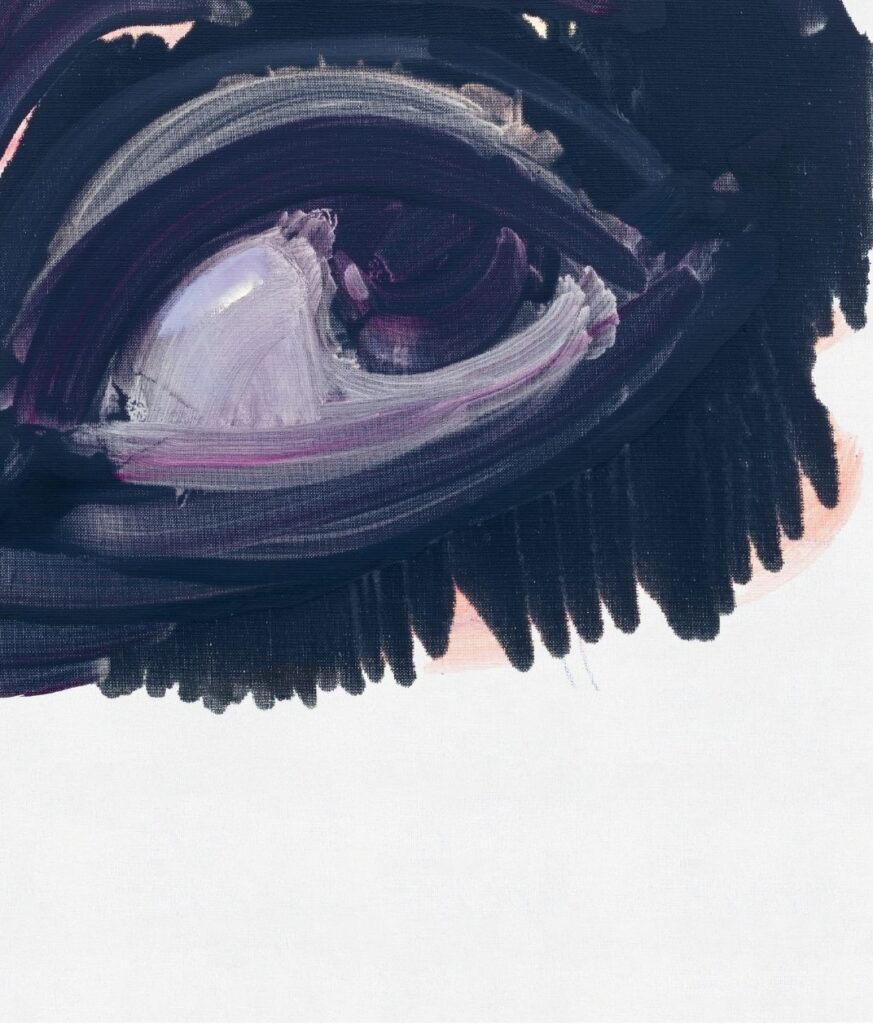
The Eye of Curator Joël Riff
‘Some gallery owners I saw more often than my own mother’
Editor-in-chief Nicole Ex visited La Verrière in Brussels – the almost-square, light-filled space. Curator Joël Riff: ‘I want to share what it feels like to stand in the artist’s studio – that sense of freedom, the searching, the beauty.’
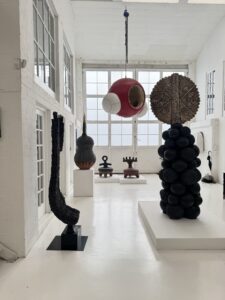
The folding doors between the Hermès store at Boulevard de Waterloo 50 in Brussels and the art space behind it stand open. It’s a semi-permeable wall, allowing diffusion between two worlds – that of refined clothing and handcrafted accessories, and that of the arts. Worldwide, there are only three other of these unique, daylight-filled exhibition spaces: in France, Japan, and Korea. But the house’s desire to support the arts through the Fondation d’entreprise Hermès began twenty-five years ago, in part with the purchase of this old garage.
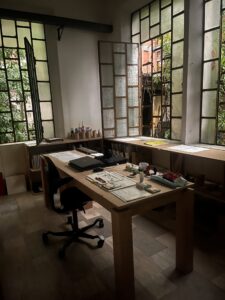
La Verrière is an almost-square space – as everything here is ‘almost’, says curator Joël Riff. The entrance is slightly off-centre, and the four glass roof panels come just short of meeting in the centre of the room. Riff values this subtle disruption: ‘If there’s one thing I want to achieve with this space, it’s that everyone who enters finds their own centre – an intrinsic point on which the viewer lands. I want to share what it feels like to be in an artist’s studio – that freedom, that searching, and the beauty of ateliers is what I want to bring here.’
Riff has been curator of La Verrière since 2023. Before that, he was a curator and published his weekly column Chronique Curiosité for fifteen years (2008–2022). The dedication behind this column – ‘determination’, according to Riff – is unparalleled: he selects at least one exhibition per day in Paris and beyond, seven days a week. In total, that amounts to 780 columns and 5,540 exhibitions. Often he visited several exhibitions in a single day to have ‘something to select’. Riff: ‘Some gallery owners I saw more often than my own mother.’ The archive remains online – and once you start scrolling, it’s hard to stop.
Visiting exhibitions remains part of his daily routine. How did it all begin? ‘On my first day at the Duperré Art School in Paris, a teacher said, “See as much art as you can.” From that moment – 27 September 2004, at 10:00 a.m. – I set out daily. Every morning I opened my eyes, leapt out of bed, swung open the front door, and stepped into the world. There’s so much to see.’ Has his way of looking changed since then? ‘My perception didn’t yet exist; it was, and still is, under construction.’
He has traded writing his columns for organising eight (group) exhibitions for La Verrière, including in 2024 Emi e dames messeur with Koenraad Dedobbeleer, Spektrum with Emmanuelle Castellan, and Esperluette with Hélène Bertin. In 2025, Antre with Pélagie Gbaguidi and Aster with Eva Nielsen followed. The exhibitions are accompanied by small, pocket-sized catalogues with covers deliberately free of typography. Taken as a series, they reveal his practiced eye: varied enough to keep the interplay from becoming monotonous, with colour choices that harmonise without any single volume standing out.
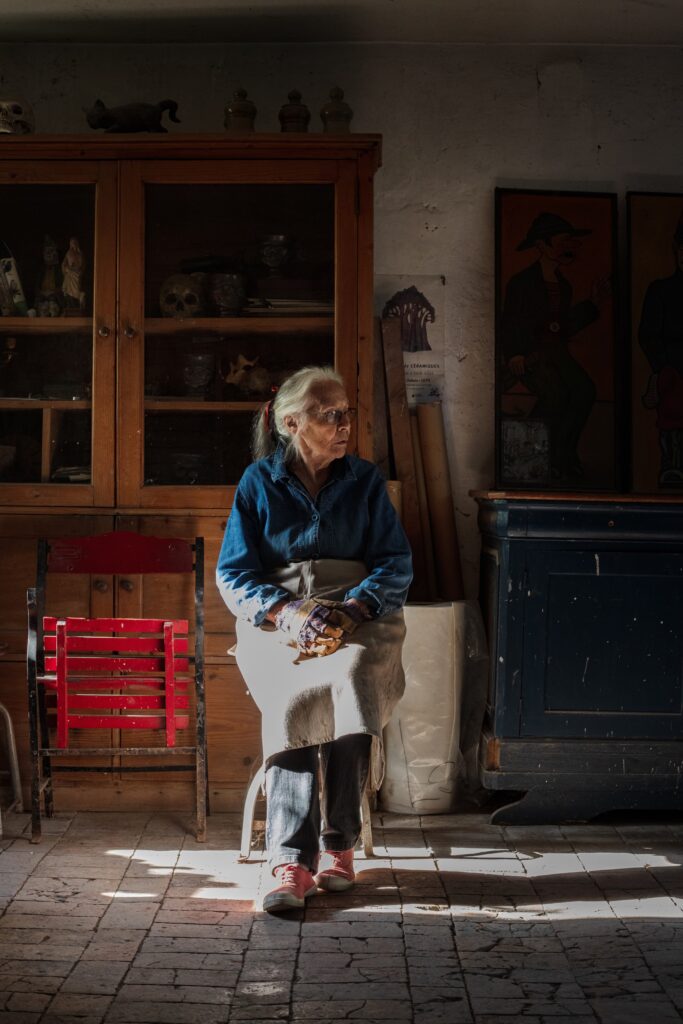
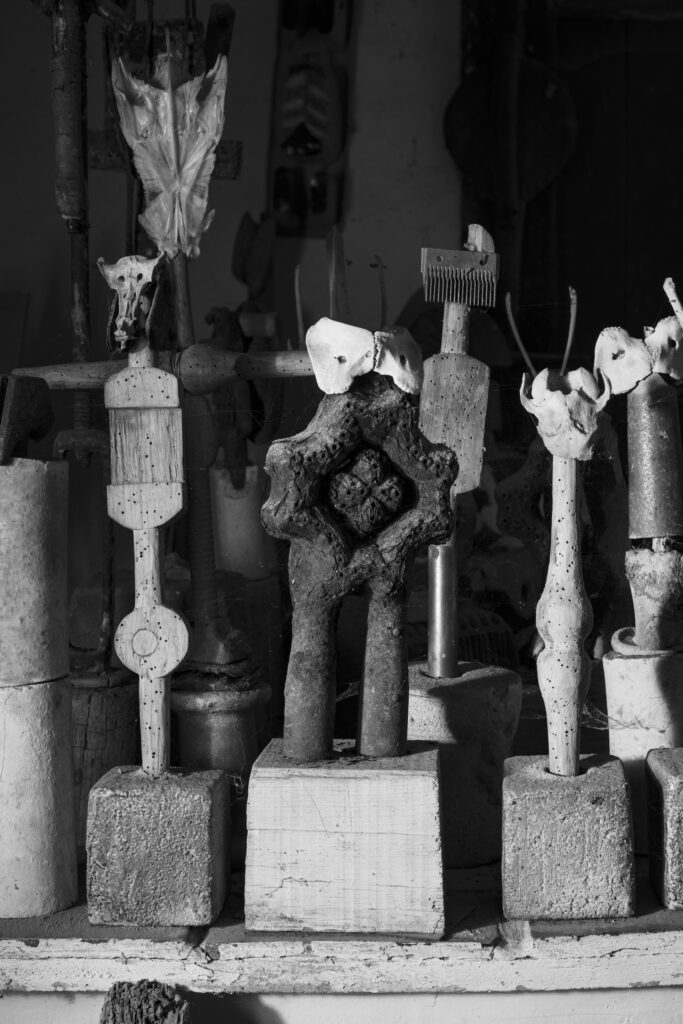
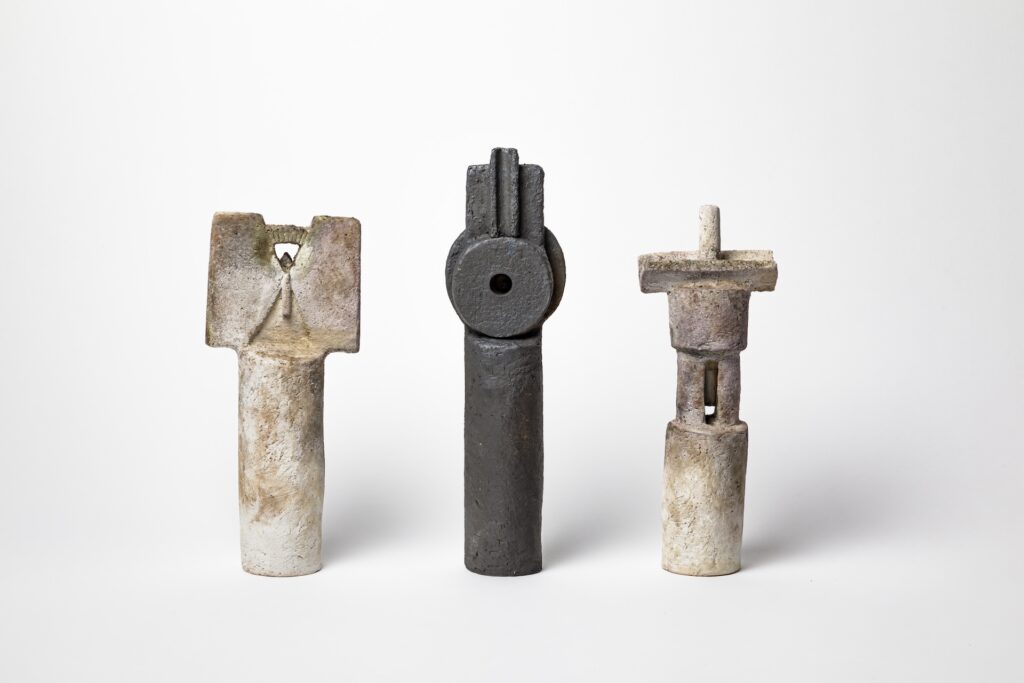
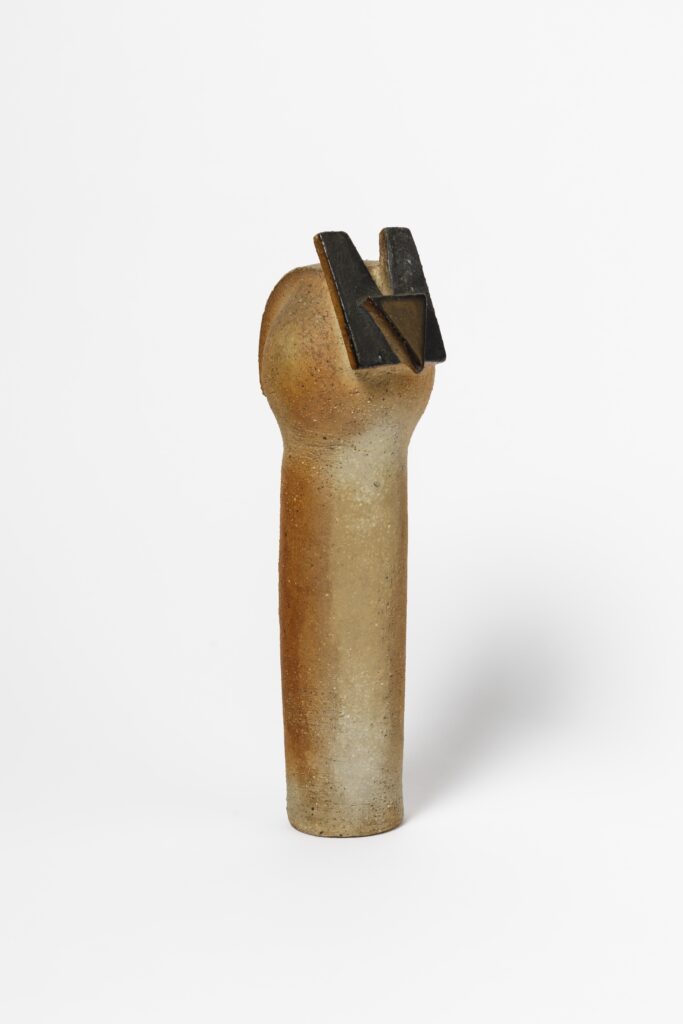
During the interview, I look out at Nielsen’s work. ‘Windows,’ he calls her monumental canvases – ‘views,’ ‘horizons.’ Nielsen created them specifically for the space and saw them for the first time hung side by side in their full width during installation: ‘To be able to do this for an artist, it’s quite something.’ Meanwhile, he is working on his ninth exhibition with the 89-year-old ceramicist Claudine Monchaussé. She still works every day in her studio in La Bourne, a ceramics village in central France, focusing on her small clay sculptures.
Riff: ‘She made her first object in 1959, and whether anyone looks or not, she has to make them; she cannot and will not do otherwise. She told me she will fire her kiln one more time this summer, so who knows – she may yet create something new. Monchaussé’s work creates a kind of short-circuit in my head, because all her standing pieces are different yet the same. That means that if you can see just one in your lifetime, you can already grasp her work. She makes “idols” with small variations. Some depict the male figure and animals such as bulls, others the female form – motherhood, fertility, Venus. For me, they are symbols of humanity.’
What will the exhibition look like? ‘I know her objects will not be on plinths, but placed on the works of another, younger sculptor, Nicolas Bourthoumieux, who literally supports and elevates her creations. Beyond that, I have no fixed plan – and in fact, never do when installing an exhibition. That’s what’s exceptional about this place: the carte blanche, the total freedom to do as you wish. And to earn the trust of the artists you work with. It’s this sense of freedom, in full daylight – [he’s wearing sunglasses during the interview] – that I hope visitors experience too. There are so many institutional spaces in the world; a place like this balances that. La Verrière is more of a platform, a coming together of all types and forms: fine and applied arts, old and contemporary, existing and commissioned works.’
‘That sense of freedom is what the Fondation d’entreprise Hermès seeks to convey in all four of its art spaces – places where craftsmanship and artistic experimentation come together, a natural extension of Hermès’ dedication to the act of creation.’
As the interview draws to a close, Riff shares an important reflection. He describes two ways people are drawn to art: as ‘the curious’ and as ‘the studious’ – those who gain knowledge and understanding through books and libraries. He himself has no trouble with not-knowing: ‘I only know what I have seen and experienced with my own eyes – for me, nothing exists outside of that physical encounter. And I can live with that, because I know others will carry forward the art that remains invisible to me.’ What, then, is the meaning of this worldwide web of art? Perhaps it is the knowledge that I am not alone in experiencing it, on a personal level. On a global scale, we evolve art collectively, providing it with context in the process. After all, what is art if no one is watching?’
Claudine Monchaussé: Sourdre is on view from 11 September until 13 December 2025 at La Verrière (Fondation d’entreprise Hermès) in Brussels.
Recent stories
-
![Marisol Foto: Nancy Astor]()
Between Glamour and Rebellion: Marisol at Depot Boijmans
-
![Helen Frankenthaler met April Mood in haar studio op East 83rd Street in New York, 1974 | © 2026 Helen Frankenthaler Foundation, Inc./ProLitteris, Zurich | foto: Alexander Liberman © J. Paul Getty Trust]()
Helen Frankenthaler & Donald Judd at Kunsthal KAdE: Radical and rigorous
-
![Zeeplokaal]()
Li’s Forecast #11: In praise of soap
-
![Piet Oudolf garden at Noma, Copenhagen]()
Piet Oudolf’s 16 favourite plants: Create your own Oudolf garden
-
![William Kentridge, Waiting for the Sibyl]()
BREAKING #338: She has all the answers
-
![Nicole Ex (rechts) en Sarah Knigge (links) ergens tussen spiegelbeeld, stippen en oneindigheid in Yayoi Kusama’s nieuwe Infinity Mirror Room in het Stedelijk Museum Amsterdam, 9 september 2026]()
BREAKING #337: Yayoi Kusama
-
![]()
BREAKING #336: Body language
-
![Getty Research Institute, Los Angeles, schenking van de Roy Lichtenstein Foundation ter nagedachtenis aan Harry Shunk en Janos Kender | Foto: Shunk-Kender © J. Paul Getty Trust]()
Endlessly innovative: Yayoi Kusama in Amsterdam
-
![Marisol Escobar met haar sculptuur The Kennedyʼs, 1964 | © foto: Sam Falk]()
In the Kitchen with Marisol Escobar: ‘I decided never to talk again’
-
![]()
BREAKING #334: The Orchard Project, Part II
-
![Wolfgang Tillmans, Inner City Apple Tree, 2004]()
BREAKING #333: An orchard for the future
-
![]()
Which room did you fall in love with?: Send us your all-time favourite cinematic room
-
![]()
BREAKING #332: In love with a room
-
![De studio van Carlo Maria Morsiani, Modena, juli 2026 | foto: Nicole Ex]()
BREAKING #331: The shape of clouds
-
![Shopwork magazine issue 01]()
Treasure Hunt #5: Make your own designer clothes
-
![]()
The Body of Water: Endlessly circulating
-
![]()
1,2,3 under the apple tree: Make your own herman de vries
-
![]()
Li’s Forecast #10: The creative custodian
-
![]()
Water Guide: 10 stories exploring (bodies of) water
-
![]()
Cape Town & The Karoo: Travel Diary