William Kentridge
Look Closer no. 1
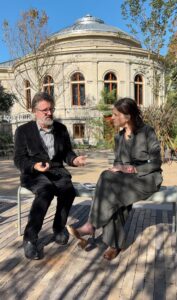
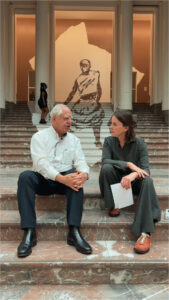
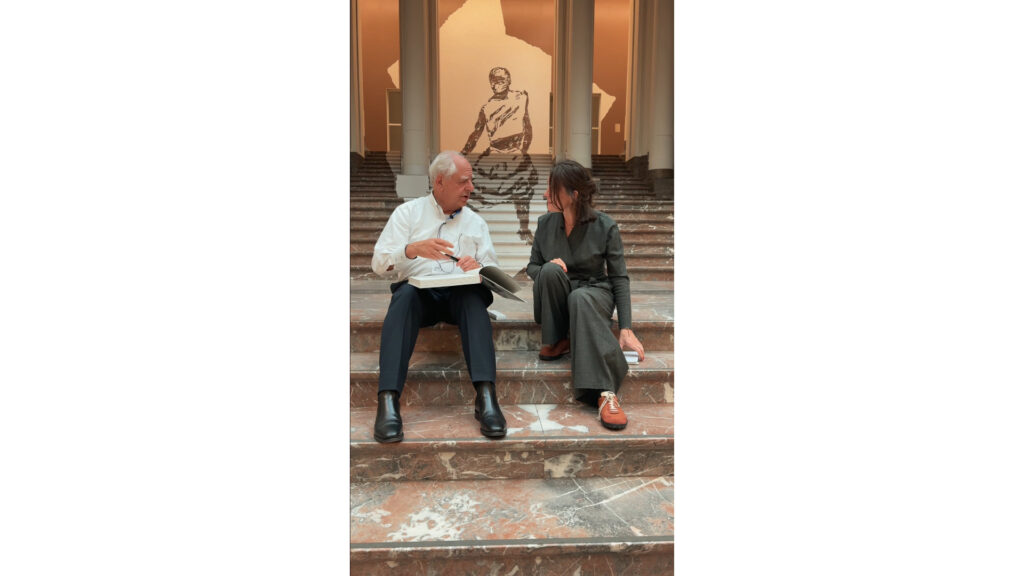
In Look Closer, an artist chooses a single work for us to look at closely. In the first episode, we join the internationally loved South African artist William Kentridge (1955) in front of the striking projection from his chamber opera Waiting for the Sibyl. We spoke to him at Bozar in Brussels, just before the opening of his major solo exhibition I am not me, the horse is not mine.
So you chose the work Waiting for the Sibyl. What exactly are we looking at?
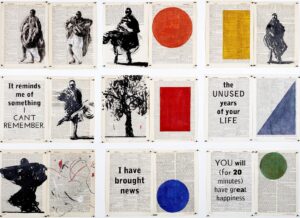
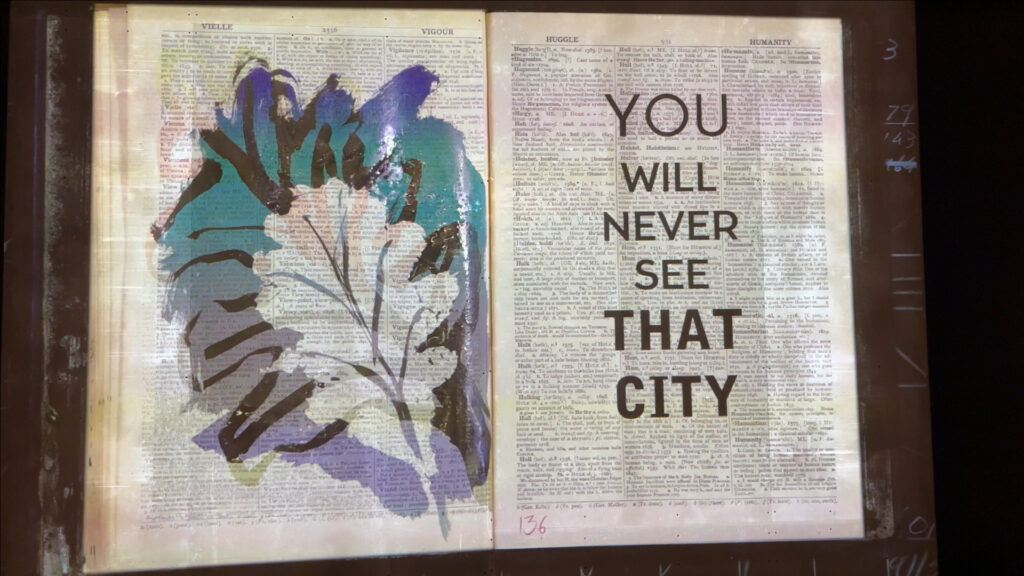
The Sibyl is the mythical figure you would go to with all your questions, and she would answer your questions. But the central story of the Sibyl is this: you would go to the mouth of the cave where she lived and write your questions, and she would write the answers on an oak leaf and put the leaf at the mouth of the cave. You would go to the cave to pick up the answer to your question. Will I live? Will I die of Covid? Whatever the question. But as you got to the mouth of the cave, there would always be a wind blowing, so you never knew if you were getting your fate or someone else’s. That’s the central paradox: wanting one’s fate, but not being able to get it. The book of the Sibyl is all the pages, all the answers of the Sibyl, gathered together in a single book. That’s what we’re seeing in the video projection.
For this work you use different disciplines: film, drawing, language. How do they come together, and how do you create such emotion? You almost made me cry. Can you explain the power of the piece?
I think it has a very strong effect on many people. It’s a combination of, particularly, the words in the book, in large script, and the extraordinary voice of the singer. The lines of every song, like ‘Where shall we place our hope?’, are essentially the text of the song. If we don’t know our fate, if we’re not in charge of it, how do we still keep ourselves going? We recorded the song very soon after the singer had lost her mother. I think deep in her voice there’s a kind of grief, and a consoling of that. You can’t say what it is. Is it a catch in the voice? That she sings her high notes not so strongly, technically? I’ve no idea how one would break that down, but through it one receives an extraordinary grief and consolation in the voice. And that, combined with the words about our fate and the images: each one strengthens the other. That was the hope when making it, and it seems to be the result as well.
You talk about the voice. What does language do?
The language sets up a series of riddles that don’t have answers. What does it quite mean? ‘Where shall we place our hope?’ ‘15 minutes on the soft shoulder.’ ‘It is not enough, but it is not nothing.’ Phrases that jump out, which you can then pull into sets of associations, sideways from the production, and that I hope evoke a particular personal connection for people reading them. They are almost connected, but they don’t form a single coherent narrative.
At the press meeting you said that a drawing knows more than the artist. That a poem knows more than the poet. What do you mean by that?
I can give you an example. When I started doing the animation, it was drawing and erasing, drawing and erasing, drawing and erasing. It was never a perfect erasure. I tried very hard to erase the marks completely, and for the first while I would apologise for the imperfect erasures, for the mess left on the paper. Only after a while, when somebody said to me, ‘Stop complaining, the erasures are the interesting part of the drawing,’ did I suddenly recalibrate. What was there in the drawing that I hadn’t thought about was a trace of time passing. That was something the drawing showed. It was evident from the drawing itself, not something I’d invented. So it’s not a question of ‘Oh, how clever I am’, but ‘How stupid was I not to have seen it’. And there are many other cases of those kinds of revelations after the event, about what you have been doing.
So stupidity is quite an important part of your work?
To not be frightened of it. To say that good ideas, or inventiveness, or understanding don’t only come from hard, rational thinking. There are other parts of our brain that lead us into understanding as well. It’s a matter of waiting for it to evolve, and relying on the category of recognition: recognising something when it emerges, rather than knowing it in advance.
The exhibition opened on 18 September 2026 and runs until 7 March 2027 at Bozar in Brussels. The performance SIBYL, which includes the chamber opera Waiting for the Sibyl, can be seen at De Singel in Antwerp on 12 and 13 December 2026.
Recent stories
-
![]()
Olafur Eliasson: Look Closer no. 3
-
![Tatiana Trouvé | foto: Hélène Pambrun & Thomas Merle, met dank aan de kunstenaar]()
Tatiana Trouvé at Xavier Hufkens: Look Closer no. 2
-
![]()
Kent Guide: From Margate to Manor
-
![Alberto Giacometti, Hour of the Traces, 1932, gips, hout en staal, 69 x 36 x 29 cm]()
That One Moment: Chronos and Kairos
-
![Bar Magritte Hotel, Amigo, Brussels]()
Brussels Bound: City guide
-
![]()
A harmonic universum: A one-of-a-kind pocket watch
-
![]()
William Kentridge: Look Closer no. 1
-
![Marisol Foto: Nancy Astor]()
Between Glamour and Rebellion: Marisol at Depot Boijmans
-
![Helen Frankenthaler met April Mood in haar studio op East 83rd Street in New York, 1974 | © 2026 Helen Frankenthaler Foundation, Inc./ProLitteris, Zurich | foto: Alexander Liberman © J. Paul Getty Trust]()
Helen Frankenthaler & Donald Judd at Kunsthal KAdE: Radical and rigorous
-
![Zeeplokaal]()
Li’s Forecast #11: In praise of soap
-
![Piet Oudolf garden at Noma, Copenhagen]()
Piet Oudolf’s 16 favourite plants: Create your own Oudolf garden
-
![William Kentridge, Waiting for the Sibyl]()
BREAKING #338: She has all the answers
-
![Nicole Ex (rechts) en Sarah Knigge (links) ergens tussen spiegelbeeld, stippen en oneindigheid in Yayoi Kusama’s nieuwe Infinity Mirror Room in het Stedelijk Museum Amsterdam, 9 september 2026]()
BREAKING #337: Yayoi Kusama
-
![]()
BREAKING #336: Body language
-
![Getty Research Institute, Los Angeles, schenking van de Roy Lichtenstein Foundation ter nagedachtenis aan Harry Shunk en Janos Kender | Foto: Shunk-Kender © J. Paul Getty Trust]()
Endlessly innovative: Yayoi Kusama in Amsterdam
-
![Marisol Escobar met haar sculptuur The Kennedyʼs, 1964 | © foto: Sam Falk]()
In the Kitchen with Marisol Escobar: ‘I decided never to talk again’
-
![Justine Kurland, {{Orchard}}, 1998, chromogenic print, 76.2 × 101.6 cm]()
BREAKING #334: The Orchard Project, Part II
-
![Wolfgang Tillmans, Inner City Apple Tree, 2004]()
BREAKING #333: An orchard for the future
-
![]()
Which room did you fall in love with?: Send us your all-time favourite cinematic room
-
![]()
BREAKING #332: In love with a room