A harmonic universum
A one-of-a-kind pocket watch
For the first time in history, three different systems of timekeeping come together in a single mechanical universe: Audemars Piguet’s 150 Heritage Pocket Watch.
In the Western world, time is generally regarded as a universal framework within which modern life is organised. Clocks and watches tell us exactly what time it is – according to the Gregorian calendar and globally standardised timekeeping. Audemars Piguet’s 150 Heritage Pocket Watch, by contrast, celebrates the many ways in which time can be interpreted. Rather than imposing a single system, the Swiss maison launched a timepiece earlier this year that demonstrates there is no single way of thinking about time.
In what the brand calls the Universal Calendar, three fundamentally different astronomical systems of timekeeping come together for the first time in the history of watchmaking in a single mechanical computer. Whereas traditional astronomical watches are limited to the Western, solar-based Gregorian calendar, this timepiece reads the cosmos as other cultures have done for thousands of years. Through eighteen indications and a complete nineteen-year Metonic cycle, its rare and complex mechanism simultaneously calculates solar, lunar and lunisolar cycles. This allows holidays from different calendrical systems – such as Christmas, Ramadan, Passover, Diwali and Chinese New Year – to be displayed side by side. In doing so, Audemars Piguet transforms purely mathematical timekeeping into a cultural and philosophical statement: however differently cultures divide and interpret time, ultimately we all look up at the same sky.
The 150 Heritage celebrates the century-and-a-half legacy of the Swiss house, founded in 1875 by Jules Louis Audemars and Edward Auguste Piguet in Le Brassus. From the outset, the brand specialised in highly complicated masterpieces combining calendars with acoustic time indications, such as L’Universelle from 1899 and La Grosse Pièce from 1921.
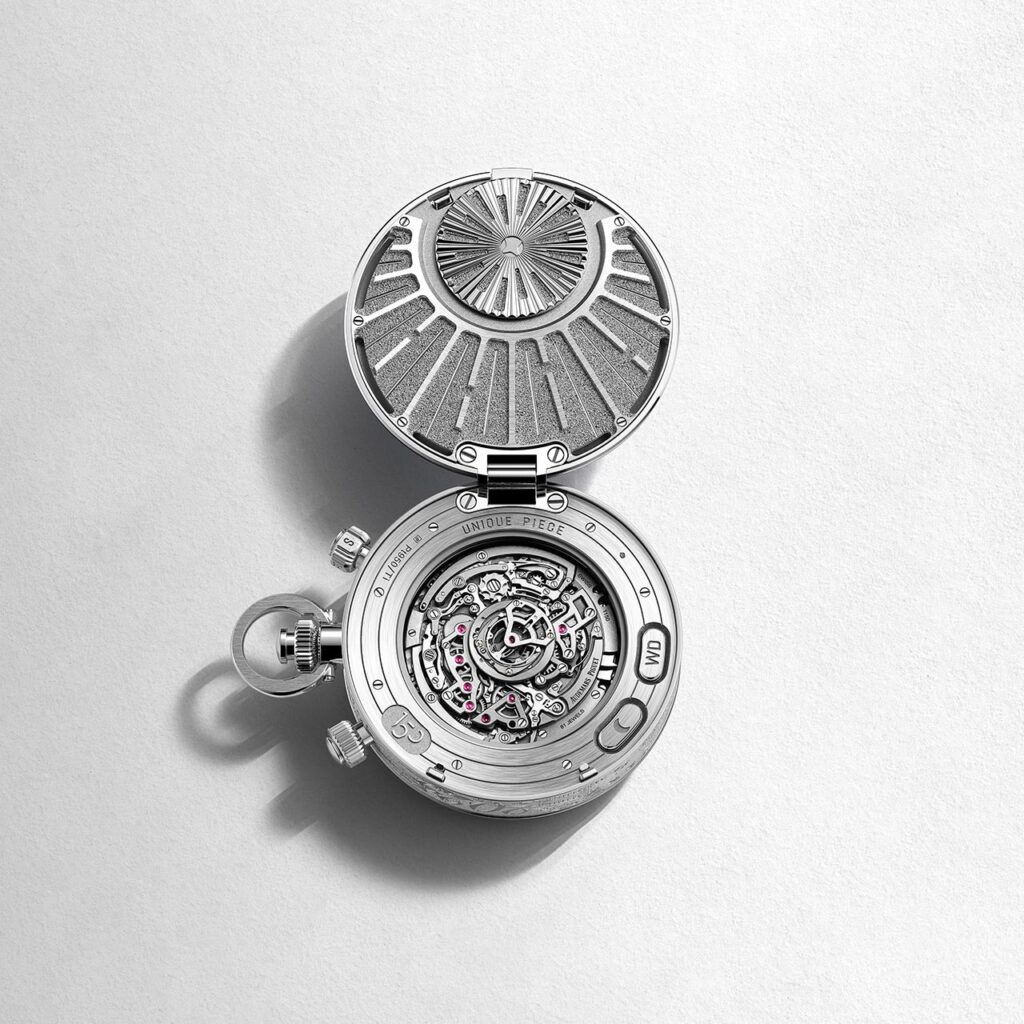
That tradition of ultra-complicated watchmaking continues with the new hand-wound movement, Calibre 1150, housed in the 150 Heritage Pocket Watch. It comprises no fewer than 1,099 components and 47 functional indications, including a flying tourbillon (a system designed to compensate for the effects of gravity on the rate of a mechanical timepiece) and sapphire gongs that sound the time musically. Housing all this in a pocket watch rather than a wristwatch is a deliberate aesthetic choice: it frees the mechanics from the constraints of the wrist and gives the object the space to be regarded as a work of art in its own right.
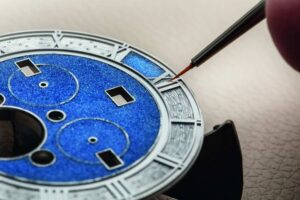
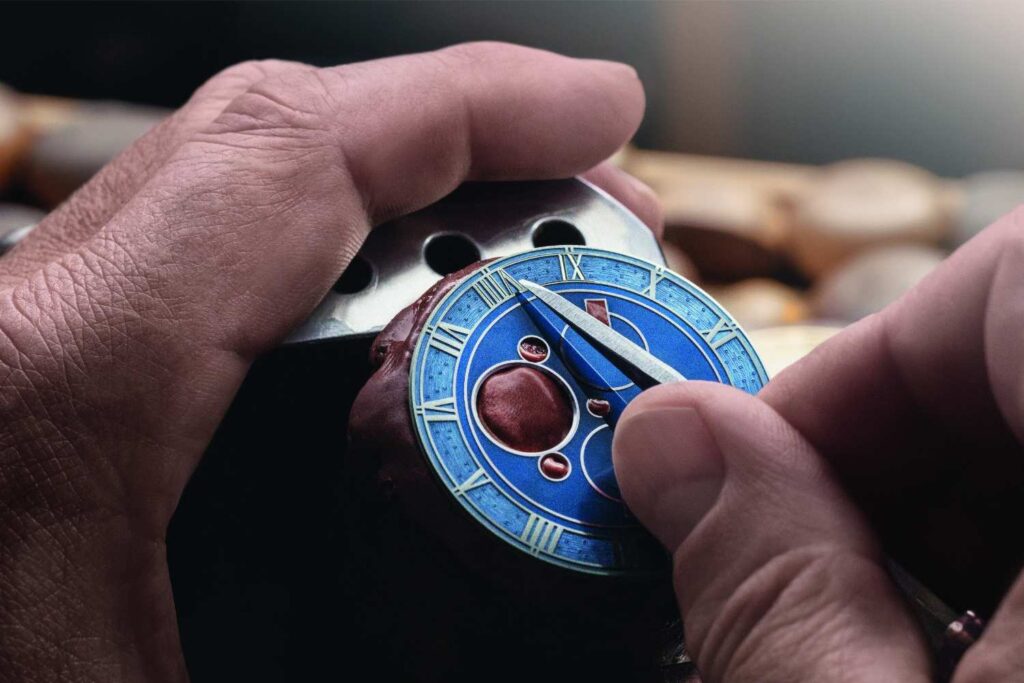
Only on the exterior does this mechanical universe take physical form. The satin-finished grey platinum case features hand-engraved landscapes of the Vallée de Joux and portraits of the founders. A translucent layer of blue grand feu enamel over the engraved white-gold dial gives it a layered, cosmic depth. Audemars Piguet’s 150 Heritage Pocket Watch is therefore not an instrument designed to dictate the rhythm of the day, but tangible proof that different cultures and systems of time can coexist in harmony.
Find out more about this exceptional timepiece on the Audemars Piguet website.
Recent stories
-
![]()
Olafur Eliasson: Look Closer no. 3
-
![Tatiana Trouvé | foto: Hélène Pambrun & Thomas Merle, met dank aan de kunstenaar]()
Tatiana Trouvé at Xavier Hufkens: Look Closer no. 2
-
![]()
Kent Guide: From Margate to Manor
-
![Alberto Giacometti, Hour of the Traces, 1932, gips, hout en staal, 69 x 36 x 29 cm]()
That One Moment: Chronos and Kairos
-
![Bar Magritte Hotel, Amigo, Brussels]()
Brussels Bound: City guide
-
![]()
A harmonic universum: A one-of-a-kind pocket watch
-
![]()
William Kentridge: Look Closer no. 1
-
![Marisol Foto: Nancy Astor]()
Between Glamour and Rebellion: Marisol at Depot Boijmans
-
![Helen Frankenthaler met April Mood in haar studio op East 83rd Street in New York, 1974 | © 2026 Helen Frankenthaler Foundation, Inc./ProLitteris, Zurich | foto: Alexander Liberman © J. Paul Getty Trust]()
Helen Frankenthaler & Donald Judd at Kunsthal KAdE: Radical and rigorous
-
![Zeeplokaal]()
Li’s Forecast #11: In praise of soap
-
![Piet Oudolf garden at Noma, Copenhagen]()
Piet Oudolf’s 16 favourite plants: Create your own Oudolf garden
-
![William Kentridge, Waiting for the Sibyl]()
BREAKING #338: She has all the answers
-
![Nicole Ex (rechts) en Sarah Knigge (links) ergens tussen spiegelbeeld, stippen en oneindigheid in Yayoi Kusama’s nieuwe Infinity Mirror Room in het Stedelijk Museum Amsterdam, 9 september 2026]()
BREAKING #337: Yayoi Kusama
-
![]()
BREAKING #336: Body language
-
![Getty Research Institute, Los Angeles, schenking van de Roy Lichtenstein Foundation ter nagedachtenis aan Harry Shunk en Janos Kender | Foto: Shunk-Kender © J. Paul Getty Trust]()
Endlessly innovative: Yayoi Kusama in Amsterdam
-
![Marisol Escobar met haar sculptuur The Kennedyʼs, 1964 | © foto: Sam Falk]()
In the Kitchen with Marisol Escobar: ‘I decided never to talk again’
-
![Justine Kurland, {{Orchard}}, 1998, chromogenic print, 76.2 × 101.6 cm]()
BREAKING #334: The Orchard Project, Part II
-
![Wolfgang Tillmans, Inner City Apple Tree, 2004]()
BREAKING #333: An orchard for the future
-
![]()
Which room did you fall in love with?: Send us your all-time favourite cinematic room
-
![]()
BREAKING #332: In love with a room