Vivian Suter
Look Closer no. 4
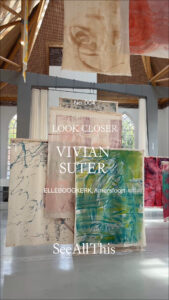
In Look Closer, an artist chooses an artwork for us to look at closely. In this episode, we talk to the Swiss-Argentine artist Vivian Suter (1949) about her installation at the Elleboogkerk in Amersfoort. Much like her own studios in Guatemala, here we find ourselves in a rainforest of oil paint, cotton canvases and rainwater.
Can you tell us what we are looking at?
These are actually three paintings.
Three? I see two… no?
Yes, one is in the background.
Oh, we have to turn around, of course. Ah, here. Beautiful. And with this one, with the light, you can also see through it. It’s transparent.
It is transparent, yes.
And the material?
The cloth is cotton, and I get it made in Guatemala.
Can I feel it?
Yes, of course.
I love it. So you don’t use linen? You always use cotton?
Cotton is what I get in Guatemala, yes. This is acrylic and oil paint, but I also use fish glue and pigments and rainwater, if there is rain. Or water, whatever.
Explain the rainwater to me. Do you leave the work outside when it’s raining?
I leave it outside, yes. The garden where I paint is full of paint and empty pots, and they collect the rain. Then I use it.
So you have a studio outside, and you work partly outdoors?
Yes, I have two places where I work, mainly three. One is under a mango tree, a big, tall mango tree. Before, it was a coffee plantation, but it’s overgrown and I planted more and more, so now it’s really jungle. There’s also a rubber tree. I took a branch from somewhere and planted it, and now it’s a huge tree.
You have lived there since the eighties?
Yes. And this tree has grown a lot of roots, so I always have to walk like this. But I like that. It puts me right in there.
Six years ago we used a photo of you working outside with pigments. For me it’s a photo about freedom. When I look at it, I feel this co-working with nature, and I love that picture. I also saw your beautiful biotope in Guatemala. You live in this biotope and you work with it, so how do you come to trust the rainforest as a co-worker?
Well, I don’t know who trusts who. (laughs) I just let it happen.
You let it happen. I even read that you sometimes paint at night, and then you wake up and see the painting basically for the first time. Is that correct?
That’s correct. (laughs) The other studio is up in the mountain, and some days I work till late. Then I go down, so I don’t know what the painting looks like. The next morning I think about what I did at the end.
And this was a church, right?
Yes, so I was excited by the niches, by the whole situation here. And you see here… (Vivian points at a a stained-glass window depicting the Annunciation and a bright red cloth hanging before it)
That’s beautiful, this cloth. Amazing. Is it from Panajachel?
Yes, and it is next to an Annunciation, I think. That’s what I was told. Then I had this idea, and we put it up this morning.
You put it up this morning?
Yes. It’s the cloth of Panajachel, a traditional cloth for putting the tortillas in.
For the tortillas. What a nice cloth.
And here are the niches, and I had this too. Look, put this here, there. I brought it along as a present. You see, this is the rain.
This is the rain.
Yes.
If you paint every day, does it feel like a diary?
Yes, it does. It’s my way of expressing myself, of telling my feelings and what happened.
We’re looking at one piece now, but there’s this whole installation…
It’s basically one work. I see it as one work.
Could you say it’s a kind of rainforest, a kind of forest, but made with paint?
Yes, I think so. But it’s not that I wanted this from the beginning. It developed through exhibiting. It slowly happened.
Recent stories
-
![]()
Vivian Suter: Look Closer no. 4
-
![]()
Olafur Eliasson: Look Closer no. 3
-
![Tatiana Trouvé | foto: Hélène Pambrun & Thomas Merle, met dank aan de kunstenaar]()
Tatiana Trouvé at Xavier Hufkens: Look Closer no. 2
-
![]()
Kent Guide: From Margate to Manor
-
![Alberto Giacometti, Hour of the Traces, 1932, gips, hout en staal, 69 x 36 x 29 cm]()
That One Moment: Chronos and Kairos
-
![Bar Magritte Hotel, Amigo, Brussels]()
Brussels Bound: City guide
-
![]()
A harmonic universum: A one-of-a-kind pocket watch
-
![]()
William Kentridge: Look Closer no. 1
-
![Marisol Foto: Nancy Astor]()
Between Glamour and Rebellion: Marisol at Depot Boijmans
-
![Helen Frankenthaler met April Mood in haar studio op East 83rd Street in New York, 1974 | © 2026 Helen Frankenthaler Foundation, Inc./ProLitteris, Zurich | foto: Alexander Liberman © J. Paul Getty Trust]()
Helen Frankenthaler & Donald Judd at Kunsthal KAdE: Radical and rigorous
-
![Zeeplokaal]()
Li’s Forecast #11: In praise of soap
-
![Piet Oudolf garden at Noma, Copenhagen]()
Piet Oudolf’s 16 favourite plants: Create your own Oudolf garden
-
![William Kentridge, Waiting for the Sibyl]()
BREAKING #338: She has all the answers
-
![Nicole Ex (rechts) en Sarah Knigge (links) ergens tussen spiegelbeeld, stippen en oneindigheid in Yayoi Kusama’s nieuwe Infinity Mirror Room in het Stedelijk Museum Amsterdam, 9 september 2026]()
BREAKING #337: Yayoi Kusama
-
![]()
BREAKING #336: Body language
-
![Getty Research Institute, Los Angeles, schenking van de Roy Lichtenstein Foundation ter nagedachtenis aan Harry Shunk en Janos Kender | Foto: Shunk-Kender © J. Paul Getty Trust]()
Endlessly innovative: Yayoi Kusama in Amsterdam
-
![Marisol Escobar met haar sculptuur The Kennedyʼs, 1964 | © foto: Sam Falk]()
In the Kitchen with Marisol Escobar: ‘I decided never to talk again’
-
![Justine Kurland, {{Orchard}}, 1998, chromogenic print, 76.2 × 101.6 cm]()
BREAKING #334: The Orchard Project, Part II
-
![Wolfgang Tillmans, Inner City Apple Tree, 2004]()
BREAKING #333: An orchard for the future
-
![]()
Which room did you fall in love with?: Send us your all-time favourite cinematic room