Stéphane Aisinber (Saint-Martin Bookshop)
Look Closer no. 5
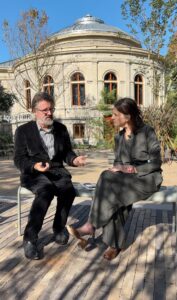
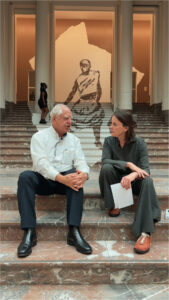
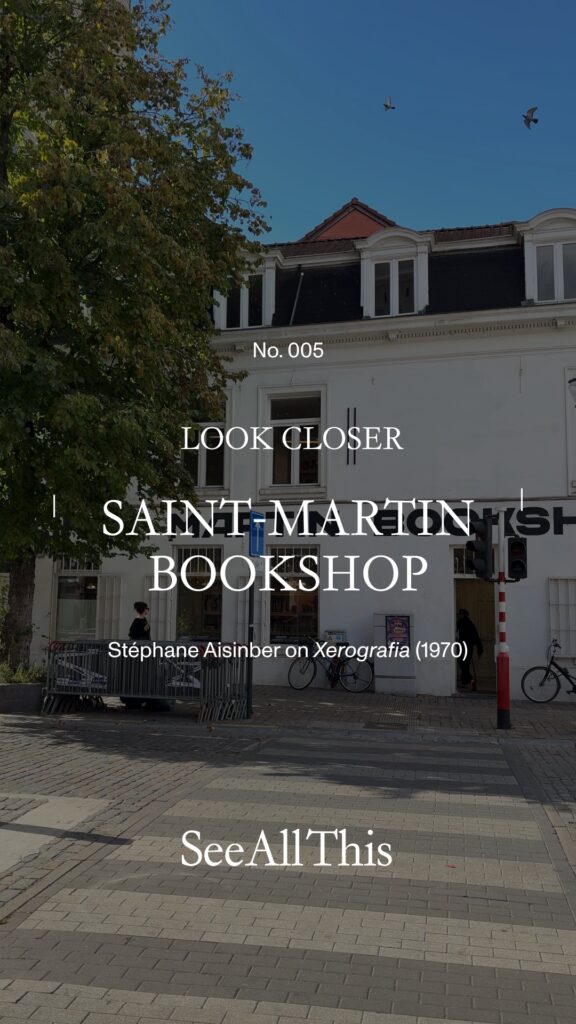
In Look Closer, an artist chooses a single work for us to look at closely. In this episode, Stéphane Aisinber of Saint Martin Bookshop in Brussels opens a slim book from 1970: Xerografia by Bruno Munari (1907–1998). Published by Rank Xerox, it records an exercise Munari kept up for some thirty years. He placed ordinary things on the glass of a photocopier and moved them while the machine was copying: a piece of cloth, a child’s toy, a photograph of himself. A machine built to copy things exactly ended up producing images that had never existed before. Or, as Aisinber puts it: ‘It was a period when serious people were creative.’
So Stéphane, what are we looking at?
This is Bruno Munari’s Xerografia, a book from 1970. It was published by Rank Xerox, and it’s an exercise book made by Bruno Munari with a Xerox machine – so, a photocopy machine. He started the exercise in the mid-’60s, I believe in ’64, and continued until ’94, ’95, just before he died. So it’s handmade photocopy, custom photocopy: you move things, with simple objects – sometimes a piece of cloth, or a child’s toy or car, or a photo of himself. It’s really funny, because it was a period when serious people were creative.
(laughs) And now serious people are not creative anymore?
Not ‘not creative anymore’ – people are not serious anymore, that’s the problem! (laughs)
What was a Xerox machine? What was it?
A Xerox machine? It's a photocopy machine, it was a really huge machine, like 2 tons at the time, and when you look at the exercise he made, it's really strange because today, even if you have a good scanner and Photoshop and whatever, it's not so easy to do. So it was handmade, and it was published in the year 1970, and it's super hard to find. Today, you find a copy for €2,000.
Oh, really? So, can we still touch it?
Yes, of course! So, what happened, for years every time I saw a copy I tried to buy if I could afford it. And at one point, I decided to contact the estate of Bruno Munari and Rank Xerox, asking them if it would be possible to make a facsimile of the book, which is this one. It was published three months ago, so it's the second edition and what's really interesting is that we tried to be as close as possible to the original one.
Well done! Can I touch it?
Of course! So, it's an edition of thousand, and it's a cool story for Saint-Martin Bookshop because it's the first time that we published something bold. Sometimes I published a limited edition of things, for example to help artists, with small numbers or small runs, but this is a real accomplishment. Also, it was expected by all the Munari fans.
And, did you use the same paper as the original book?
Almost, yes. The original one is a bit more yellowish, because it is almost 60 years old. But with time, this one will be a bit yellow as well.
It's an amazing book, I love it! And can you explain a little, what are you looking for in a book?
That's a good question.
It's a hard one.
Yes, it's a hard one. I guess it's super sensitive in a way, because it's something that is related to the content, but to the object itself as well, and also to, I don't know... That's a good question, I have to think a bit more.
You take your time.
I think I need some surprise.
Yeah!
I think I need to be a bit surprised, because we are surrounded by images, by content everywhere all the time, so at one point you don't see anything anymore. It becomes blurry or everything looks the same.
Well, this is a surprise! (Nicole points at {{Xerografia}}). It's a beautiful book!
Exactly, and that's also why black and white books are quite interesting, or even photography, because it's not reality, so suddenly your brain has to interpret it again and to find...
You start to imagine things.
Exactly!
Recent stories
-
![]()
Stéphane Aisinber (Saint-Martin Bookshop): Look Closer no. 5
-
![]()
Vivian Suter: Look Closer no. 4
-
![]()
Olafur Eliasson: Look Closer no. 3
-
![Tatiana Trouvé | foto: Hélène Pambrun & Thomas Merle, met dank aan de kunstenaar]()
Tatiana Trouvé at Xavier Hufkens: Look Closer no. 2
-
![]()
Kent Guide: From Margate to Manor
-
![Alberto Giacometti, Hour of the Traces, 1932, gips, hout en staal, 69 x 36 x 29 cm]()
That One Moment: Chronos and Kairos
-
![]()
Does the Universe Keep Time?: From atomic clocks to the cosmic film reel
-
![Bar Magritte Hotel, Amigo, Brussels]()
Brussels Bound: City guide
-
![]()
A harmonic universum: A one-of-a-kind pocket watch
-
![]()
William Kentridge: Look Closer no. 1
-
![Marisol Foto: Nancy Astor]()
Between Glamour and Rebellion: Marisol at Depot Boijmans
-
![Helen Frankenthaler met April Mood in haar studio op East 83rd Street in New York, 1974 | © 2026 Helen Frankenthaler Foundation, Inc./ProLitteris, Zurich | foto: Alexander Liberman © J. Paul Getty Trust]()
Helen Frankenthaler & Donald Judd at Kunsthal KAdE: Radical and rigorous
-
![Zeeplokaal]()
Li’s Forecast #11: In praise of soap
-
![Piet Oudolf garden at Noma, Copenhagen]()
Piet Oudolf’s 16 favourite plants: Create your own Oudolf garden
-
![William Kentridge, Waiting for the Sibyl]()
BREAKING #338: She has all the answers
-
![Nicole Ex (rechts) en Sarah Knigge (links) ergens tussen spiegelbeeld, stippen en oneindigheid in Yayoi Kusama’s nieuwe Infinity Mirror Room in het Stedelijk Museum Amsterdam, 9 september 2026]()
BREAKING #337: Yayoi Kusama
-
![]()
BREAKING #336: Body language
-
![Getty Research Institute, Los Angeles, schenking van de Roy Lichtenstein Foundation ter nagedachtenis aan Harry Shunk en Janos Kender | Foto: Shunk-Kender © J. Paul Getty Trust]()
Endlessly innovative: Yayoi Kusama in Amsterdam
-
![Marisol Escobar met haar sculptuur The Kennedyʼs, 1964 | © foto: Sam Falk]()
In the Kitchen with Marisol Escobar: ‘I decided never to talk again’
-
![Justine Kurland, {{Orchard}}, 1998, chromogenic print, 76.2 × 101.6 cm]()
BREAKING #334: The Orchard Project, Part II