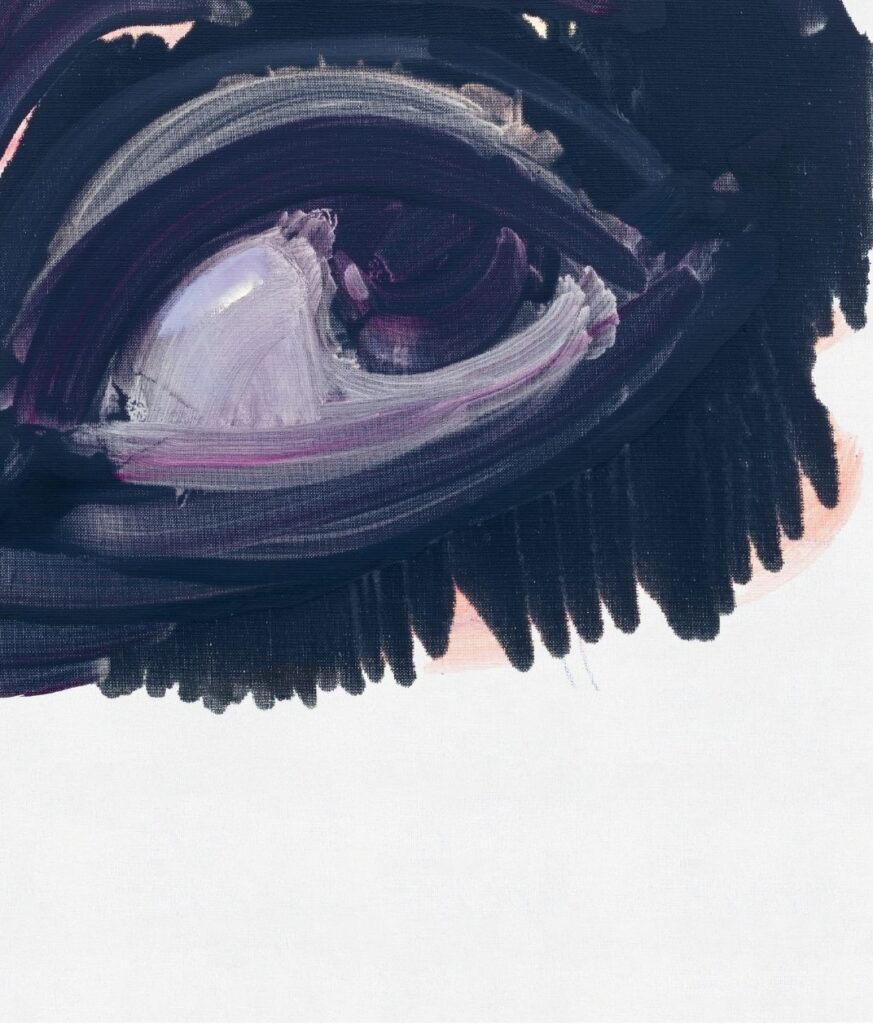
That One Moment
Chronos and Kairos
While physicists try to fathom time, philosophers explore it from within.
Time is both the foundation of human existence and its greatest mystery. As long as we measure time, there seems to be little cause for concern, but the moment we try to grasp its essence, problems arise. No philosopher, poet or scientist has yet succeeded in providing a definitive description. I have written extensively about time, but the only certainty I have arrived at is that time has at least two faces: the difference between measuring time and experiencing it, or between having time and being time.
Because our rational faculties falter as soon as we try to capture time in a definition, we often turn to the imagination. Over the centuries, a rich array of metaphors and symbols has emerged, with a marked preference for images of water. Panta rhei, everything flows – this is how Heraclitus’s thought is often summarised. ‘The water in the river that you touch with your hand is the last of what has passed and the first of that which comes,’ Leonardo da Vinci wrote, ‘and so it is with time.’
T.S. Eliot, too, imagined time through the river. In The Dry Salvages (1941), he writes that time does not flow outside us, but that ‘the river is within us’. In doing so, he touches on the distinction between clock time and time as we experience it. An hour may always last exactly sixty minutes on the clock, but in our experience it can fly by, stand still or crawl excruciatingly slowly.
Time as we experience it inwardly cannot be captured in universal units, but is subjective in nature. Every moment is shaped by what came before it: impressions, memories and personal history. The experienced moment is a ‘past swelling into the present’, as the French philosopher Henri Bergson described it. At the same time, we remain open to what still lies unseen ahead of us. Present, past and future are not sharply separated, as linear clock time would have us believe, but flow into one another. Bergson compares this to a melody: the notes already heard determine how the next one sounds.
Knowing what time it is, in short, tells us nothing about how we experience time or how we exist within it. In my thinking about these different forms of time, Chronos and Kairos play an important role. Chronos represents measurable, chronological time; Kairos the right or charged moment, in which a different experience of time becomes possible.
In Greek mythology, Kairos is the rebellious youngest grandson of Chronos. He is depicted as a young, winged god with a shaven head and a long lock of hair falling over his forehead. Anyone wishing to seize the right moment must be attentive enough to catch him by this forelock. Chronos, by contrast, is depicted as an old man with an hourglass and a scythe: time that measures and passes. Together, they represent qualitative and quantitative time. It is not a matter of choosing between the two, but of finding the right balance.
Since antiquity, Kairos, as the god of the opportune moment, has captured the imagination of writers and artists. He represents a temporary interruption of chronological time, an interlude in which something new can become possible. Attention, stillness and the careful weighing of circumstances can help us recognise such a moment.
During such an interval of Kairos, we do not so much have time as become time. Past, present and future converge in a single moment; time does not merely tick away, but opens up.
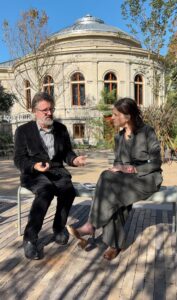
Writer and philosopher Joke J. Hermsen has been thinking and writing about time, memory and the opportune moment for many years. In books such as Stil de tijd, Kairos and, most recently, Tijd is hoop, she explores ways of understanding time that go beyond the clock alone.
Recent stories
-
![]()
Olafur Eliasson: Look Closer no. 3
-
![Tatiana Trouvé | foto: Hélène Pambrun & Thomas Merle, met dank aan de kunstenaar]()
Tatiana Trouvé at Xavier Hufkens: Look Closer no. 2
-
![]()
Kent Guide: From Margate to Manor
-
![Alberto Giacometti, Hour of the Traces, 1932, gips, hout en staal, 69 x 36 x 29 cm]()
That One Moment: Chronos and Kairos
-
![Bar Magritte Hotel, Amigo, Brussels]()
Brussels Bound: City guide
-
![]()
A harmonic universum: A one-of-a-kind pocket watch
-
![]()
William Kentridge: Look Closer no. 1
-
![Marisol Foto: Nancy Astor]()
Between Glamour and Rebellion: Marisol at Depot Boijmans
-
![Helen Frankenthaler met April Mood in haar studio op East 83rd Street in New York, 1974 | © 2026 Helen Frankenthaler Foundation, Inc./ProLitteris, Zurich | foto: Alexander Liberman © J. Paul Getty Trust]()
Helen Frankenthaler & Donald Judd at Kunsthal KAdE: Radical and rigorous
-
![Zeeplokaal]()
Li’s Forecast #11: In praise of soap
-
![Piet Oudolf garden at Noma, Copenhagen]()
Piet Oudolf’s 16 favourite plants: Create your own Oudolf garden
-
![William Kentridge, Waiting for the Sibyl]()
BREAKING #338: She has all the answers
-
![Nicole Ex (rechts) en Sarah Knigge (links) ergens tussen spiegelbeeld, stippen en oneindigheid in Yayoi Kusama’s nieuwe Infinity Mirror Room in het Stedelijk Museum Amsterdam, 9 september 2026]()
BREAKING #337: Yayoi Kusama
-
![]()
BREAKING #336: Body language
-
![Getty Research Institute, Los Angeles, schenking van de Roy Lichtenstein Foundation ter nagedachtenis aan Harry Shunk en Janos Kender | Foto: Shunk-Kender © J. Paul Getty Trust]()
Endlessly innovative: Yayoi Kusama in Amsterdam
-
![Marisol Escobar met haar sculptuur The Kennedyʼs, 1964 | © foto: Sam Falk]()
In the Kitchen with Marisol Escobar: ‘I decided never to talk again’
-
![Justine Kurland, {{Orchard}}, 1998, chromogenic print, 76.2 × 101.6 cm]()
BREAKING #334: The Orchard Project, Part II
-
![Wolfgang Tillmans, Inner City Apple Tree, 2004]()
BREAKING #333: An orchard for the future
-
![]()
Which room did you fall in love with?: Send us your all-time favourite cinematic room
-
![]()
BREAKING #332: In love with a room