In the Kitchen with Marisol Escobar
‘I decided never to talk again’
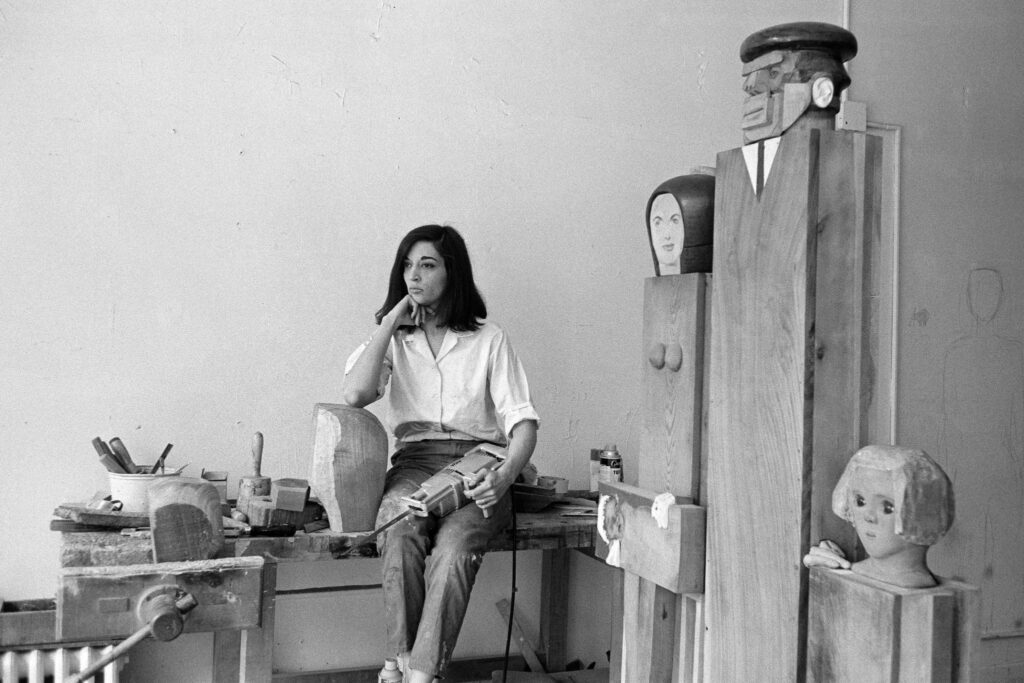
‘I can’t explain it,’ Marisol replies. ‘Oh! And the Mona Lisa,’ the interviewer continues. ‘How did you get that idea of the Mona Lisa? That’s such a marvelous idea!’ Marisol: ‘I don’t know. I think I got the idea from looking at a piece of wood and it reminded me of her.’
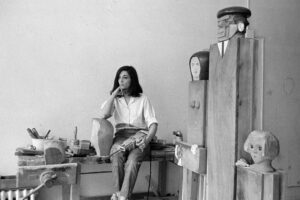
Venezuelan-American María Sol Escobar (1930-2016) – who decided early on that she wanted to be known simply by her first name – was a challenge for any interviewer: a woman of few words. And, for a long time, no words at all. When her mother suddenly took her own life, the eleven-year-old Marisol vowed never to speak again. ‘I decided never to talk again,’ she said in an interview in the 1970s, ‘except for what was absolutely necessary in school and on the street.’ She was well into her twenties when she began speaking again, but silence had become so much a part of her that she felt her words had little to add.
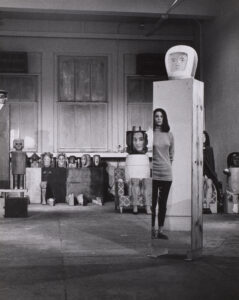
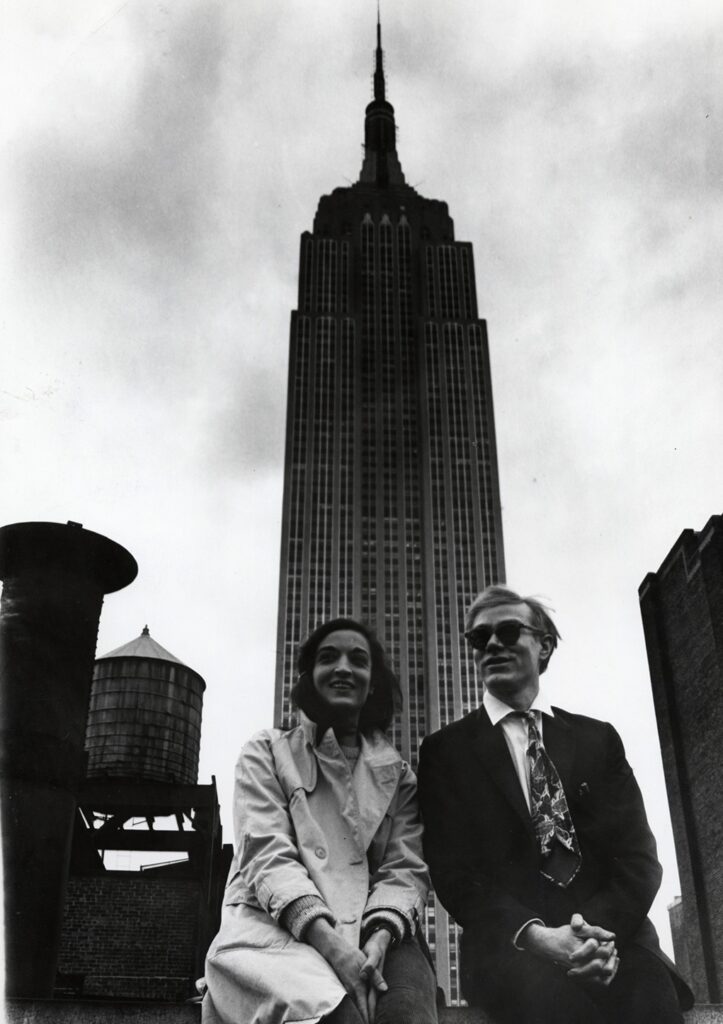
Her quiet manner, barely audible voice and Spanish accent, along with her appearances in Andy Warhol’s films and factory, only seemed to heighten the fascination surrounding her. Her work did the rest. Painted wooden sculptures, block-like in form and combined with found objects, portrayed American society from farming families to the Kennedys. Marisol quickly became a sensation. In 1968, she represented Venezuela at the Venice Biennale and was one of just four women, out of 149 artists, selected for documenta in Kassel.
But recognition brought an attention she had never asked for. As the spotlight grew brighter, Marisol stepped away. She spent the next few years travelling through the Caribbean, South America, India and Southeast Asia. By the time she returned, the art world had changed. Marisol and her work gradually slipped from view.
In recent years, however, she has been finding her way back into the story of post-war art. An important moment came with the retrospective Marisol: Sculptures and Works on Paper, which opened at the Memphis Brooks Museum of Art in 2014.
A year after her death in 2016, the Museum of Contemporary Art Chicago (MCA) opened a restaurant named after her. It was a fitting tribute: in 1968, Marisol had given the museum her sculpture Six Women, the first work to enter its collection. The menu took inspiration from some of her favourite recipes, among them the ‘Marisol Salad’, with lettuce, apple, dill, macadamia nuts and pecorino. Its green goddess dressing was inspired by Marisol’s own ‘natural food dressing’, published in MoMA’s Artists’ Cookbook.
Read more recipes in The Artists’ Cookbook from 1977, with 155 recipes from thirty artists, like Marisol, Andy Warhol, Louise Bourgeois and Willem de Kooning.
Recent stories
-
![Tatiana Trouvé | foto: Hélène Pambrun & Thomas Merle, met dank aan de kunstenaar]()
Tatiana Trouvé at Xavier Hufkens: Look Closer no. 2
-
![]()
Kent Guide: From Margate to Manor
-
![Alberto Giacometti, Hour of the Traces, 1932, gips, hout en staal, 69 x 36 x 29 cm]()
That One Moment: Chronos and Kairos
-
![Bar Magritte Hotel, Amigo, Brussels]()
Brussels Bound: City guide
-
![]()
A harmonic universum: A one-of-a-kind pocket watch
-
![]()
William Kentridge: Look Closer no. 1
-
![Marisol Foto: Nancy Astor]()
Between Glamour and Rebellion: Marisol at Depot Boijmans
-
![Helen Frankenthaler met April Mood in haar studio op East 83rd Street in New York, 1974 | © 2026 Helen Frankenthaler Foundation, Inc./ProLitteris, Zurich | foto: Alexander Liberman © J. Paul Getty Trust]()
Helen Frankenthaler & Donald Judd at Kunsthal KAdE: Radical and rigorous
-
![Zeeplokaal]()
Li’s Forecast #11: In praise of soap
-
![Piet Oudolf garden at Noma, Copenhagen]()
Piet Oudolf’s 16 favourite plants: Create your own Oudolf garden
-
![William Kentridge, Waiting for the Sibyl]()
BREAKING #338: She has all the answers
-
![Nicole Ex (rechts) en Sarah Knigge (links) ergens tussen spiegelbeeld, stippen en oneindigheid in Yayoi Kusama’s nieuwe Infinity Mirror Room in het Stedelijk Museum Amsterdam, 9 september 2026]()
BREAKING #337: Yayoi Kusama
-
![]()
BREAKING #336: Body language
-
![Getty Research Institute, Los Angeles, schenking van de Roy Lichtenstein Foundation ter nagedachtenis aan Harry Shunk en Janos Kender | Foto: Shunk-Kender © J. Paul Getty Trust]()
Endlessly innovative: Yayoi Kusama in Amsterdam
-
![Marisol Escobar met haar sculptuur The Kennedyʼs, 1964 | © foto: Sam Falk]()
In the Kitchen with Marisol Escobar: ‘I decided never to talk again’
-
![Justine Kurland, {{Orchard}}, 1998, chromogenic print, 76.2 × 101.6 cm]()
BREAKING #334: The Orchard Project, Part II
-
![Wolfgang Tillmans, Inner City Apple Tree, 2004]()
BREAKING #333: An orchard for the future
-
![]()
Which room did you fall in love with?: Send us your all-time favourite cinematic room
-
![]()
BREAKING #332: In love with a room
-
![De studio van Carlo Maria Morsiani, Modena, juli 2026 | foto: Nicole Ex]()
BREAKING #331: The shape of clouds