Tatiana Trouvé at Xavier Hufkens
Look Closer no. 2
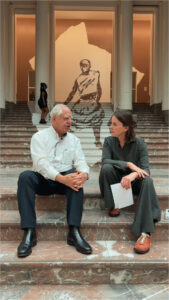
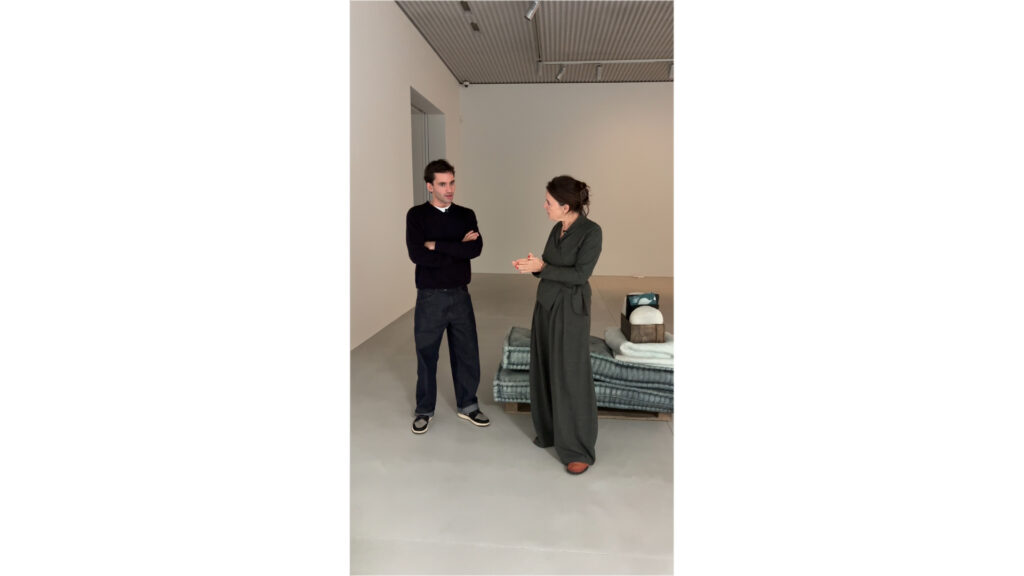
In Look Closer, we focus on a single artwork that invites us to look longer and more closely. In this episode, we visit The Auxiliaries an exhibition by French-Italian artist Tatiana Trouvé (b. 1968) at Xavier Hufkens gallery in Brussels. Together with Piet Bloquiaux, we discover how everyday objects from her studio, from mattresses to wooden pallets and beer cans, are transformed into artworks themselves.
What are we looking at exactly?
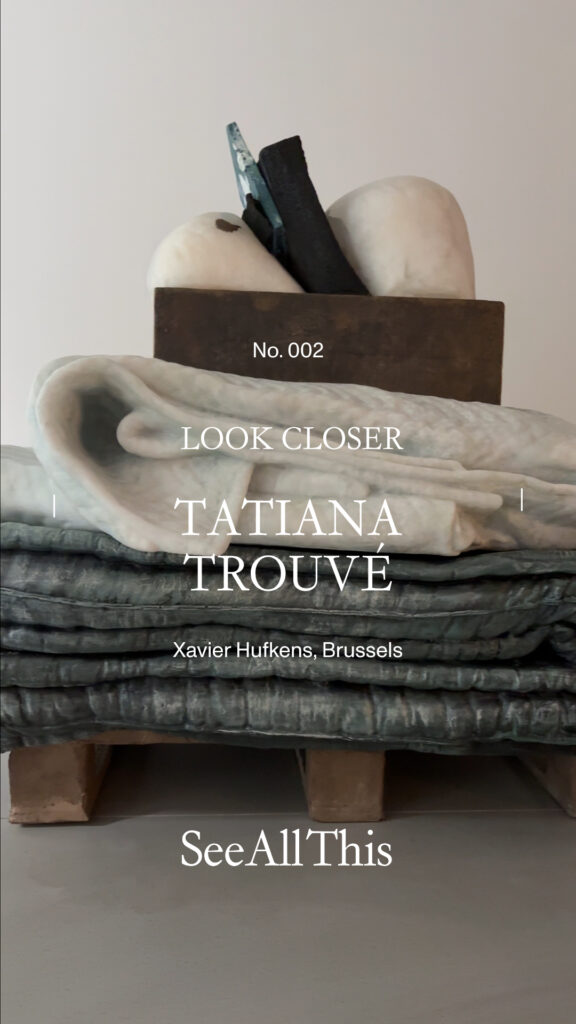
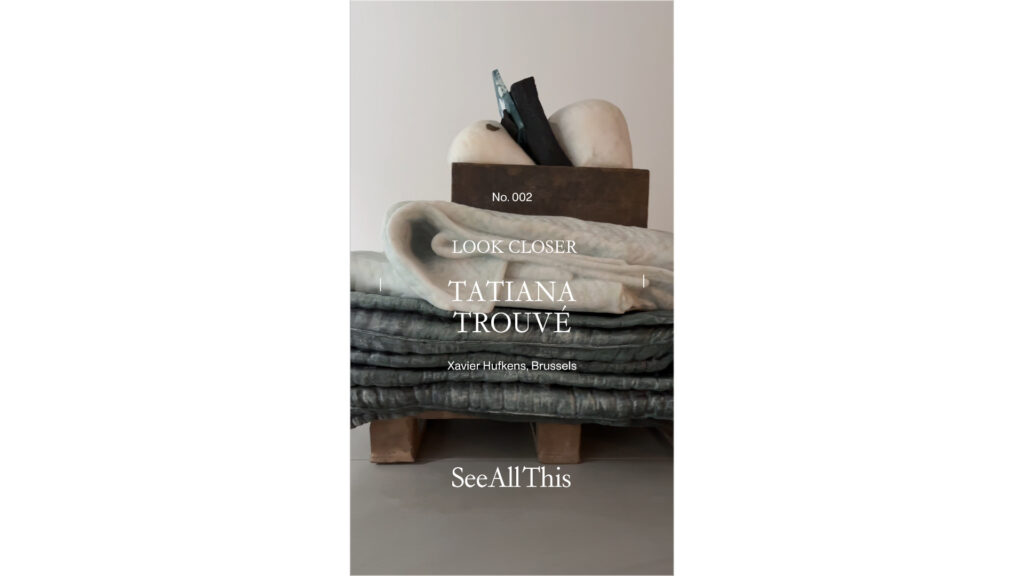
We’re sitting on a bench, a ‘sitting sculpture’, as Tatiana Trouvé calls them. When you look at these from far away, you recognise what you see: a mattress with a wooden pallet underneath. And then you see some fabrics and a wooden crate. But when you look a bit closer, you see that the mattress is actually made from bronze, and the fabric is made from marble.
These everyday objects, that the artist uses in her studio to drag along the artworks, or to conserve or protect them, become the artwork. So the artist reverses that idea of what we have to look at. These, what she calls ‘auxiliary workers’, these invisible workers, become the artwork.
When you come even closer, you see all these painterly details on the artwork. You see the fabric patina, the signs of wear and tear of a person that has been there, but is no longer there. And so the transformation of the object continues into the materiality. In the work of Tatiana, the lines between what is sculpture and what is painting really fade.
You were saying that she uses the mattresses to drag things. What kind of things is she dragging?
Stone slabs, for instance. These are the actual marble slabs, or this is travertine, that she uses to make her works. And so these invisible workers kind of support her artwork and become the artwork.
She calls them ‘sitting sculptures’. But can we, as viewers, actually sit on them?
Yes, you can sit on them. They’re made to sit on.
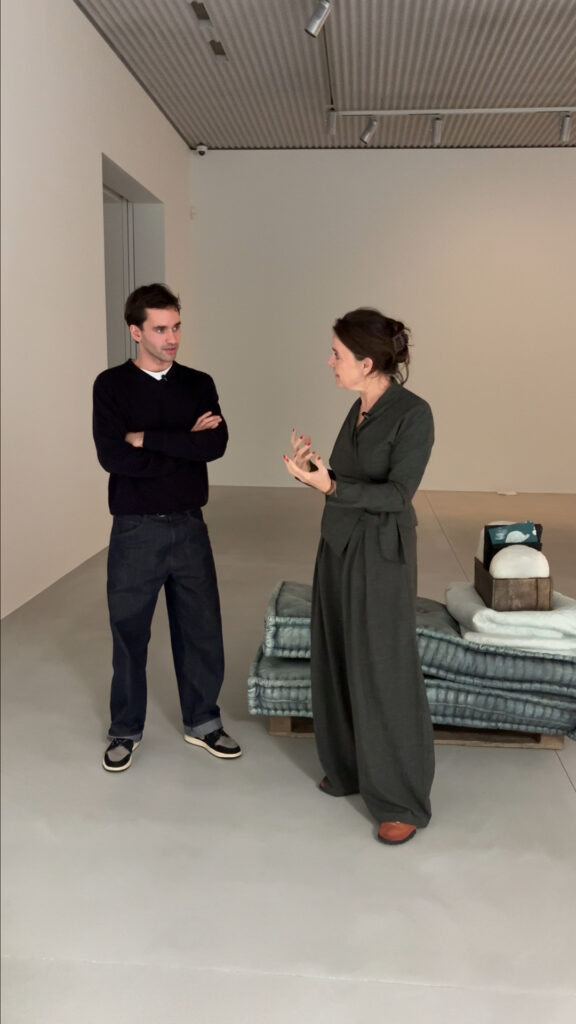
For Tatiana, all objects are animated. They have their own spirit. Can you explain a little bit more?
She is what’s called an animist. She believes that every object has a spirit, and every object is equal in that sense. So she will think about the pencil she uses, the shoes she wears, the mattress she uses in her studio.
These objects, what she sees as ‘auxiliary workers’, the invisible workers that kind of create her work and her exhibition, she wants to put on a pedestal and make them the artwork. Things we usually wouldn’t look at.
So the beer can she drinks from when she’s painting, which is also an invisible worker in a way, she makes it into a permanent sculpture in this exhibition.
Do you know if the objects are happy that they became sculptures?
I’m not an animist myself, so I don’t know if they’re happy. I don’t speak to them. But I think that if I were a beer can and suddenly I was in a gallery as a bronze object, I would be very happy.
ABOUT THE ARTIST
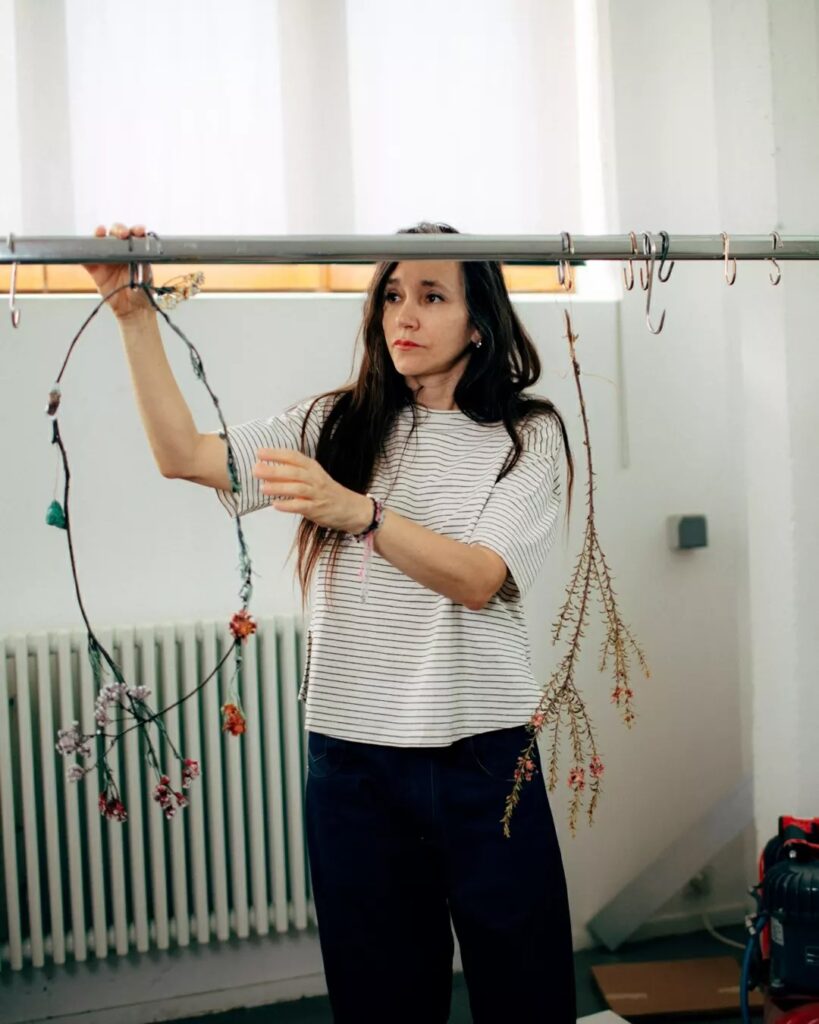
Tatiana Trouvé (b. 1968) is a French-Italian artist, born in Cosenza, Italy, and raised in Dakar, Senegal. She now lives and works in Paris. Through her sculptures, drawings and installations, she explores our experience of time, space and memory. In her hands, everyday objects take on new forms and meanings, blurring the boundaries between reality and imagination. Her work has been exhibited at institutions including the Centre Pompidou in Paris and Palazzo Grassi in Venice. In 2007, she was awarded the prestigious Prix Marcel Duchamp.
De tentoonstelling The Auxiliaries van Tatiana Trouvé is nog t/m 31 oktober 2026 te zien bij galerie Xavier Hufkens (St-Georges) in Brussel.
Recent stories
-
![Tatiana Trouvé | foto: Hélène Pambrun & Thomas Merle, met dank aan de kunstenaar]()
Tatiana Trouvé at Xavier Hufkens: Look Closer no. 2
-
![]()
Kent Guide: From Margate to Manor
-
![Alberto Giacometti, Hour of the Traces, 1932, gips, hout en staal, 69 x 36 x 29 cm]()
That One Moment: Chronos and Kairos
-
![]()
A harmonic universum: A one-of-a-kind pocket watch
-
![]()
William Kentridge: Look Closer no. 1
-
![Marisol Foto: Nancy Astor]()
Between Glamour and Rebellion: Marisol at Depot Boijmans
-
![Helen Frankenthaler met April Mood in haar studio op East 83rd Street in New York, 1974 | © 2026 Helen Frankenthaler Foundation, Inc./ProLitteris, Zurich | foto: Alexander Liberman © J. Paul Getty Trust]()
Helen Frankenthaler & Donald Judd at Kunsthal KAdE: Radical and rigorous
-
![Zeeplokaal]()
Li’s Forecast #11: In praise of soap
-
![Piet Oudolf garden at Noma, Copenhagen]()
Piet Oudolf’s 16 favourite plants: Create your own Oudolf garden
-
![William Kentridge, Waiting for the Sibyl]()
BREAKING #338: She has all the answers
-
![Nicole Ex (rechts) en Sarah Knigge (links) ergens tussen spiegelbeeld, stippen en oneindigheid in Yayoi Kusama’s nieuwe Infinity Mirror Room in het Stedelijk Museum Amsterdam, 9 september 2026]()
BREAKING #337: Yayoi Kusama
-
![]()
BREAKING #336: Body language
-
![Getty Research Institute, Los Angeles, schenking van de Roy Lichtenstein Foundation ter nagedachtenis aan Harry Shunk en Janos Kender | Foto: Shunk-Kender © J. Paul Getty Trust]()
Endlessly innovative: Yayoi Kusama in Amsterdam
-
![Marisol Escobar met haar sculptuur The Kennedyʼs, 1964 | © foto: Sam Falk]()
In the Kitchen with Marisol Escobar: ‘I decided never to talk again’
-
![]()
BREAKING #334: The Orchard Project, Part II
-
![Wolfgang Tillmans, Inner City Apple Tree, 2004]()
BREAKING #333: An orchard for the future
-
![]()
Which room did you fall in love with?: Send us your all-time favourite cinematic room
-
![]()
BREAKING #332: In love with a room
-
![De studio van Carlo Maria Morsiani, Modena, juli 2026 | foto: Nicole Ex]()
BREAKING #331: The shape of clouds
-
![Shopwork magazine issue 01]()
Treasure Hunt #5: Make your own designer clothes