BREAKING #334
The Orchard Project, Part II
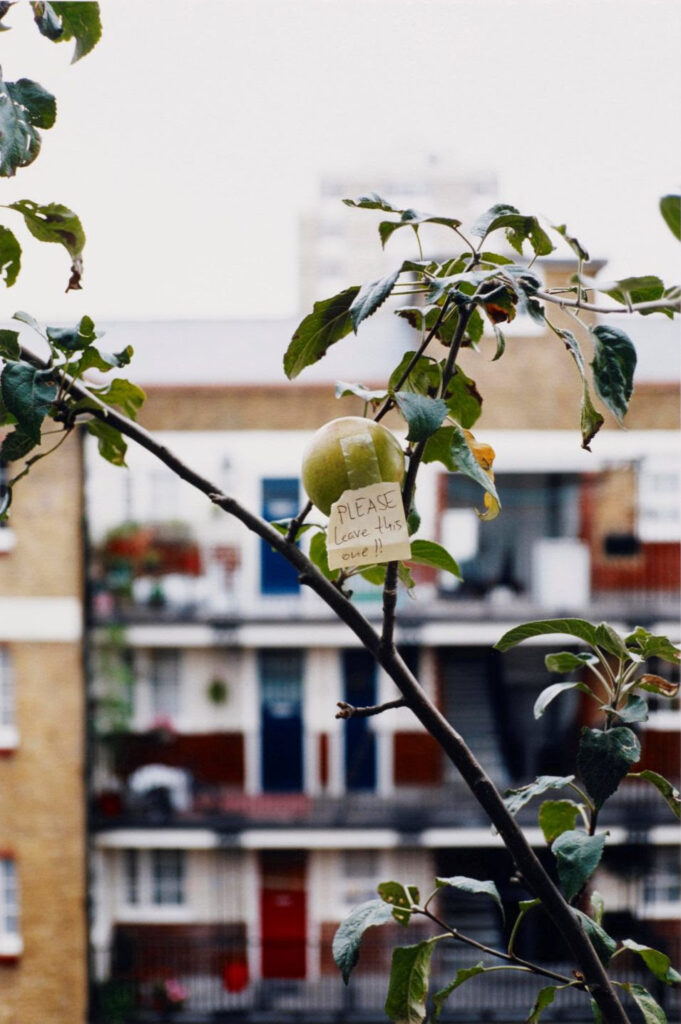
Last week, we told you about the Historic Orchard of the Future, featuring rare wild apple trees (Malus sylvestris) that we are giving away to readers of our art letter in collaboration with Staatsbosbeheer, the Dutch forestry service. In this second letter, we share more about the wild apple and its long history. Further down, you can read how you can still take part – and there is another surprise waiting.
‘Even if I knew that tomorrow the world would end,
I would still plant my apple tree today.’
– from a letter by a resistance fighter, 1944
ABOUT THE WILD APPLE
Even the most famous apple in our culture is actually based on a misunderstanding. Nowhere in Genesis does it say that Eve picked an apple – it speaks only of the fruit of the tree of the knowledge of good and evil. It was only later, in the European visual tradition, that this fruit took the form of an apple. Art history is full of them.
In Greek mythology, a golden apple could even start a war: the apple ‘for the fairest’ led, through the Judgement of Paris, ultimately to the Trojan War. And closer to home, the apple played a role in folk beliefs. An apple pip was thrown into the fire while speaking the name of your beloved: if it burst open, the love was true.
The small, sour apples of the fragrant wild apple tree (Malus sylvestris), with its clusters of pale pink blossom, were pressed in the Middle Ages to make verjus, a sharp, acidic juice used in cooking. Apple wood was used for fine turning and furniture, while the roots of Malus sylvestris provided a dye for colouring wool yellow.
Only around 150 wild apple trees remain in the Netherlands. This makes Malus sylvestris one of the rarest and most endangered native tree species in the country. This is not the sylvestris you can buy at a garden centre. The seeds of the trees we are talking about were collected from so-called ‘relict populations’ and preserved in the gene bank of Staatsbosbeheer.
Staatsbosbeheer has allowed us to give away 33 seedlings from these mother trees for our Historic Orchard of the Future, which we hope will eventually consist of 333 fruit trees. Since our call last week, we have already received more than 150 infectious responses, with wonderful descriptions of gardens, fields and plots of land.
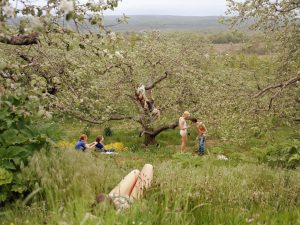
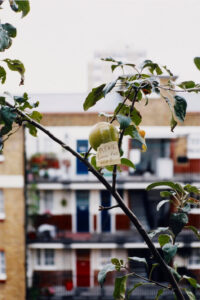
What stands out is how many shared places have been offered: school gardens, food forests, community allotments, a peace garden and farmyards visited by many people. Alongside estates and farmland, people have suggested front gardens, courtyards and even an Amsterdam rooftop. Our scattered orchard is already beginning to take shape, before the first young tree has even been planted.
Some of the first responses:
‘I don’t want to plant a monument to the past, but a living gift to the future.’
‘Behind our house, I planted an orchard around a single old apple tree, a Notarisappel, planted by my grandfather in 1914.’
‘We would like to plant it for Otto, so they can grow up together.’
‘If our vegetable garden is chosen, this little tree will become the centrepiece of our school project.’
‘Then it will be a real Amsterdam apple.’
‘After the North Sea flood of 1953, all the orchards had to be cleared. Now, every year, we plant a few fruit trees back in the meadow behind the farm.’
THE ORCHARD KEEPS GROWING
THE WILD CHERRY
The overwhelming response to last week’s call prompted us to look for more fruit trees. And during our search, we made a discovery: alongside the 33 wild apples, we can also find a home for 77 native wild cherry trees, Prunus avium.
This native cherry tree bursts into abundant white blossom in spring and bears small, dark-red cherries in summer, loved by birds and people alike. These young fruit trees, too, were grown from native seed held in the gene bank. And so our Historic Orchard of the Future is gradually taking shape: not as a collection of a single species, but as a living network of native fruit trees.
Please note: this wild cherry grows into a monumental tree, reaching up to 25 metres in height, and needs a clear space of 8–10 metres.
WHAT’S NEXT
Unfortunately, applications to become a tree guardian are now closed. The 33 new guardians of the wild apple and the 77 guardians of the wild cherry will be announced in early September.
Recent stories
-
![]()
Kent Guide: From Margate to Manor
-
![Alberto Giacometti, Hour of the Traces, 1932, gips, hout en staal, 69 x 36 x 29 cm]()
That One Moment: Chronos and Kairos
-
![]()
A harmonic universum: A one-of-a-kind pocket watch
-
![]()
William Kentridge: Look Closer no. 1
-
![Marisol Foto: Nancy Astor]()
Between Glamour and Rebellion: Marisol at Depot Boijmans
-
![Helen Frankenthaler met April Mood in haar studio op East 83rd Street in New York, 1974 | © 2026 Helen Frankenthaler Foundation, Inc./ProLitteris, Zurich | foto: Alexander Liberman © J. Paul Getty Trust]()
Helen Frankenthaler & Donald Judd at Kunsthal KAdE: Radical and rigorous
-
![Zeeplokaal]()
Li’s Forecast #11: In praise of soap
-
![Piet Oudolf garden at Noma, Copenhagen]()
Piet Oudolf’s 16 favourite plants: Create your own Oudolf garden
-
![William Kentridge, Waiting for the Sibyl]()
BREAKING #338: She has all the answers
-
![Nicole Ex (rechts) en Sarah Knigge (links) ergens tussen spiegelbeeld, stippen en oneindigheid in Yayoi Kusama’s nieuwe Infinity Mirror Room in het Stedelijk Museum Amsterdam, 9 september 2026]()
BREAKING #337: Yayoi Kusama
-
![]()
BREAKING #336: Body language
-
![Getty Research Institute, Los Angeles, schenking van de Roy Lichtenstein Foundation ter nagedachtenis aan Harry Shunk en Janos Kender | Foto: Shunk-Kender © J. Paul Getty Trust]()
Endlessly innovative: Yayoi Kusama in Amsterdam
-
![Marisol Escobar met haar sculptuur The Kennedyʼs, 1964 | © foto: Sam Falk]()
In the Kitchen with Marisol Escobar: ‘I decided never to talk again’
-
![]()
BREAKING #334: The Orchard Project, Part II
-
![Wolfgang Tillmans, Inner City Apple Tree, 2004]()
BREAKING #333: An orchard for the future
-
![]()
Which room did you fall in love with?: Send us your all-time favourite cinematic room
-
![]()
BREAKING #332: In love with a room
-
![De studio van Carlo Maria Morsiani, Modena, juli 2026 | foto: Nicole Ex]()
BREAKING #331: The shape of clouds
-
![Shopwork magazine issue 01]()
Treasure Hunt #5: Make your own designer clothes
-
![]()
The Body of Water: Endlessly circulating