The bone as a connection
Relics in the Art Zoo Museum
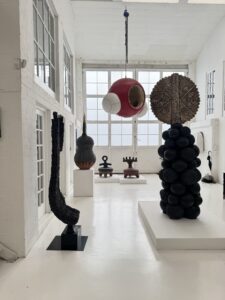
The exhibition Relics consists of a collection of fossils, transformed into contemporary artworks by Darwin, Sinke & Van Tongeren. The collection stands as an artistic ode to the remains of a long-lost era and invites reflection, reverence and admiration for the beauty and fragility of nature. Peter van Duinen, director and co-founder of the Vrije Academie, gave a lecture on the exhibition and how these relics connect us to various times in history.
A few weeks ago I was at Jaap and Ferry’s studio and I held this bone in my hand. It struck me how strange that actually is, because we never see it. A bone sits inside an animal; inside ourselves. It carries us our whole life, and we never get to see it. Only when everything around it has disappeared – the flesh, the skin, time itself – does it come into view. The moment it becomes visible, something happens that always surprises me.
For as long as there have been humans, a bone can become a carrier of meaning, of connection with our humanity, with our mortality. Take the catacombs beneath the streets of Rome, in the second century AD. The early Christians descended into the tuff and laid their dead in niches along the walls. Most importantly, those who had died for their faith were martyrs. Something remarkable happened there: they began to celebrate Mass on those martyr graves, right there, with the bones literally beneath their feet. They believed that something was present in these remains that deserved reverence.
And look what came of it. A rule that still holds today: every altar in the Catholic Church must contain a relic. Every altar, everywhere in the world, still rests symbolically on a bone from these Roman corridors. Here the bone is still invisible, behind stone, in the dark. Everyone knows it is present, and knowing is enough. Yet people wanted more, they wanted to see what was underneath the surface.
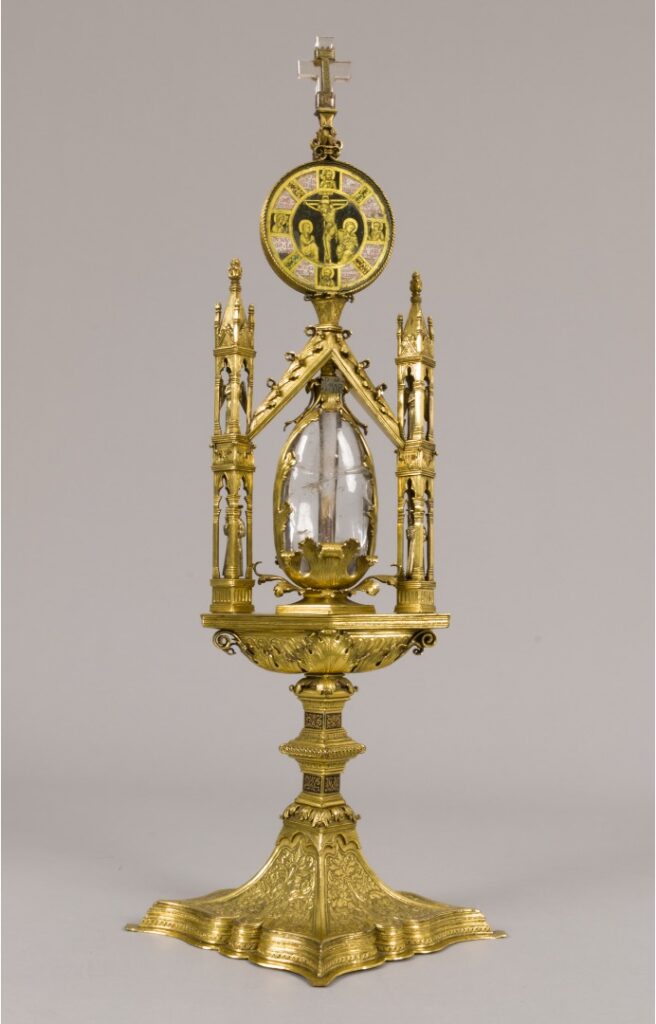
The reliquary from Tuscany is made of gilded silver, gilded copper, and rock crystal. In the middle you see an egg-shaped vessel of the rock crystal, and inside this is the real tooth of Mary Magdalene.
The German medieval craftsmen had a word for the urge to actually see the bone: Schaubedürfnis, the need to be beheld. It was not enough to know that the tooth of Mary Magdalene existed somewhere, it had to be seen. Therefore they built the most precious thing they could – not to hide, but to draw you closer, to compel you to look through that rock crystal and at the tooth itself. The impulse to glorify, and to connect has never disappeared. It has only moved. From the church to the museum; from the saint to the animal.
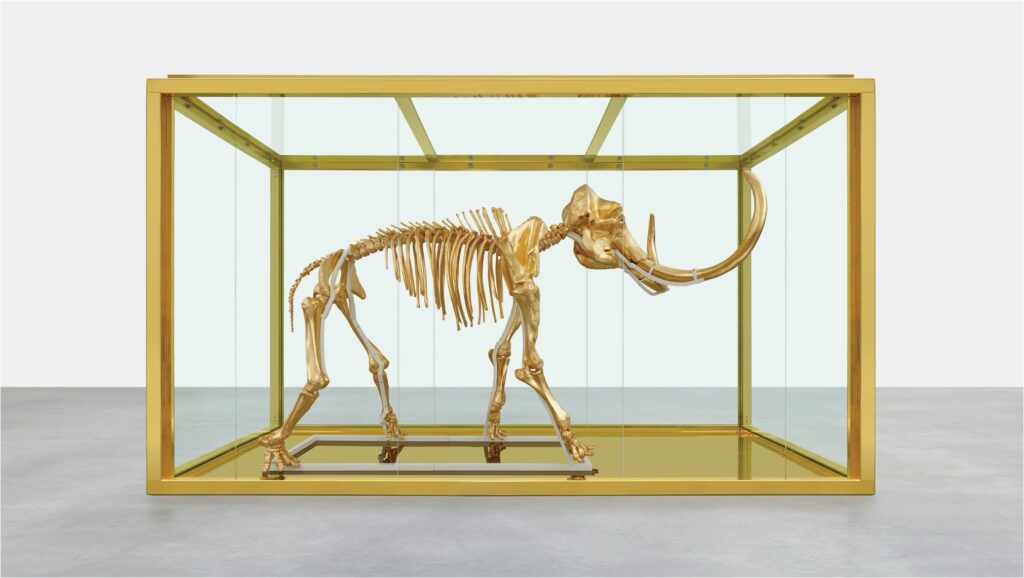
Look at this. Damien Hirst, 2014. The skeleton of a woolly mammoth, three metres tall, covered in twenty-four-carat gold. In a colossal glass display with a gilded frame, it stands in the garden of a hotel in Miami Beach. Hirst called it Gone but not Forgotten. He once said: ‘Without art, it’s hard for us to believe in anything.’ With his he implies that what used to happen in church – the belief, the meaning, the sense that something matters – now happens in the museum. And for Hirst, his own works are exactly that: modern relics. Dead animals in formaldehyde; a diamond skull; a gilded mammoth; objects that confront us with mortality, and at the same time touch something in us that is older than art itself. The bone is the connection.
This is exactly what the goldsmith in Tuscany did with that tooth behind the rock crystal: enclosing it with the most precious material we know. Not to hide it, but to elevate it. And that glass display with its gilded frame is like the rock crystal of Mary Magdalene, but six hundred years later.
So we arrive here, with Jaap, Ferry and Iacopo, and with their works of art. What they are doing has, as far as I know, never been done before. Not one spectacular piece like Hirst’s mammoth, but an entire collection of gigantic fossils are treated as a collection of relics and art. These are not just study objects like in other natural history museums, these are artworks. And art is the spark of humanity that we add to science, it is a means to connect to these bones.
I connect to different times when I walk through this room. I am looking at a bone that is sixty-seven million years old. An animal that breathed, that lived, that moved, is sparked by art.
Two thousand years ago, an early Christian in Rome decided that a bone deserved reverence. Six hundred years ago, a goldsmith in Tuscany built a rock crystal around the tooth of Mary Magdalene. This century, Damien Hirst gilded a mammoth in Miami. And today, in a seventeenth-century canal house in Amsterdam, Jaap Sinke and Ferry van Tongeren are doing the same thing for creatures that lived before there were humans.
I invite you to walk through this room for a moment, in the same way a medieval pilgrim walked through a cathedral. The bone is the connection between us and Mary Magdalene, between us and the mammoth in Miami, between us and the creatures standing around you here, who breathed sixty-seven million years ago.
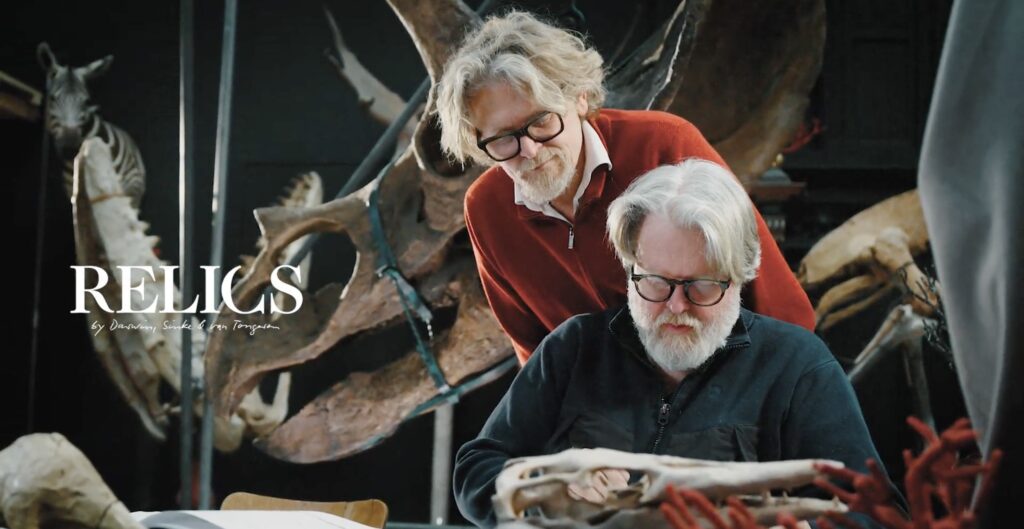
The exhibition Relics can be seen from April 17 to November 30 at Art Zoo Amsterdam.
Recent stories
-
![Getty Research Institute, Los Angeles, schenking van de Roy Lichtenstein Foundation ter nagedachtenis aan Harry Shunk en Janos Kender | Foto: Shunk-Kender © J. Paul Getty Trust]()
Endlessly innovative: Yayoi Kusama in Amsterdam
-
![]()
BREAKING #334: The Orchard Project, Part II
-
![Wolfgang Tillmans, Inner City Apple Tree, 2004]()
BREAKING #333: An orchard for the future
-
![]()
Which room did you fall in love with?: Send us your all-time favourite cinematic room
-
![]()
BREAKING #332: In love with a room
-
![De studio van Carlo Maria Morsiani, Modena, juli 2026 | foto: Nicole Ex]()
BREAKING #331: The shape of clouds
-
![Shopwork magazine issue 01]()
Treasure Hunt #5: Make your own designer clothes
-
![]()
The Body of Water: Endlessly circulating
-
![]()
1,2,3 under the apple tree: Make your own herman de vries
-
![]()
Li’s Forecast #10: The creative custodian
-
![]()
Water Guide: 10 stories exploring (bodies of) water
-
![]()
Cape Town & The Karoo: Travel Diary
-
![]()
Any Body there?: An exhibition-on-paper curated by Marlene Dumas
-
![Vincent van Gogh, IJsvogel aan de waterkant, 1886]()
Treasure Hunt #4: An app for bird lovers
-
![]()
-
![]()
-
![Poster van de cover van See All This #42 | foto: Katerina Bezedei]()
BREAKING #325: See All This is censored
-
![Launch of See All This #42, Café Fonda, Stedelijk Museum, Amsterdam | Photo Katerina Bezedei, clothing Nicole: Cortana]()
See All This #42 – The Body: Launch speech by Nicole Ex
-
![]()
-
![]()
Labourland: Stories from the Womb