BREAKING #317 | TRAVEL DIARY
Why does the ‘seabed’ look azure?
An underwater kelp forest lies in a remote part of False Bay, near Simon’s Town on the Cape Peninsula: a forty-five-minute drive south of Cape Town and an hour north of the Cape of Good Hope. It is exposed to the cold Benguela Current of the Atlantic Ocean, rich in plankton, which is why so many lives and grows here.
This is a very particular place, beloved around the world thanks to My Octopus Teacher (2020), the almost meditative nature documentary about a man who dives in this bay and forms a friendship with an octopus. We head out with Pisces Divers in a rubber boat, joined on board by diver and founder Mike Nortje and oceanologist Ethan Smith.
We have come from a landscape that was once an inland sea, with succulent plants such as the ‘soutvygies’, whose fleshy leaves still taste of salt. Now it is time to surrender to the swell and shimmer of the ocean itself, to upwellings and wind-driven waves, with lenticular clouds floating above us like flying UFO’s.
It truly does not get more beautiful than this. But first I have to move past my fear of the unknown: lower myself into the water in a wetsuit, fins and snorkelling gear. It feels like having your first tennis lesson at Wimbledon, and I know it. But they talk me through it, and then my whole perspective tilts.
Water above and below, clear to a depth of eight metres, sunlight falling in shafts onto the giant seaweed. Heavy, smooth stems rise up, with strips and ribbons of kelp swaying between them, schools of fish moving through a shifting architecture of starfish, sea anemones and sea urchins, in blue, purple and pink.
Why does the ‘seabed’ look azure? Because blue light penetrates deepest into the water, explains Ethan. After a morning out there, we return to the dive school in the back of a pick-up truck. Anke, who has even seen pyjama sharks, says: ‘I have no words for it. I feel like a smile.’
My Octopus Teacher is available to watch on Netflix. Watch the trailer here.
Recent stories
-
![]()
Olafur Eliasson: Look Closer no. 3
-
![Tatiana Trouvé | foto: Hélène Pambrun & Thomas Merle, met dank aan de kunstenaar]()
Tatiana Trouvé at Xavier Hufkens: Look Closer no. 2
-
![]()
Kent Guide: From Margate to Manor
-
![Alberto Giacometti, Hour of the Traces, 1932, gips, hout en staal, 69 x 36 x 29 cm]()
That One Moment: Chronos and Kairos
-
![Bar Magritte Hotel, Amigo, Brussels]()
Brussels Bound: City guide
-
![]()
A harmonic universum: A one-of-a-kind pocket watch
-
![]()
William Kentridge: Look Closer no. 1
-
![Marisol Foto: Nancy Astor]()
Between Glamour and Rebellion: Marisol at Depot Boijmans
-
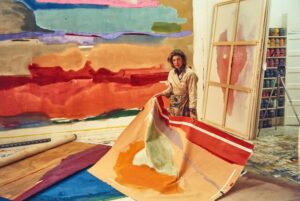
![Helen Frankenthaler met April Mood in haar studio op East 83rd Street in New York, 1974 | © 2026 Helen Frankenthaler Foundation, Inc./ProLitteris, Zurich | foto: Alexander Liberman © J. Paul Getty Trust]()
Helen Frankenthaler & Donald Judd at Kunsthal KAdE: Radical and rigorous
-
![Zeeplokaal]()
Li’s Forecast #11: In praise of soap
-
![Piet Oudolf garden at Noma, Copenhagen]()
Piet Oudolf’s 16 favourite plants: Create your own Oudolf garden
-
![William Kentridge, Waiting for the Sibyl]()
BREAKING #338: She has all the answers
-
![Nicole Ex (rechts) en Sarah Knigge (links) ergens tussen spiegelbeeld, stippen en oneindigheid in Yayoi Kusama’s nieuwe Infinity Mirror Room in het Stedelijk Museum Amsterdam, 9 september 2026]()
BREAKING #337: Yayoi Kusama
-
![]()
BREAKING #336: Body language
-
![Getty Research Institute, Los Angeles, schenking van de Roy Lichtenstein Foundation ter nagedachtenis aan Harry Shunk en Janos Kender | Foto: Shunk-Kender © J. Paul Getty Trust]()
Endlessly innovative: Yayoi Kusama in Amsterdam
-
![Marisol Escobar met haar sculptuur The Kennedyʼs, 1964 | © foto: Sam Falk]()
In the Kitchen with Marisol Escobar: ‘I decided never to talk again’
-
![Justine Kurland, {{Orchard}}, 1998, chromogenic print, 76.2 × 101.6 cm]()
BREAKING #334: The Orchard Project, Part II
-
![Wolfgang Tillmans, Inner City Apple Tree, 2004]()
BREAKING #333: An orchard for the future
-
![]()
Which room did you fall in love with?: Send us your all-time favourite cinematic room
-
![]()
BREAKING #332: In love with a room