Mory Sacko
A Remarkable Recipe
Raised with an African palate, inspired by Japanese intuition and shaped by a French flair for food. Forecaster Lidewij Edelkoort visits her neighbour Mory Sacko in his Parisian restaurant – and is a little starstruck.
‘Evolution is key. I’m in the kitchen for every service – that’s a priority for me.’
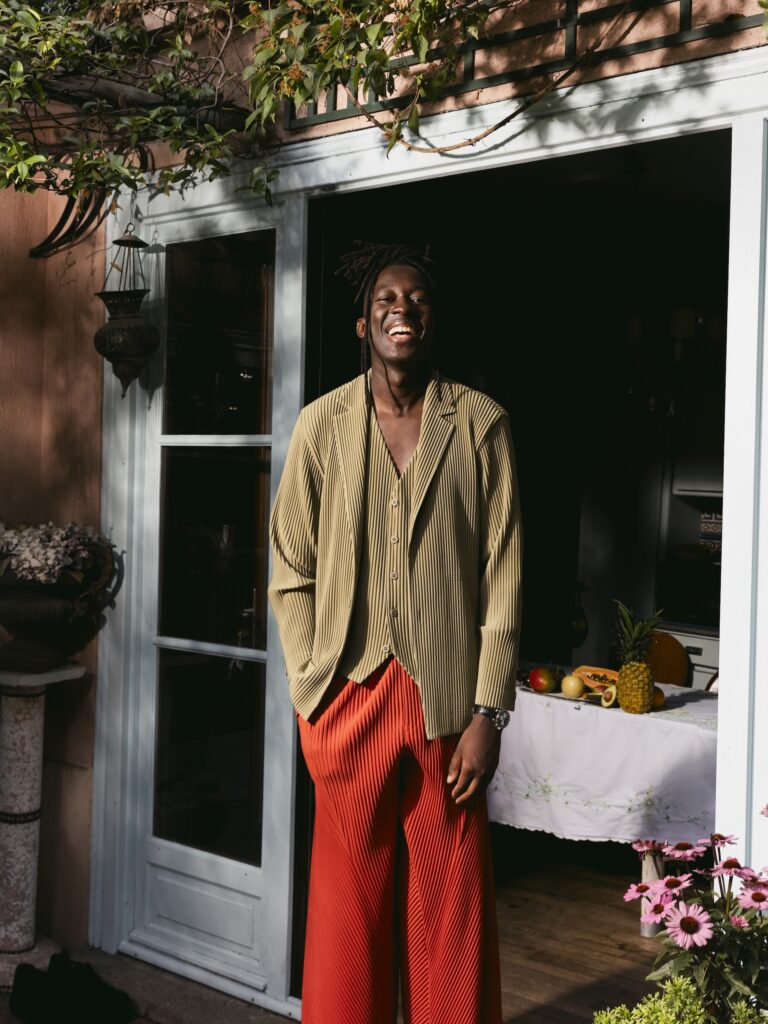
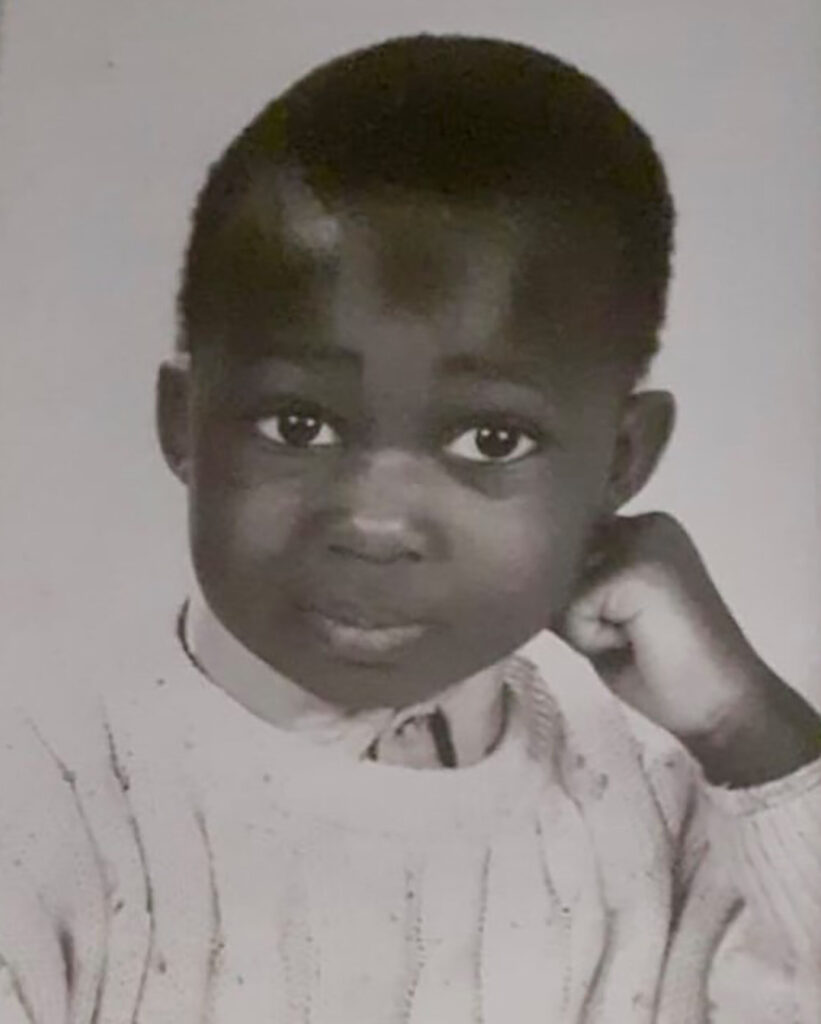
As a striking and tall young man, with an engaging smile and looking more like a model than a cook, he swept into Parisian gastronomy like a whirlwind, disrupting a dormant landscape. Originating from his mother’s Mali and father’s Senegal, the young chef grew up in the Parisian suburbs and started culinary studies from his fourteenth birthday, followed by intensive training in various chef kitchens, ascending rapidly from gate-sauce to first assistant.
Wilful and with a sense of humour, Mory has willed his career ever since: he opened his own restaurant in September 2020, earned a Michelin star in January 2021, appeared on the cover of Time in September 2023, and now serves as guest curator of See All This in December 2025.
‘It’s a cuisine that doesn’t exist anywhere else, because through it I am telling my own story.’
Born between the last Parisian skyscraper and the first bit of nature bordered by trees on the horizon, Sacko has been gifted with a dual urban-rural sensibility. For him, slipping a comic book into his pocket and picking wild strawberries follow the same rhythm – experiences now implemented into the hybrid strategies he has since imagined, providing the natural with the cultural. Even the name of his restaurant, ‘MoSuke’, combines the first part of his own name with the last of Yasuke – an African who, once freed from enslavement, became the famous sword-bearer of a Japanese samurai. A subtle reminder of his people’s diaspora.
‘If there’s one thing I can do, it’s to inspire others and show that being a black chef isn’t something out of the ordinary.’
Introduced by the actor Omar Sy as one of the hundred people to watch, he then, to his big surprise, made the cover of the famous Time – juggling oranges, just as he juggles his profession: cooking twice a day at his famous signature restaurant, art-directing two street-food spots, creating the menu for an aristocratic bistro, and orchestrating luxury-brand events – organised and conceptualised by his spirited partner, Émilie Rouquette, the mother of their young child. Émilie defends their vision like a lioness, battling inequality and discrimination in their profession. She runs the company to set Mory free from the boring realities and paves the way for his creativity and altruism to grow.
When the pressure is on, they decompress by spending weekends with siblings, friends and their baby daughter. The restaurant closes. As a contemporary chef, Mory knows his team needs to recharge to keep the food fantastic.
‘The product itself is often my first source of inspiration. I love discovering new ingredients or rediscovering spices that bring back memories. These moments often unlock recipe ideas.’
When thinking about his personal ingredients, the first word that comes to mind is integrity. Catapulted to fame as a beloved contestant on the television show Top Chef, Mory Sacko gives his life for his food and his audiences. He is disarmingly generous, eager to share and to give his foodies what they long for. After an eight-course menu full of explosive moments, they are giddy, thanking him profusely for an unforgettable dinner, using the word ‘voyage’, embracing him, making selfies, complimenting him. He is a star. The experience goes beyond food and into a kind of metamorphosis, where he elevates the ordinary, like art can do. Echoing the theory that the gut is indeed the second brain, that tasting is like reflecting.
Mory, however, says that he is not an artist but a craftsman, recreating the same masterpieces every day, constantly questioning whether he is worthy of his star. Nearly two metres tall, with fluid, spindly limbs, he hovers over his universe, guiding his six disciples through the principles of his revered kitchen – a sanctuary that dominates a quarter of his intimate restaurant. At once present yet soft-mannered and soft-spoken, his fame hasn’t altered him, doesn’t even seem to be registered by him. All things unfold around him with a quiet inevitability.
‘Perseverance is essential.’
Faith in his future – and the remedies he uses to cope with deception – make him robust and reliable. Smiling, he wipes a flimflam from the table; he will do better tomorrow. As an old soul he traverser adversary with lighthearted energy. Arrested by the pandemic lockdown, he had to close his brand-new restaurant after just two weeks, and used the sudden headspace to imagine even more and unusual foods, infusing them into the menu at the official re-opening in September. After six months, the first Michelin star was awarded – a rare, surreal consecration – exhilarating for his growing audience and admired by colleagues, celebrating not only the kitchen but his hors norme character.
He further capitalised on the unprofitable covid closure by training and launching a takeaway operation, which gave him an avant-goût of further adventures. He opened one, then another, street-food spot under the name ‘MoSugo’. The signature takeaway is fried chicken, spiced the African way, served with sweet-potato fries. What seemed an ordeal became opportunity.
‘I see each recipe as a wonderful way of sharing my view of the world and my personal story, but also what I need to communicate at that particular moment.’
It feels surreal to finally talk to the man at the close of Ramadan, as Mory has been fasting all month, and all day today. Yet talking about food on an empty stomach doesn’t prevent him from offering mouth-watering pairings, animating the genius of his kitchen. Providing deep insight into culture through culinary practice.
Born with an African intuition, raised with Japanese modesty and shaped by a French flair for food, he measures the impact of each ingredient in each dish – and its dialogue with the rest of the menu – each recipe has its own signature salt. All ingredients are sourced from France, all condiments come from afar, all dishes feel at once close and curious. The dinner is choreographed with restrained energy giving taste buds time to adjust and understand. Alternating the abstraction of the experiment with the narration of a childhood dish. He calls this profiting from innocence.
Dedicated waiters guide diners in how best to experience each creation, encouraging them to embrace the outlandish. Spooning, dipping, spreading, and layering, coming face to face with unexpected flavours. Delicacies are tasted to make the degustation beguiling and explicit, trying fermented radishes with salted butter on homemade bread, dipping in spicy Japanese sauce, drinking plumwine. Household ingredients mutated with foreign fruits, spices and artisan skills.
His radical intuition has no limit: he creates new dishes every other day, able to mentally taste them, even before preparing them. His imagination brings banana, foie gras and wasabi together in a signature that is part West Africa, part Dordogne valley, part Japan’s mountain ranges. These regions’ flavours enter into dialogue and amplify one another, inventing a new gourmet language. His African origin embraces an ancestral approach, his Japanese inspection brings new condiments and ancient ways of fermentation, and his love or French produce and protocol is the measure that holds everything together.
In his mother’s community, Qur’anic teachings were woven with animism – the ancient belief system as anti-dote from a natural faith over spiritual rule. Mory’s kitchen embraces this everyday animism with a deep reverence for every ingredient, whether a salad leaf, an egg or a slice of bread.

‘Inspired by my childhood passion for Japan, I began experimenting with miso, yuzu and togarashi.’
His fascination with Japan began in early adolescence, when he fell under the spell of manga – devouring books and videos, spending his pocket money on sushi to feel closely connected to this unknown culture. A recent trip to Japan nourished his understanding of the culinary philosophy of its great masters, who prize temperature as the decisive variable in tempura and elevate precision over abundance. He sees the symbolic power of presentation as an integral part of the craft. His tablescapes – which he personally artdirects and oversees – draw on his trip to Japan, from the knives to the wooden boxes and ceramics, with each piece conceived in collaboration with arts-and-crafts designers. Broken plates are repaired with gold soldering, practicing the age-old Japanese tradition of Kintsugi.
‘I believe that terroir is one of France’s greatest assets. It’s the foundation of our gastronomy.’
His love for French food is tied to the savoir-faire of haute cuisine and to its unwavering principles he is ready to alter with youthful disrespect, adhering to the basic rules but bending them until they become his own voice. First abiding by the laws, then abolishing their pertinence. Like a cadavre exquis, the different offerings come together as one composition, one dinner, one celebration. This, he explains, brings great length on the palate: a blending of opposites that throws diners off guard, as each tang carries them from the known to the unknown ecstatic elation.
‘We don’t do “fusion cuisine”. We blur the lines between cultures while respecting their essence.’
Asked where his flawless dress – a navy-blue apron over a severe black outfit – comes from, his answer is simply: ‘my parents’. Growing up within West African tradition means impeccable clothing for parties and prayers. Washed and starched garments stand out to signal good manners and higher goals. One of nine siblings, he grew up in a wonderful nest of togetherness, where everyone took care of one another. A rigorous upbringing was his foundation. With his father building houses and his mother cleaning them, the values of constructing and polishing were spoon-fed – like the mafé from his mother’s kitchen.
The obligatory ‘ragoût de mafé’ on his menu honours his ancestors by elevating every ingredient. Mory’s sauce is a classic peanut base, intensified by concentrating its flavours, while the beef is massaged and tenderised with beurre de karité, cooked over the barbecue and served rare with a delicate smoky note, alongside fonio – an African cereal with a hazelnut flavour. The layering of distilled ideas turns his food into a kind of fragrance, composed with top, heart and base notes, the finish lingering and titillating the taste buds.
‘I haven’t yet found the right location. But I think that having a restaurant on the African continent would allow me to work differently, and create new recipes.’
Asked about his future, he speculates and dreams of restaurants in Abidjan and Kyoto, mentally sketching the balance each place would demand – even folding in more French ideas to keep that equilibrium.
Another aspiration is to trace the journey of his beloved Nigerian fish soup – a piece of culinary heritage he likens to bouillabaisse – for which he uses meats and mackerel, infused with smoked bonito for more lightness. He has recently discovered that the local soup of his childhood has a near-identical counterpart in Brazil, and he wants to explore how far the recipe has travelled and transformed through the transatlantic slave trade to places such as Jamaica, Haiti and Cuba – an anthropological approach to cuisine.
‘Where you come from doesn’t define where you can go.’
As a young man, Mory began as an assistant at Le Royal Monceau, making omelettes before being trusted anywhere near the signature dishes. He was followed by a stint at the prestigious Shangri-La, and later became sous-chef to Thierry Marx at the Mandarin Oriental. In this formative period his love of palace hotels took root, and one can already imagine the day when he will be consecrated at such a prestigious helm. The question is when? For now, he is inventing his own path.
The forecaster in me is always curious about what comes next. Without hesitation, he names India as the influence of tomorrow, with its still largely untouched traditional kitchen waiting to be reimagined. Already preparing for that moment, he serves a curry from Pondicherry, once again blending Indian, African and, of course, French roots. His instinct is anticipating his future.
Chef Mory Sacko is guest curator of See All This #40: Cooking is Caring. Order your copy here.
Recent stories
-
![Getty Research Institute, Los Angeles, schenking van de Roy Lichtenstein Foundation ter nagedachtenis aan Harry Shunk en Janos Kender | Foto: Shunk-Kender © J. Paul Getty Trust]()
Endlessly innovative: Yayoi Kusama in Amsterdam
-
![]()
BREAKING #334: The Orchard Project, Part II
-
![Wolfgang Tillmans, Inner City Apple Tree, 2004]()
BREAKING #333: An orchard for the future
-
![]()
Which room did you fall in love with?: Send us your all-time favourite cinematic room
-
![]()
BREAKING #332: In love with a room
-
![De studio van Carlo Maria Morsiani, Modena, juli 2026 | foto: Nicole Ex]()
BREAKING #331: The shape of clouds
-
![Shopwork magazine issue 01]()
Treasure Hunt #5: Make your own designer clothes
-
![]()
The Body of Water: Endlessly circulating
-
![]()
1,2,3 under the apple tree: Make your own herman de vries
-
![]()
Li’s Forecast #10: The creative custodian
-
![]()
Water Guide: 10 stories exploring (bodies of) water
-
![]()
Cape Town & The Karoo: Travel Diary
-
![]()
Any Body there?: An exhibition-on-paper curated by Marlene Dumas
-
![Vincent van Gogh, IJsvogel aan de waterkant, 1886]()
Treasure Hunt #4: An app for bird lovers
-
![]()
-
![]()
-
![Poster van de cover van See All This #42 | foto: Katerina Bezedei]()
BREAKING #325: See All This is censored
-
![Launch of See All This #42, Café Fonda, Stedelijk Museum, Amsterdam | Photo Katerina Bezedei, clothing Nicole: Cortana]()
See All This #42 – The Body: Launch speech by Nicole Ex
-
![]()
-
![]()
Labourland: Stories from the Womb