The Power and the Glory
The origins of colour
Colour expert and cultural historian Kassia St Clair, author of the best-selling book The Secret Lives of Colour, reveals the turbulent origins of colour – as well as its power ‘to drive people insane’.

During the late spring of 1665 death began to stalk London’s streets. Over the following eighteen months, a catastrophic outbreak of bubonic plague claimed a quarter of the city’s population – some 100,000 people. While it raged, city dwellers ventured out only furtively, hand- kerchiefs soaked with rosewater pressed to their noses, eyes averted as they passed by neighbours’ doors daubed with large red crosses. One of those cowering in their homes was the 22-year-old Isaac Newton. To distract himself from the troubles of the city surrounding him, or perhaps because the subject posed a challenge like no other, he turned his prodigious mind to the subject of colour.
While plague raged beyond his door, he held sheets of gold leaf between his eye and a candle to examine the hues they reflected. He used prisms to prise apart a single beam of light shining into his room through a hole in his curtains. He blew soap bubbles and feverishly observed their colour-dappled surfaces. He even stuck a needle into his eye – or rather, in his words, ‘betwixt my eye & the bone as neare to the Backside of my eye as I could’. This latter experiment was not particularly useful, illustrating perhaps only that colour has the power to drive men to madness. Many of Newton’s other findings, however, were revelatory.
It was at this time that Newton proved beyond all doubt that white sunlight contains a rainbow of colours from red to violet. This in turn paved the way for an entirely new understanding of colours: where they come from, and how and why we see them.
White light – the visible portion of the electromagnetic spectrum – is the foundation stone for colour. Humans are usually trichromatic, which means we have light-sensitive photoreceptor cells (cone cells) in our eyes that allow us to discern red, green and blue light wavelengths. A strawberry looks red to us because when white sunlight hits its surface, the green and blue light wavelengths are absorbed, leaving only the red to bounce off the strawberry and into our eyes. Information from these cells is then relayed to our brains, which translate what we are seeing. Even if the strawberry were bathed in strong blue light, we would still register it as red. We know what colour it should be; our minds help fill in what we expect.
We’ve been seeing this way for around 30 million years (although around one in 12 men and one in 200 women have some colour vision deficiency). The theory is that our trichromatic vision helped our ancestors gather ripe fruit from among leafy, green branches. Other animals see colour differently. Dogs have only two types of cone cells, for example, and so see similarly to many colour-blind humans: a world denuded of reds. Many species of insects, birds and snakes, meanwhile, have photoreceptors sensitive to ultraviolet and infrared portions of the spectrum.
That our ability to perceive colour is encoded into our DNA and was useful for our survival goes some way to explaining its significance in our history, but our connection to it goes deeper than that.
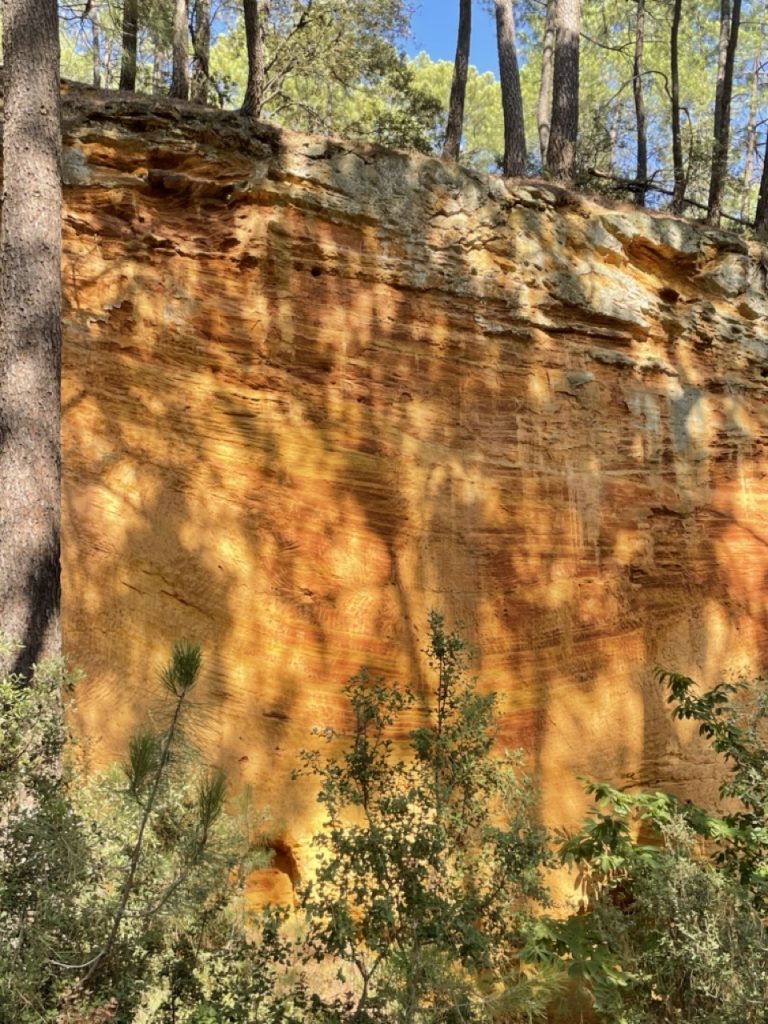
Indeed, some of the earliest proofs we have that our distant ancestors had inner lives are awash with colour. Archaeologists have suggested that the use of red ochres – which have been found in graves, smeared on shells and rubbed into textiles – indicates the development of human cognition. Then there is the cave art. The Lascaux caves in France were inhabited from around 17,000 to 15,000 BCE. The people living there adorned the cave walls with herds of charging bison, stags, horses and cats in saturated red and yellow ochres, dark manganese and charcoal, and whites from clay or chalk. Dozens of other, equally sumptuous examples have been discovered across the globe. Early in 2021, archaeologists in Indonesia discovered the life-sized image of a wild pig in reds and browns that is at least 45,500 years old: the oldest example of cave art currently known.
Sources of fine colours, like ochres and deposits of pale kaolin clay, were clearly highly prized. Later, as trade routes developed and civilisations began to ebb and flow, colours remained intrinsic to human culture. The volcanic mineral cinnabar, which produces the scarlet pigment vermilion, has been used since at least the 10th millennium BCE. Its evocative blood-red colour meant that it was pressed into service in everything from burial rites to fertility rituals, as well as in simple home decoration. Archaeologists found the remains of a large jar of raw cinnabar in a pigment shop near Pompeii, the Roman city destroyed in 79AD by the eruption of Mount Vesuvius. Much of the Romans’ supply came from Sisapu (now Almadén) in Spain. It was transported – under guard because of its value – throughout the empire.
Centuries later, the Aztec and Inca empires demanded sacks of cochineal – a blood-red colourant made from an insect native to the Americas – from subjugated groups as a form of taxation. Túpac Amaru, the last of the royal Inca line, was executed by the Spanish in 1572 wearing a ‘mantle and doublet of crimson velvet’.
But while shades of red have long held humans in their thrall, other hues have also proved important for communicating wealth, status and power. In China, yellow was one of the colours of the Five Element theory. Allied with a season (late summer), direction (centre), planet (Saturn) and animal (the dragon), it was considered ‘the colour of rulers’, according to a treatise composed in the second century BC. Cloth dyed sunny yellow with the golden roots of the Rehmannia glutinosa, or Chinese foxglove, was for centuries reserved for royalty and intimate retainers.
The prestige of a colourant often depended on a combination of the colour saturation of the resulting dye and the difficulty of producing the pigment. Take ultramarine, a brilliant blue. It was made by crushing and purifying the semi-precious stone lapis lazuli, traditionally mined in a remote and mountainous region of what is today north-eastern Afghanistan. The stone was for many centuries traded east and west along the silk roads, together with textiles, furs, dyestuffs and countless other commodities. Even once it had reached its destination, turning lapis lazuli into a useable pigment meant tortuously grinding it to powder, mixing it with wax or saps into a dough-like consistency, then kneading it in a solution of lye to isolate the blue and remove impurities. The result, however, was a blue of astonishing depth and power. In Europe, its lustre became symbolically linked with the Virgin Mary: paintings of her from the 12th century onwards often depict her swathed in blue cloth, the rarity and expense of the pigment reflecting the devotion of the artists and patrons.
The scarcity and cost of ultramarine – at times it was more expensive than gold – led societies to develop alternatives. For the An- cient Egyptians, blue represented the sky, the sacred River Nile and Amun-Ra, a principal deity. Their devotion to the hue drove them, sometime around 2500 BCE, to develop and then mass-produce a synthetic alternative they called hsbd-iryt: literally ‘artificial lapis lazuli’. This pigment, now known as Egyptian Blue, was made by firing chalk, sand and a copper-rich mineral such as malachite together at precise ranges of high temperatures. The process created a long-lasting, glassy blue pigment used, among other things, to decorate the tall, conical crown of Queen Nefertiti.
Around the Mediterranean, Tyrian purple was an equivalent colour of power. Producing a rich, dark shade compared by Pliny to clotted blood, the dye was made from glandular liquid extracted from two varieties of sea snail. The liquid extracted from the snails – it might take 250,000 individuals to produce a single ounce of dye – was placed in a vat of stale urine (a source of ammonia) for ten days to ferment. Cloth dipped in the finished dye would turn first yellow, then green, then blue, before finally settling into the desired vinous shade. Costing as much as silver in the fourth century BCE, its value increased further as the sea snail populations collapsed.
In Rome, it was first a symbol of military favour and later, as its worth increased, further restricted until it could only be worn by a select few. ‘This is the purple for which the Roman fasces and axes clear a way’, Pliny wrote. ‘It is the badge of noble youth; it distinguishes the senator from the knight; it is called in to appease the gods.’ The Byzantine imperial court similarly guarded its use, until the colour became synonymous with its power. By the ninth century, children born to a reigning emperor were said to be ‘porphyrogennetos’. Literally: ‘born in the purple.’

When price and custom alone were insufficient to regulate the use of colour, sumptuary laws were passed. These sought to regulate access and consumption of certain goods such as food and clothing and were passed all over the world by various cultures. Farmers in early 17th-century Shogun Era Japan, for example, were forbidden to wear crimson or plum. In 15th-century England, the wearing of scarlet-dyed cloth was restricted, as was access to cloth of gold.
Although use of highly prized natural colourants – including cochineal, now more often known as the food colouring E120 – has persisted, the past two centuries have been marked by the emergence of a symphony of synthetics. In 1856, an 18-year-old British chemist called William Perkin stumbled across the method for producing the first aniline dye. It was entirely ac- cidental – he had actually been trying to create a cure for malaria – but his discovery of a pur- ple dye he called mauveine changed the colour landscape forever. Extracted from non-renewable petrochemicals, mauve became an affordable fashion sensation and led to the discovery of a rainbow of other aniline dyes. Previously thriving industries, such as the cultivation of the plants responsible for madder and indigo dyes, went out of existence overnight. The price of fifty kilograms of the former, for example, plummeted from 30 shillings (the equivalent of a week’s wages for a labourer) in 1868, to just eight shillings the following year. The new aniline dyes, by and large, are the ones used today.
Concurrently, hosts of new pigments were being discovered. Nineteenth-century artists could squeeze lashings of previously unheard-of hues from readily portable paint tubes: mars reds; synthetic ultramarine; chrome oranges and yellows; cerulean and cobalt blues; and chromium oxide green. Like the synthetic dyes, the new pigments were often cheaper and easier to use than the traditional, natural alternatives. Easily accessible, individual hues were no longer so intrinsically bound to power and status.
Unfettered access to colour in our daily lives has only increased in recent decades. Black-and-white photography and film have ceded ground to polychrome equivalents. Clothing has become ever cheaper with the advent of synthetic textiles and mass-market production. Trends for cars, interiors, clothes and cosmetics vary with the seasons. Hues and finishes are being developed that could never exist beyond digital media and have no equivalents in the physical world. Using our smartphones, televisions and social media, companies and individuals can vie for our limited attention using saturated bursts and intriguing palettes – we immerse ourselves in cacophonies of colour.
Few would advocate a return to a time when some hues were the sole preserve of the wealthy and powerful, but interest in more home-grown and natural pigments and dyes seems to be gathering pace. Heidi Gustafson, who has been collecting ochres in the foothills of the Cascade Mountains in Washington for years, has inspired many others – principally women – to do likewise. Stella Maria Baer, Lorraine Brigdale, Amanda Brazier, Nancy Pobanz and Caitlin French all research, produce and use found or wild pigments. The colourants may not be as bright as synthetics, but they come in captivating ranges of tones and shades, each with their own foibles and subtleties.
Similarly, communities of dyers working with plants, animals or even domestic kitchen waste have gained strength. Many utilise social media to share techniques, offer workshops and sell the textiles they create. The current pandemic has helped. The past two years, during which many people have been forced to live more of their lives digitally than ever before, seems only to have fed our latent desire for palettes that owe their existence to the world around us. People seem to crave more physical, tangible interactions with colours that can be unpredictable and challenging. Isaac Newton would surely approve.
Recent stories
-
![]()
Vivian Suter: Look Closer no. 4
-
![]()
Olafur Eliasson: Look Closer no. 3
-
![Tatiana Trouvé | foto: Hélène Pambrun & Thomas Merle, met dank aan de kunstenaar]()
Tatiana Trouvé at Xavier Hufkens: Look Closer no. 2
-
![]()
Kent Guide: From Margate to Manor
-
![Alberto Giacometti, Hour of the Traces, 1932, gips, hout en staal, 69 x 36 x 29 cm]()
That One Moment: Chronos and Kairos
-
![]()
Does the Universe Keep Time?: From atomic clocks to the cosmic film reel
-
![Bar Magritte Hotel, Amigo, Brussels]()
Brussels Bound: City guide
-
![]()
A harmonic universum: A one-of-a-kind pocket watch
-
![]()
William Kentridge: Look Closer no. 1
-
![Marisol Foto: Nancy Astor]()
Between Glamour and Rebellion: Marisol at Depot Boijmans
-
![Helen Frankenthaler met April Mood in haar studio op East 83rd Street in New York, 1974 | © 2026 Helen Frankenthaler Foundation, Inc./ProLitteris, Zurich | foto: Alexander Liberman © J. Paul Getty Trust]()
Helen Frankenthaler & Donald Judd at Kunsthal KAdE: Radical and rigorous
-
![Zeeplokaal]()
Li’s Forecast #11: In praise of soap
-
![Piet Oudolf garden at Noma, Copenhagen]()
Piet Oudolf’s 16 favourite plants: Create your own Oudolf garden
-
![William Kentridge, Waiting for the Sibyl]()
BREAKING #338: She has all the answers
-
![Nicole Ex (rechts) en Sarah Knigge (links) ergens tussen spiegelbeeld, stippen en oneindigheid in Yayoi Kusama’s nieuwe Infinity Mirror Room in het Stedelijk Museum Amsterdam, 9 september 2026]()
BREAKING #337: Yayoi Kusama
-
![]()
BREAKING #336: Body language
-
![Getty Research Institute, Los Angeles, schenking van de Roy Lichtenstein Foundation ter nagedachtenis aan Harry Shunk en Janos Kender | Foto: Shunk-Kender © J. Paul Getty Trust]()
Endlessly innovative: Yayoi Kusama in Amsterdam
-
![Marisol Escobar met haar sculptuur The Kennedyʼs, 1964 | © foto: Sam Falk]()
In the Kitchen with Marisol Escobar: ‘I decided never to talk again’
-
![Justine Kurland, {{Orchard}}, 1998, chromogenic print, 76.2 × 101.6 cm]()
BREAKING #334: The Orchard Project, Part II
-
![Wolfgang Tillmans, Inner City Apple Tree, 2004]()
BREAKING #333: An orchard for the future