Pizza
The Crispy Canvas Reflecting our History, Identity and Future
There is no better way to look at our history than through the lens of our food, Louise O. Fresco says. The acclaimed scientist, writer and thought leader in food, agriculture and sustainability explores the evolution of food through one iconic dish: pizza. ‘Even the humble, white pizza hides many stories, for it was never purely local.’
Humans are unique among animals because we eat our food as meals. We do not simply consume whatever edible items we encounter; instead, we produce the raw materials, prepare them, and consume them in countless ways, often in the company of others. From this, we draw our identity and moral values, both as individuals and as communities. Everything we eat carries a long history of origin, migration and transformation, shaped by knowledge, beliefs and convictions.
Across nearly every culture, staple foods follow a similar pattern, although the ingredients vary with local resources. At the core lies a trinity of carbohydrates (starch), protein and fat. Carbohydrates are provided by grains and tubers – mainly wheat, rice, corn, millet, potatoes, yams and cassava. Since the gradual development of agriculture more than twelve thousand years ago, these carbohydrates have been the main source of calories. They are often paired with beans – soybeans in China, lentils and chickpeas in the Middle East and India, and various local beans in Africa and Central America. This pairing is powerful: grains and beans contain complementary amino acids, the building blocks of proteins, making them more nourishing than when eaten separately. This was a significant evolutionary milestone for humankind.
Wheat starch is the most versatile of all carbohydrates: eaten unleavened or leavened, as bread, croissants, pancakes and coffee rolls, as well as Eastern European blinis, Indian naan and roti, or Turkish simit and, of course, pizza – an enduring icon of the evolution of our food.
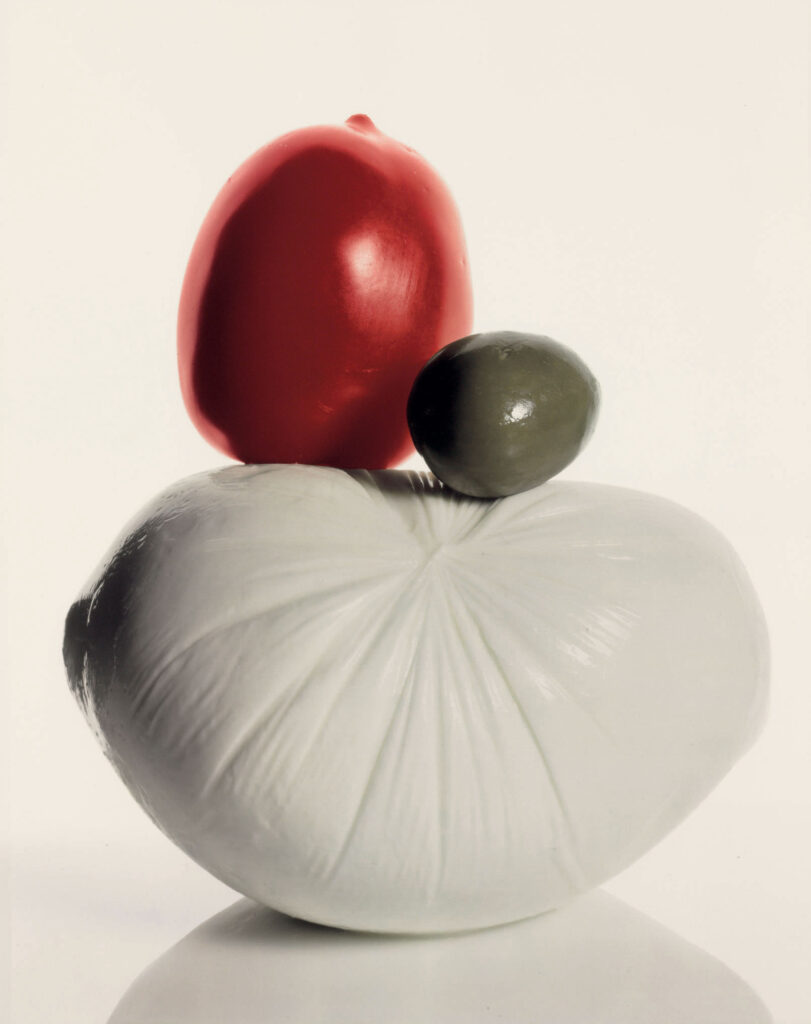
Pizza, that simple thin sheet of wheat dough, baked in hot wood ovens in Naples since the 17th century, smeared with a little oil, salt, and black pepper, perhaps garlic and basil. Pizza bianca, white pizza, was the food of the poor: carbohydrates, a little protein from the flour and a touch of fat. Meat, fish and cheese – rare and costly sources of protein – were not yet included. Pizza was not eaten as a snack but served as a full meal for those who had little to spare or worked away from home.
Even this humble white pizza hides many stories, for it was never purely local. Take garlic, an essential to the Italian cuisine, known in Pharaonic Egypt long before it reached Naples. Or basil, often considered quintessentially Italian, but native to a wide belt stretching from Africa to far beyond the Middle East – the Greek term may hint at its use in royal dishes or perfumes. Wheat was cultivated in Italy at the time, but it originated from wild grasses in the Middle East. Only the olive oil came from a plant native to the Mediterranean. No pizza has ever been a purely local product.
About half a century later came the pizza margherita, with mozzarella, basil, and tomato, named after the queen at the time and bearing the colours of the Italian flag. The tale is probably apocryphal, as tomatoes were scarce in Italy then. Soon after appeared the pizza marinara, topped with leftovers from the day’s fish catch.
Over a few centuries, pizza became part of the world’s culinary heritage. The original Neapolitan white pizza survives, but in both preparation and meaning, it has undergone countless – and often radical – transformations. In the latter half of the 19th century, pizza travelled with Neapolitan immigrants to the US. By the mid-20th century, their descendants – along with American soldiers – brought it back to Italy and from there it spread across Europe. This was no longer a white pizza, but red, topped with tomato paste and grated cheese, a style that emerged once tomatoes – originally from Central America – became commonplace. Today, nothing seems more Italian than the tomato, and consumers prize those grown in the Italian sun. Yet even the tomato is a migrant in Europe and Asia.
‘Much of what we embrace as authentic is, in fact, quite recent’
In addition to the red pizza, the FAST-FOOD PIZZA also originated in the US. Born in Chicago, it is made from thick, elastic dough baked in a tin for nearly an hour. This variant, served in enormous portions, is laden with layer upon layer of cheese, sausage, peppers, and yet more cheese, mushrooms, ham, anchovies and any other toppings the costumer might desire. This abundance reflects the promised land, America – a stark contrast to impoverished Italy. It is this fast-food style, with crusts of varying thickness and a dizzying range of toppings, that conquered the globe.
It also introduced a new, synchronous eating culture: no longer course after course, but everything served at once, and therefore fast – fast food, indeed. Its most extreme example is pizza with the character of a dessert – the infamous PIZZA HAWAII, topped with sweet tinned pineapple on ham or mozzarella. This was not an adaptation by Italian immigrants who ended up in Hawaii, but a recipe invented around 1960 by two Greek brothers who had emigrated to Canada. It became a global success, named after the world’s top pineapple producer at the time.
The rise of pizza in Western Europe, aided by the first wave of guest workers, began in the 1950s. From that moment on, pizza’s spread was unstoppable, although it took longer to gain popularity in countries behind the Iron Curtain and in China, where it was seen as a symbol of the United States. In Japan, where Americans introduced pizza after World War II, local variants appeared – such as sushi pizza. In every case, pizza gradually shed its modest origins and its identity as a dish that united Italian migrants.
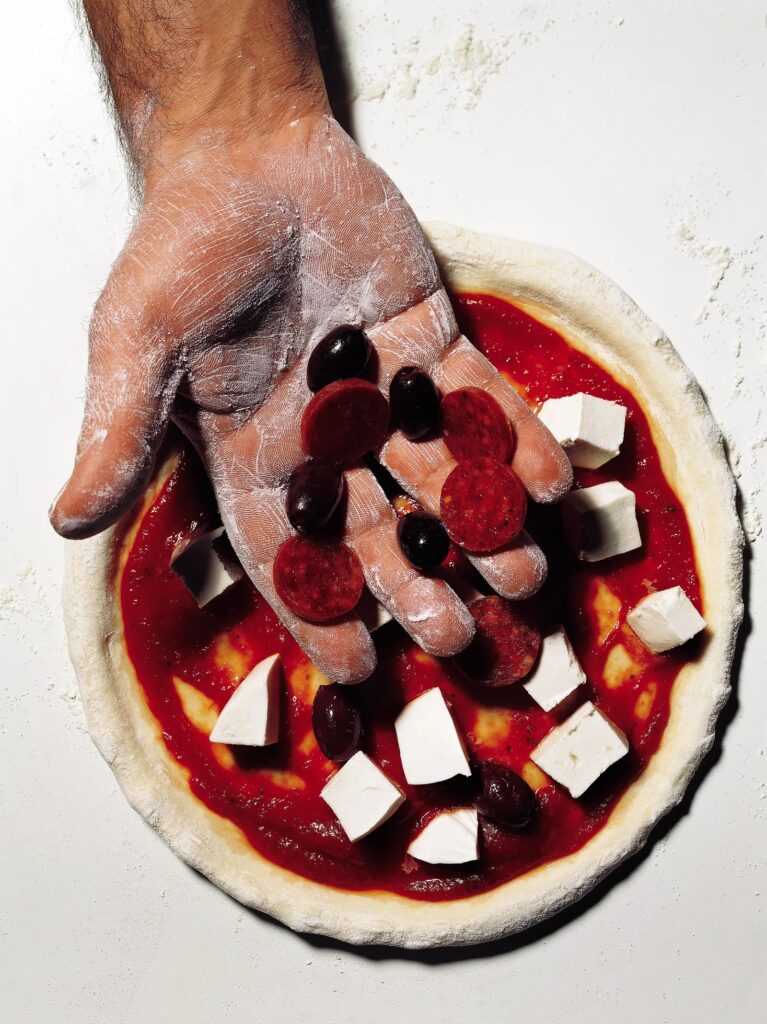
Today, it is loved by all – especially the young. Pizza delivery has become a profession, though this too evolved: now, we simply order pizza online and have it delivered. Or you can buy frozen pizza at the supermarket, or fresh by the slice in shopping streets. Under various brand names that either refer to Italy (e.g. Pizza Ristorante, Casa) or to the US (New York Pizza), you can find a wide variety of fast-food pizzas in almost every city in the Western world and beyond. True enthusiasts bake their own, often with supermarket dough. In addition, Italian restaurants all over the world serve pizza alongside pasta. The traditional Neapolitan wood-fired oven has been restored in many places, and pizza is embellished with Italian elements that were not originally included, such as pesto, Parma ham, truffle, and multiple cheeses. In a roundabout way, pizza has become ‘Italian’ again. Moreover, an upscale pizza culture has emerged – with chic restaurants serving small pizzas topped with caviar, reminiscent of blinis.
Although pizza portions have become larger in its incarnation as fast food, and each bite contains more calories, not everything is getting bigger. Cherry tomatoes and miniature cucumbers have also arrived. A development that reflects our changing eating habits: we no longer always eat at the dinner table but increasingly on the go or in front of a screen. Modern humans have more eating moments per day. Hence the popularity of non-drippy food: alongside pizza and burgers, we have wraps, rolls, and sushi – finger food you can eat with one hand while scrolling with the other.
We also see the coexistence of popular and elite food in the hamburger, which in its chic reincarnation is now prepared sous-vide by chefs. But pizza and hamburgers are not alike. The hamburger originated as a highly uniform dish for the middle class in the suburbs of American cities at the beginning of the last century. The transformation to vegetarian versions like soy burgers is recent, whereas pizza was originally vegetarian. The opening of hamburger restaurants in places such as Moscow and Beijing led to long queues of young people craving a taste of the West. Much more than pizza, the hamburger has become a symbol of capitalism – provoking fierce reactions in Italy (where anti-fast food became slow food) and in India (where Hindu parties campaign against meat). Pizza and hamburgers have in common that they constantly reinvent themselves, mirroring developments in society. Not everything is reflected there: pizza is easy to find in a vegetarian version, but rarely vegan or organic. The flour used in the dough is seldom organic – it’s simply too expensive for fast food.
‘Ingredients and recipes are migrants too, constantly adapting’
Few consumers realise what goes into making a pizza. Farmers and gardeners, grain mills, and factories supplying ingredients, others assembling them into semi-finished products, further producers responsible for the final goods, transport and distribution companies, supermarkets, chefs – even the pizza you buy from the corner shop involves hundreds of people across numerous countries (a fact highlighted by current trade disputes). In such complex supply chains, it is nearly impossible to trace every ingredient’s origin and method of production. In the 21st century, we can safely assume that nearly everything on our plate comes from elsewhere and has undergone multiple transformations. Take tomato purée, for example: it is made from rejected tomatoes that are blended and preserved, the fruit itself possibly imported depending on the season. Mozzarella, increasingly made from cow’s rather than buffalo milk, is often produced by migrant workers from outside Europe, using refrigeration equipment that often comes from the Far East. Pizza, like sausage or the hamburger, can serve as a vehicle for leftover carcass meat from abattoirs – a practice that, incidentally, helps reduce food waste. Every stage, from dough-making to topping, requires both human labour and machines.
This complexity clashes with the desire – especially among Western consumers – for the authentic, the local, the small-scale. A nostalgia for pre-industrial food production that is presumed to be fairer and better for people and planet. Largely an illusion, yet pizza culture invokes it as readily as, say, the dairy industry. PIZZA RUSTICA – or ‘old-fashioned country pizza’ – often appears on packaging. Much of what we eagerly embrace as authentic or traditional is, in fact, quite recent.
Since the dawn of agriculture, the quest for food has gone hand-in-hand with the quest for knowledge. Efforts to mitigate unpredictable weather, drought, and cold; the search for the best seeds and livestock; the observation of pests from birds to fungi; and the growing need to allocate land and irrigation water all contributed, within a few millennia, to the invention of writing, accounting, geometry and law. What is edible, tradable, and shippable is now subject to strict rules in most countries. Regulatory bodies and laws exist nearly everywhere, as do international agreements on composition and naming. These do not create uniformity – the range of foods continues to expand – but can foster trust and predictability.
Even though we now know infinitely more about agriculture and food than when pizza first arose, the search is never over. Science is always a matter of evolving insight, as with changing views on cholesterol (once a dietary villain, now only a concern for high-risk groups). Knowledge, rules, and beliefs about food have existed for millennia. Today, however, scientific knowledge is criticised and ‘supplemented’ by influencers – often with half-truths or outright falsehoods. In our age of abundance, any sense of certainty seems welcome to consumers – whether it’s myths about probiotics or green smoothies. Food, so closely tied to health and beauty, is fertile ground for social trends and emerging traditions.
And then, just when you think we know all there is to know about pizza, a new wall painting is discovered in the ruins of Pompeii. In that city near present-day Naples, destroyed nearly two thousand years ago by the eruption of Vesuvius, a fresco has been uncovered in a villa that also housed a bakery. It depicts what appears to be silver platter holding a round, flat baked good. Experts suggest it as a pizza, topped with something resembling Roman herb cheese. Beside it: a glass of wine, a date and a pomegranate. Not poor man’s fare, but a depiction of a guest ritual known from Hellenistic times. Naples may therefore be the birthplace not only of the humble pizza bianca, but also of its more luxurious counterpart.
There is no better way to look at our history than through the lens of food. Everything that defines us as a human species is reflected in what and how we eat. No symbol is as powerful as food – a literal matter of life and death. Our ingenuity, our migrations, our ability to transform dishes, our cultural adaptations and the meanings we attach to them all shape what we eat. Whether we think about it or not, anyone who buys, prepares, or eats food is part of the long chain linking the first farming communities to today’s most advanced food factories, staffed by a nameless workers and equally nameless researchers and policymakers. Ingredients and recipes are migrants too, constantly adapting. Food is never static; it is always a dialogue with others, here and elsewhere.
Meanwhile, we await the first 3D-PRINTED PIZZAS, topped with healthy, disease-resistant tomatoes and plant-based ‘cheese’ enhanced through precision genetics. Or, for the adventurous, perhaps with ‘meat’ made from insects. Pizza agli insetti – will it ever happen? Until then, the simplest, crispiest pizza bianca remains a work of art in its own right.
Irving Penn (1917-2009) was one of Vogue’s leading photographers for more than sixty years. With a painter’s eye, he elevated the banal to the exquisite – especially in his food still lifes, where he was a perfectionist. ‘If we were photographing a hand holding a pizza, it had to be the pizza-maker’s hand,’ said his close collaborator Phyllis Posnick.
Recent stories
-
![Wolfgang Tillmans, Inner City Apple Tree, 2004]()
BREAKING #333: An orchard for the future
-
![]()
Which room did you fall in love with?: Send us your all-time favourite cinematic room
-
![]()
BREAKING #332: In love with a room
-
![De studio van Carlo Maria Morsiani, Modena, juli 2026 | foto: Nicole Ex]()
BREAKING #331: The shape of clouds
-
![Shopwork magazine issue 01]()
Treasure Hunt #5: Make your own designer clothes
-
![]()
The Body of Water: Endlessly circulating
-
![]()
1,2,3 under the apple tree: Make your own herman de vries
-
![]()
Li’s Forecast #10: The creative custodian
-
![]()
Cape Town & The Karoo: Travel Diary
-
![]()
Any Body there?: An exhibition-on-paper curated by Marlene Dumas
-
![Vincent van Gogh, IJsvogel aan de waterkant, 1886]()
Treasure Hunt #4: An app for bird lovers
-
![]()
-
![]()
-
![Poster van de cover van See All This #42 | foto: Katerina Bezedei]()
BREAKING #325: See All This is censored
-
![Launch of See All This #42, Café Fonda, Stedelijk Museum, Amsterdam | Photo Katerina Bezedei, clothing Nicole: Cortana]()
See All This #42 – The Body: Launch speech by Nicole Ex
-
![]()
-
![]()
Labourland: Stories from the Womb
-
![]()
A Red-Hot Handbook: A hands-on guide to pleasure
-
![]()
Any Body There?: An essay by Marlene Dumas
-
![]()
Editorial #42: They blush, dissolve, desire