Cooking with Li Jin
From a Chinese Classic
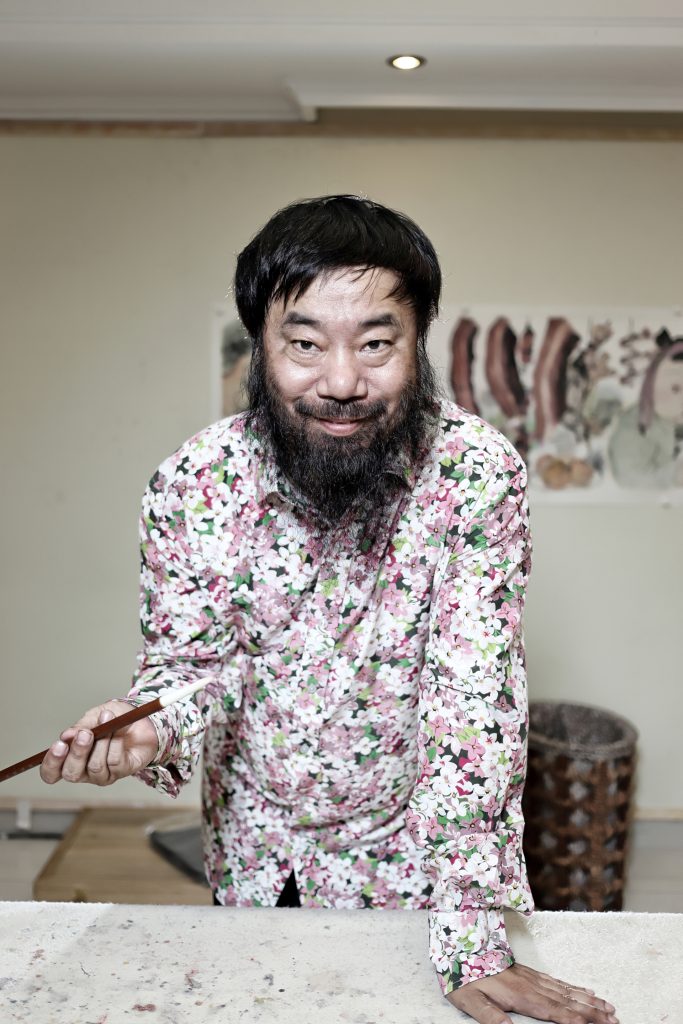
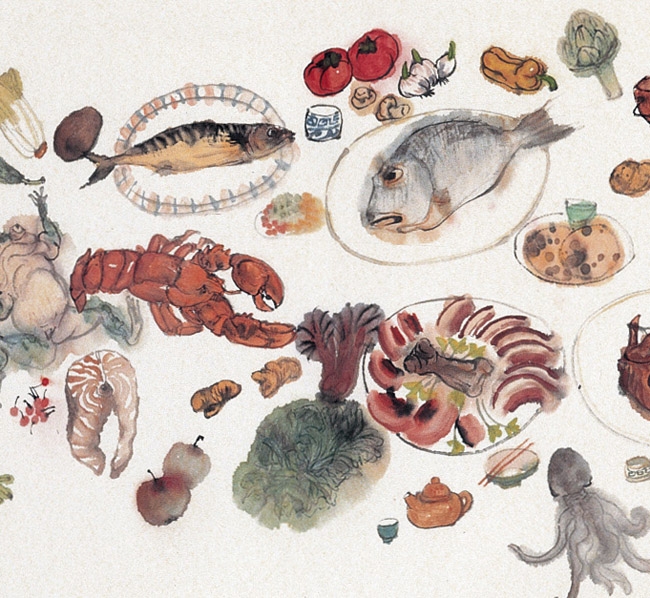
A parade of squid, tubers and lobsters marches across Li Jin’s drawn feast. You’ll also find the ways these ingredients are prepared: in calligraphy, Li Jin records recipes from Yuan Mei’s Suiyuan Shidan, a classic of Chinese cuisine.
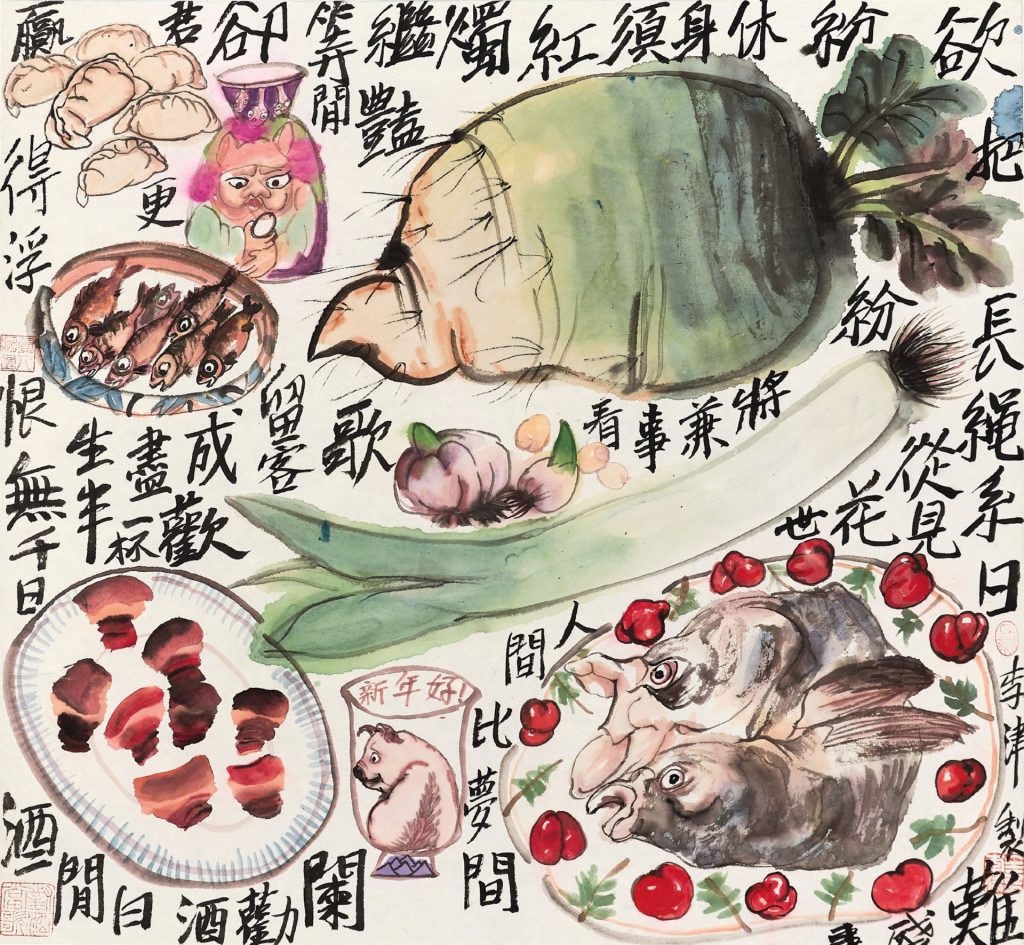
Yuan Mei (1716–1798) was an obsessive and fervent eater. According to the Chinese poet, food was one of nature’s most sensational gifts; to deny oneself its pleasures would be an insult. So whenever he encountered a spectacular meal, he would send his cook to recreate the dish. He then wrote out the recipe, adding his own commentary.
All those notes eventually led to a book, the Suiyuan Shidan, the first edition of which was printed in 1792. It became the great classic of Chinese gastronomy – a classic that inspired not only chefs but also artists. Among them Li Jin (b. 1958), who, like Yuan, shares a weakness for earthly pleasures. In his drawings of lavish banquets – in which he often appears himself, accompanied by voluptuous women – the centuries-old recipes reappear in Chinese calligraphy.
Now that Yuan’s exegesis has finally been translated into English, anyone can become versed in traditional Chinese cuisine. Or perhaps not: for some, the recipes in Recipes from the Garden of Contentment may feel like a bridge too far, with no listed measurements and an exceedingly concise method. So let us begin with a few essential do’s and don’ts. Because, as Yuan tells us, just as in science, we must first understand things before we can put them into practice.
YUAN’S DO’S AND DON’TS
- Work only with the best ingredients. The quality of the dish is 60% determined by the chef and 40% by the person who buys the groceries.
- Begin drinking only after the meal. If your guests are too drunk to speak, how can they discern flavors?
- If your guests have drunk too much and become sluggish, serve sweet and sour food to give them a boost.
- Always give compliments or constructive criticism to cooks. Otherwise, they will become lazy and indifferent.
- Every ingredient has unique properties. Do not force or exaggerate these for personal gain (read: boasting about your cooking skills).
- When your guests are almost full, serve spicy dishes to restart their appetite.
Recent stories
-
![]()
BREAKING #307: ‘We are in what passes away’
-
![]()
BREAKING #306: ‘I’m not a performing monkey’
-
![]()
BREAKING #305: It grew dark, but we didn’t need any light.
-
![]()
Li’s Forecast #8: Patterns in textile
-
![]()
Asma’s Beauty Case: ‘Who am I actually working for?’
-
![David Claerbout The Woodcarver and the Forest]()
There’s No Movement Without Friction: Director David Claerbout on ‘The Woodcarver and the Forest’
-
![Magdalene Odundo, Untitled #7 (1994)]()
BREAKING #304: ‘If you have not stood face to face with something, it has simply not truly been known by you.’
-
![]()
BREAKING #303: ‘That dizzying, hopeless procession of transformations’
-
![Judy Chicago, Peeling Back, 1974. Jordan Schnitzer Family Foundation Collection. - Judy Chicago, Peeling Back, 1974. Offset fotolithografie op ragpapier, 72,39 × 55,88 cm. Collectie Jordan Schnitzer Family Foundation. © Judy Chicago / Artists Rights Society (ARS), New York. Foto © Donald Woodman / ARS, NY. Courtesy of the artist]()
The Making Of:: Judy Chicago in Amsterdam
-
![1-54 Contemporary African Art Fair Marrakech]()
Morocco: a playground for progressive art: 1-54 in Marrakech
-
![Smileys van Maria Roosen]()
Li’s Forecast #7: Solid Energy
-
![]()
Chef’s Favourites: Books, films, restaurants and recipes
-
![Alymamah Rashed in haar studio | © Mateusz Stefanowski, courtesy Dior]()
A landscape, archive and statement: The iconic Lady Dior reimagined by artists
-
![The Islington Twins in front of Rembrandt's Nightwatch at the Rijksmuseum, Amsterdam, 7 December 2025]()
A Weekend with The Twins: In Amsterdam
-
![Chef Mory Sacko, guest-curator of See All This #40, wearing one of the hand-painted aprons at See All This' Dinner Party, 6 December 2025 | photo: Katerina Bezede]()
A Taste of Mory’s Magic: Recreate His Festive Soup Dish at Home
-
![The Islington Twins for Burberry]()
Fruits, Fats & Fundaments: Lessons in Nutrition from the Streets of London
-
![The Dinner Party, 6 december 2025, Felix Meritis Amsterdam | foto: Katerina Bezede]()
The Dinner Party: 10 Years See All This
-
![]()
The Gentle Radicalism of Eating Together: A Night with The Macallan at Flore
-
![Nicole Ex tijdens haar speech, The Dinner Party, See All This, 6 december 2025]()
10 years of See All This: ‘Do you like the party?’
-
![Joseph Beuys, Fat Chair, 1964, fat, wax, barbed wire, wooden chair, 41.6 x 94.5 cm]()
Feeding the Eye: A Visual Banquet