Against Ordinary Language: The Language of the Body
An essay by Kathy Acker
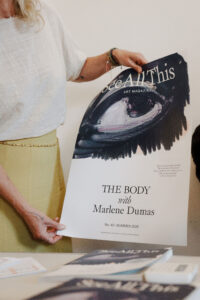
What happens to language when the body takes over? In the wider context of See All This #42 — The Body with Marlene Dumas, we turn online to the avant-garde writer Kathy Acker, whose work was radical, experimental and fiercely original.
In the early 1980s, Acker discovered weightlifting and soon found herself training with the pioneering female bodybuilder – and Robert Mapplethorpe muse – Lisa Lyon. As she immersed herself more deeply in that world, bodybuilding began to shift into an art project: a way of thinking through the body, and of learning beyond, or even against, ordinary language. But writing about what she was experiencing in the gym was not straightforward. She sensed she had entered a rich and complex world, yet her body resisted conventional expression. ‘What does language in that place look like?’ she asked. ‘What actually takes place when I bodybuild?’ Below, we publish a selection from her essay Against Ordinary Language: The Language of the Body (1993).

Preface Diary
I have now been bodybuilding for ten years, seriously for almost five years. During the past few years, I have been trying to write about bodybuilding. Immediately after each workout, I would describe all I had just experienced, thought and done. Such diary descriptions would provide the raw material. After each workout, I forgot: to write. Repeatedly. I…some part of me…the part of the ‘I’ who bodybuilds… was rejecting language, any verbal description of the processes of bodybuilding. I shall begin describing, writing about bodybuilding in the only way that I can: I shall begin by analyzing this rejection of ordinary or verbal language. What is the picture of the antagonism between bodybuilding and verbal language?
A Language Which is Speechless
Imagine that you are in a foreign country. Since you are going to be in this place for some time, you are trying to learn the language. At the point of commencing to learn the new language, just before having started to understand anything, you begin forgetting your own. Within strangeness, you find yourself without a language. It is here, in this geography of no language, this negative space, that I can start to describe bodybuilding. For I am describing that which rejects language. […] I am in the gym every three out of four days. What happens there? What does language in that place look like? According to cliche, athletes are stupid. Meaning: they are inarticulate. The spoken language of bodybuilders makes this cliche real. The verbal language in the gym is minimal and almost senseless, reduced to numbers and a few nouns. ‘Sets’, ‘squats’, ‘reps’,… The only verbs are ‘do’ or ‘fail’ adjectives and adverbs no longer exist; sentences, if they are at all, are simple. […]
What happens during these minutes is that I forget. Masses of swirling thought, verbalized insofar as I am conscious of them, disappear as mind or thought begins to focus. […] Bodybuilding is a process, perhaps a sport, by which a person shapes her or his own body. This shaping is always related to the growth of muscular mass. During aerobic and circuit training, the heart and lungs are exercised. But muscles will grow only if they are, not exercised or moved, but actually broken down. The general law behind bodybuilding is that muscle, if broken down in a controlled fashion and then provided with the proper growth factors such as nutrients and rest, will grow back larger than before. In order to break down specific areas of muscles, whatever areas one wants to enlarge, it is necessary to work these areas in isolation up to failure. Bodybuilding can be seen to be about nothing but failure. A bodybuilder is always working around failure. Either I work an isolated muscle mass, for instance one of the tricep heads, up to failure. In order to do this, I exert the muscle group almost until the point that it can no longer move. […]
I want to shock my body into growth; I do not want to hurt it. Therefore, in bodybuilding, failure is always connected to counting. I calculate which weight to use; I then count off how many times I lift that weight and the seconds between each lift. This is how I control the intensity of my workout. […] What do I do when I bodybuild? I visualize and I count. I estimate weight; I count sets; I count repetitions; I count seconds between repetitions; I count time, seconds or minutes, between sets: From the beginning to the end of each workout, in order to maintain intensity, I must continually count. For this reason, a bodybuilder’s language is reduced to a minimal, even a closed, set of nouns and to numerical repetition, to one of the simplest of language games. Let us name this language game, the language of the body. […]

The Richness Of The Language Of The Body
[…] Here is the language of the body; here, perhaps, is the reason why bodybuilders experience bodybuilding as a form of meditation. ‘I understood the seduction there is in a life that reduces everything to the simplest kind of repetition,’ Canetti says. A life in which meaning and essence no longer oppose each other. A life of meditation. ‘I understood what those blind beggars really are: the saints of repetition…’ […]
The Repetition Of The One: The Glimpse Into Chaos Or Essence
I am in the gym. I am beginning to work out. I either say the name ‘bench press’, then walk over to it, or simply walk over to it. Then, I might picture the number of my first weight; I probably, since I usually begin with the same warm-up weight, just place the appropriate weights on the bar. Lifting this bar off its rests, then down to my lower chest, I count ‘1’. I am visualizing this bar, making sure it touches my chest at the right spot, placing it back on its rests. ‘2’. I repeat the same exact motions. ‘3’… After twelve repetitions, I count off thirty seconds while increasing my weights. ‘1’… The identical process begins again only this time I finish at ‘10’… All these repetitions end only when I finish my work-out. […]
For instance, yesterday, I worked chest. Usually I easily benchpress the bar plus sixty pounds for six reps. Yesterday, unexpectedly, I barely managed to lift this weight at the sixth rep. I looked for a reason. Sleep? Diet? Both were usual. Emotional or work stress? No more than usual. The weather? Not good enough. My unexpected failure at the sixth rep was allowing me to see, as if through a window, not to any outside, but inside my own body, to its workings. I was being permitted to glimpse the laws that control my body, those of change or chance, laws that are barely, if at all, knowable. By trying to control, to shape, my body through the calculated tools and methods of bodybuilding, and time and again, in following these methods, failing to do so, I am able to meet that which cannot be finally controlled and known: the body. In this meeting lies the fascination, if not the purpose, of bodybuilding. To come face to face with chaos, with my own failure or a form of death.
Canetti describes the architecture of a typical house in the geographical labyrinth of Marrakesh. The house’s insides are cool, dark. Few, if any, windows look out into the street. For the entire construction of this house, windows, etc., is directed inward, to the central courtyard where only openness to the sun exists. Such an architecture is a mirror of the body: When I reduce verbal language to minimal meaning, to repetition, I close the body’s outer windows. Meaning approaches breath as I bodybuild, as I begin to move through the body’s labyrinths, to meet, if only for a second, that which my consciousness ordinarily cannot see. In our culture, we simultaneously fetishize and disdain the athlete, a worker in the body. For we still live under the sign of Descartes. This sign is also the sign of patriarchy. As long as we continue to regard the body, that which is subject to change, chance, and death, as disgusting and inimical, so long shall we continue to regard our own selves as dangerous others.
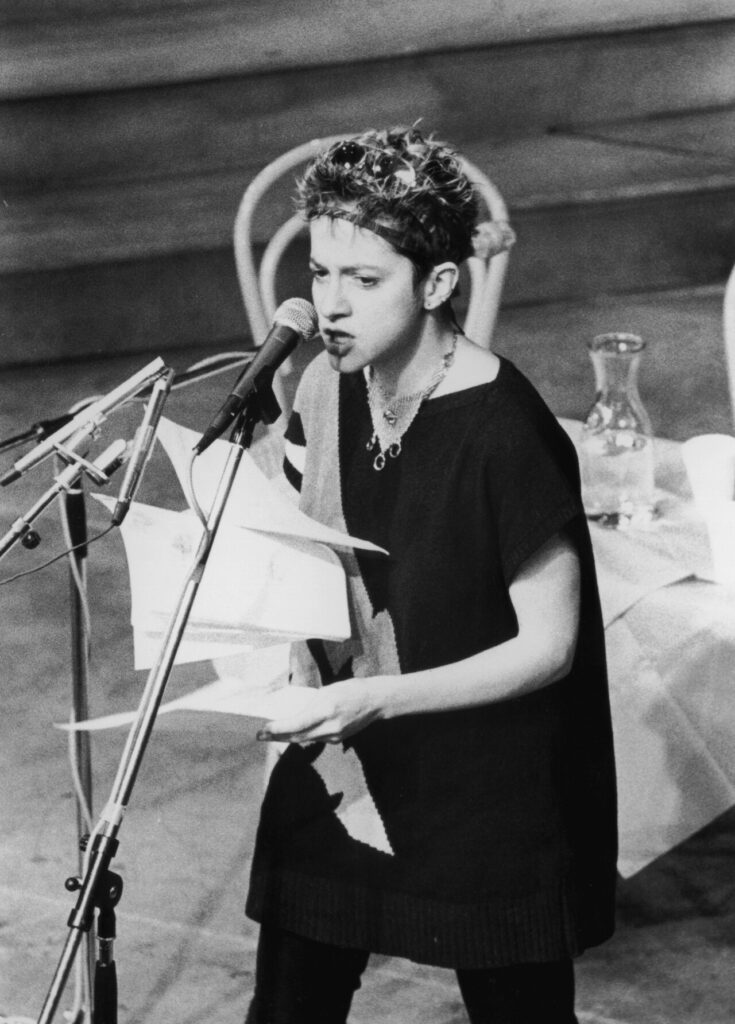
Against Ordinary Language: The Language of the Body was published in 1993 in The Last Sex: Feminism and Outlaw Bodies (edited by Arthur Kroker and Marilouise Kroker), published by Macmillan. With thanks to Matias Viegener and the Kathy Acker Literary Trust. Read the full text here.
If you want to dig deeper into Kathy Acker, the exhibition Blood, Guts, and Anarchy: The Work of Kathy Acker brings together the radical literary universe of the American avant-garde writer in West (the former American Embassy in The Hague) from 28 February 2026 to 28 February 2027.
Recent stories
-
![]()
Li’s Forecast #10: The creative custodian
-
![]()
Cape Town & The Karoo: Travel Diary
-
![]()
Any Body there?: An exhibition-on-paper curated by Marlene Dumas
-
![Vincent van Gogh, IJsvogel aan de waterkant, 1886]()
Treasure Hunt #4: An app for bird lovers
-
![]()
-
![]()
-
![Poster van de cover van See All This #42 | foto: Katerina Bezedei]()
BREAKING #325: See All This is censored
-
![Launch of See All This #42, Café Fonda, Stedelijk Museum, Amsterdam | Photo Katerina Bezedei, clothing Nicole: Cortana]()
See All This #42 – The Body: Launch speech by Nicole Ex
-
![]()
-
![]()
Labourland: Stories from the Womb
-
![]()
A Red-Hot Handbook: A hands-on guide to pleasure
-
![]()
Any Body There?: An essay by Marlene Dumas
-
![]()
Editorial #42: They blush, dissolve, desire
-
![]()
The President’s Body: How power takes shape
-
![]()
More than meets the eye: A super short history of eyeliner
-
![]()
‘I Begin with the Body as It Is’: In conversation with Rosa Esteva
-
![]()
William Forsythe: ‘The Body never lied to me’
-
![Award-winning issue See All This #42, Cooking is Caring, with chef Mory Sacko as guest curator.]()
See All This wins SPD Award!: Independent Publishing Design – Entire Issue
-
![]()
-
![]()
BREAKING #323: What matters here is focus