The right to cheat
Interview with Iris Häussler
Nothing is as important or as real to Iris Häussler (b. 1962) as the characters she invents – with their living spaces, their work, their collections. The ideal outcome? That visitors refuse to believe it is all fiction. That they call her a thief, a trickster.
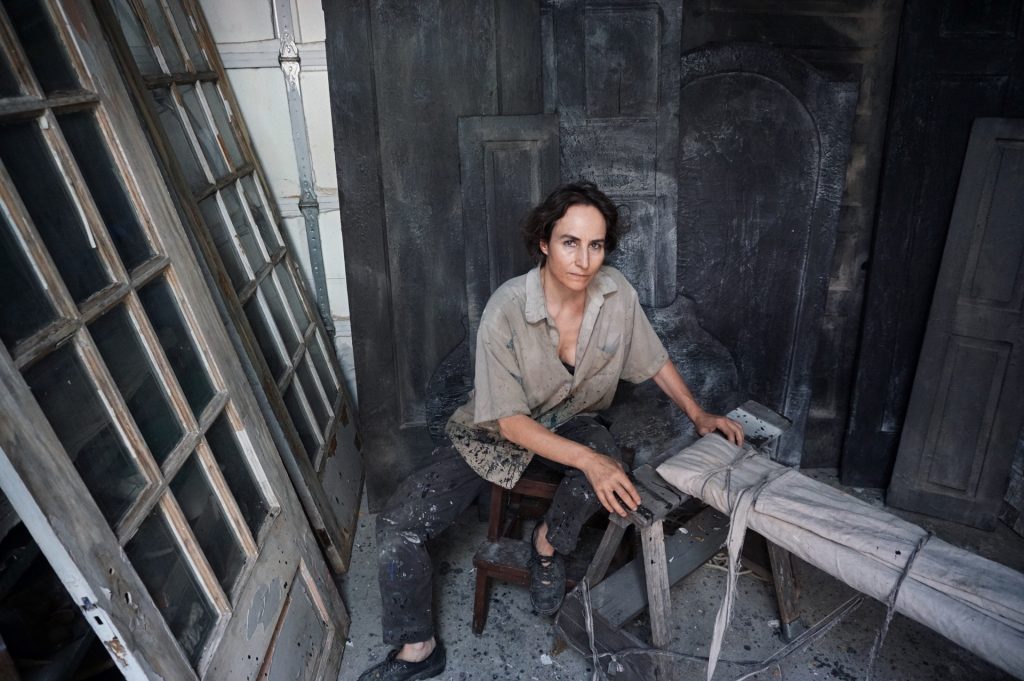
I hesitated – had I been unclear, had I misunderstood? When she asked whether I wanted to test the phone connection, she mentioned a date far in the future. Cautiously, I texted her to check if she had circled the right month. I could picture her smiling at that message: Iris Häussler, born in Germany, in her large Canadian studio – a space you could just as well call a warehouse – crammed with pieces of unfinished metal, chunks of stone, piles of clothes, and rows of folders and files. Lifeless objects that she will place into the lives of people who never existed, except in her mind, perhaps even in her heart. She replied: the month she had given me was fiction.
And so the game begins, I typed back. In the days that followed, that choice of words kept echoing in my mind. It is common to call art in which fiction and reality intertwine ‘a game’, but is that accurate?
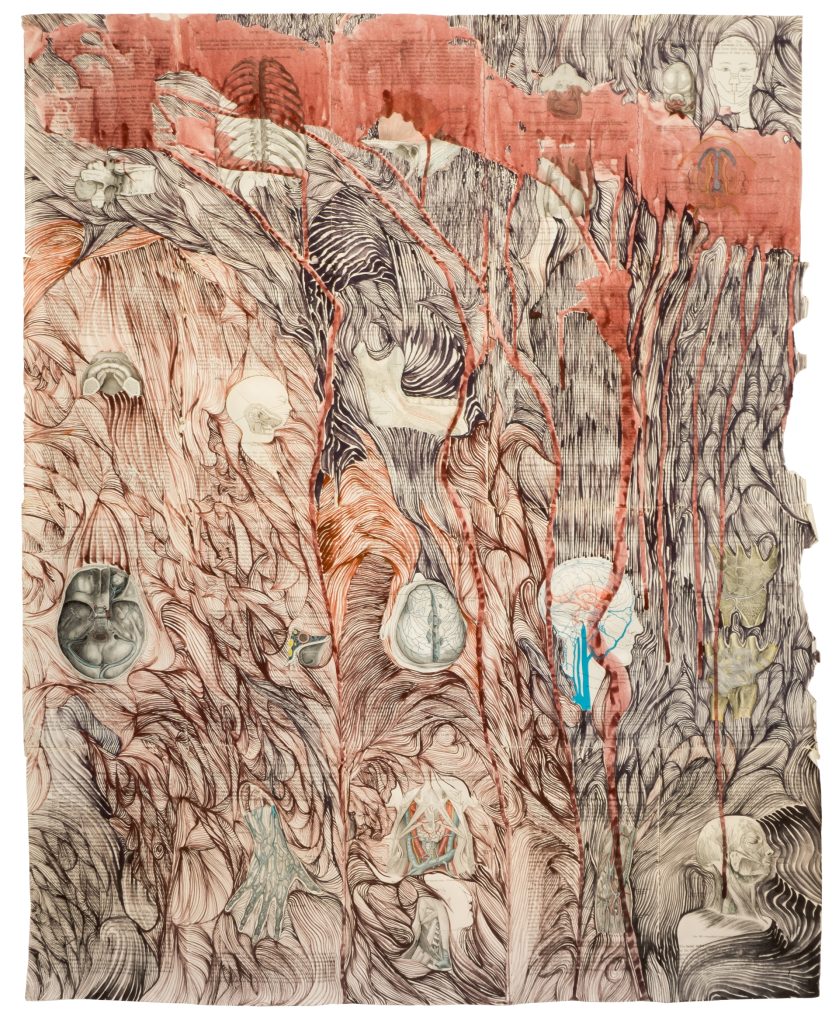
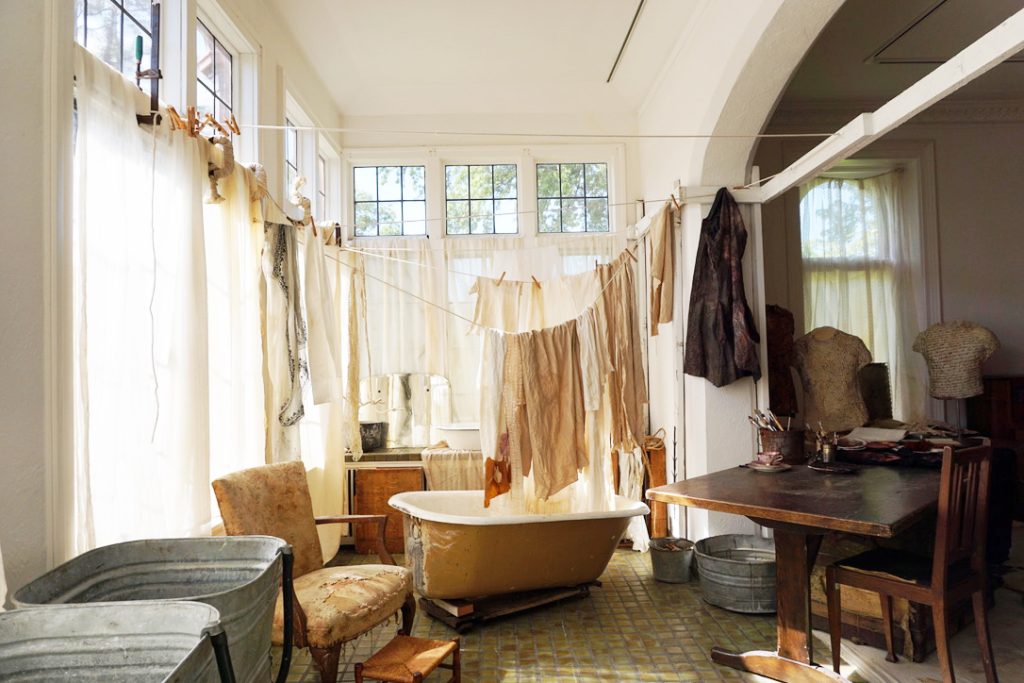
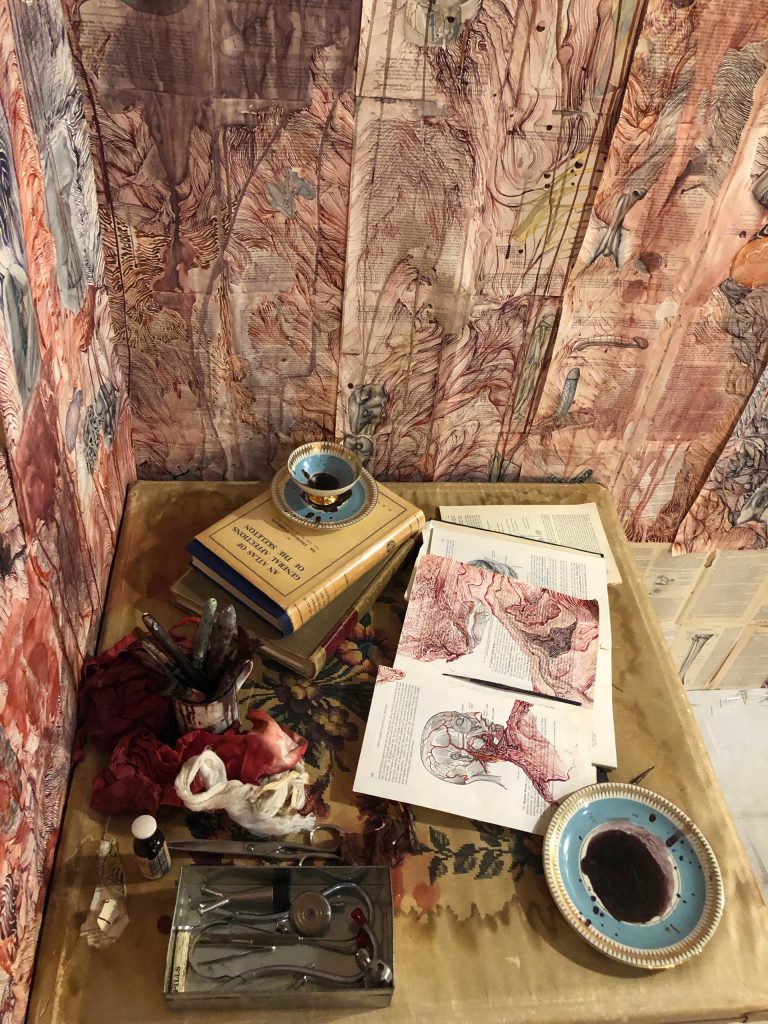
A game depends on two things: that the players know they are ‘only playing’, and that there are rules. I recognise neither of these elements in Häussler’s work. Not in her early piece Ou Topos (1989), in which she filled an apartment with canned food wrapped in lead foil, stacked on old wooden shelves. She created an environment in which visitors believed they saw the remnants of a real life – a poor, marginal, but honest life, lived by someone terrified of nuclear fallout. (Before the installation opened, Häussler lived in the apartment for six months to fully inhabit the space.) Nor do I see that element of play in later work such as The Sophie La Rosière Project (2016–2017), in which Häussler reconstructed the studio of Sophie La Rosière, a fictional lesbian French artist from the twentieth century.
permission to be naïve
How did it all begin, this creation of characters? As a child, she says over the phone – in her gentle American English, with that slight German accent that makes ‘visitor’ sound like ‘wizard’ – she would knead little figures from the white bread of her sandwiches, tiny people enacting scenes on a round, flat porcelain stage. She herself does not remember it, but her brothers and sisters do. Still, she thinks people should be careful about assigning absolute value to memories. ‘If five people experience the same thing, they all remember it differently. “Do you remember when Mum did this or that?” And then someone says: “Mum? No, that was the babysitter!” Someone else: “It was the neighbour!” Memories are constructs, fiction is the glue that holds everything together. I am not interested in fiction, but in truth. In traces. In evidence. In what people leave behind.’
Her characters do not begin as an idea, not as a concept, but as a desire – the desire to move freely into another way of experiencing the world, something she would otherwise never dare. ‘Without permission to be naïve, obsessed, endlessly curious, I cannot work. You could say that I create my characters, but you could just as well reverse the logic. I need them just as much as they need me. Each character carries something that needs to be told, but that cannot be told by him or her directly. I recognise that very strongly. Things have happened in my own life that I will never address head-on. I need alternative selves that allow themselves to be used by me, and that in turn use me.’ Online, photographs circulate of Iris at work. Dark eyes under dark eyebrows. When she looks into the camera, you see utter concentration, but her gaze also conveys something else – a mild disappointment that makes it clear: if you are mainly interested in me, you do not really understand my work.
TRUE FICTION
It is an organic and gradual process – from the abstract desire to explore a way of living, thinking or feeling, to a shadow, from a shadow to a fully fledged character with a detailed biography, and then to the lifelike ‘evidence’ of that biography: the actual physical traces of that character’s ‘life’. Historically, those traces must be completely accurate, which is why she calls on historians, experts and specialists. When it emerged that the traces of Amber, from the work He Named Her Amber (2008), about the life of a seventeen-year-old maid in 1828, contained historical inaccuracies, Häussler immediately made the necessary corrections. It may be fiction, but there is still one rule: it must be something that could have happened.
Are those all the rules? No. The character cannot be a star, a celebrity, not someone whose story has already been told. ‘They are underdogs, the voiceless, who suffer from discrimination and poverty. They lived in hiding.’ It recalls how the poet Czesław Miłosz once described poets as secretaries of the invisible. As a secretary, Häussler is occupied with making that invisible tangible. But that poetic image does not fully cover the reality. To make the invisible tangible, a lot of manual work is required. ‘What makes up a biography? Gender matters, year of birth, historical and economic circumstances – but also the generation they belong to, their physical condition, their appearance, their place in the family, their education, social status; so many elements come into play. To truly give someone form, you have to know everything.’
Alongside meticulous research, Häussler tries to sense, even to partially live, the lives of her characters. When she brought Joseph Wagenbach, born in 1929, to life, she developed back pain and shuffled around like an old man. Her children no longer wanted friends to come over, because their former playroom had been annexed by Joseph. The neighbours’ daughter told people that Häussler was in a relationship with an elderly man – which, in a way, she was, even if this old man did not exist in any civic registry. When she breathed life into Sophie La Rosière, she herself entered into a relationship with a woman. ‘It wasn’t planned, it just happened. And when the project ended, the relationship ended too.’
It wasn’t me
‘Everything is a portrait,’ Lucian Freud once said, ‘everything is autobiographical.’ That statement seems to stand in direct contradiction to the title of Häussler’s first survey catalogue (covering 1989 to 2001): It Wasn’t Me. But Häussler herself disagrees. ‘Freud and I mean exactly the same thing. Take Francis Bacon. The way Bacon represented the world, with all those contorted layers that never fully belonged to what they depicted. Because of that, you can never say: Bacon meant this, Bacon was like this or that. And yet you can’t deny that Bacon’s work is unique and deeply personal – every canvas contains a part of him. Even when you describe others, you reveal yourself; you never fully escape that.’
Isn’t it incredibly hard, then, to let go of these characters once they have been conceived, lived through and worked out in such detail? Häussler: ‘Art unfolds in phases, just like life. Those phases are very different, but they all stem from the same being.’ She pauses, forcing herself to be completely honest. ‘But all reflections aside, yes, I do find it difficult. That’s why my characters never die. They have no date of death – I simply let them disappear, I return them to the invisible.’
But she does not return everyone, not entirely. There is one exception: Joseph Wagenbach. ‘He is endlessly complex, I can wander in him forever. And in a way, he stands for my parents, who never spoke about the past, who seemed to have left no traces at all. Only when I learned about the Holocaust at school did I understand. People of those generations hoarded everything, just like Joseph, who had been too young to be conscripted but old enough to consciously live through the war years. After the war, Joseph withdrew from the world to make sculptures. All that pent-up, frozen energy was released for him through art. Joseph has a story that must be told. The other characters feel perhaps a little further away – or maybe I should say that with them I experience more emotional freedom of choice than I do with Joseph.’
Joseph stayed. In fact, he lived with her for years, in the basement, with all his works, all his things. She led interested visitors through that labyrinth of images and traces. Until she could no longer afford it. That is the problem with characters: they don’t pay rent. So Häussler invented a (fictional) foundation to take care of Joseph’s work. She still lights a candle on his birthday, which is neatly marked in her diary.
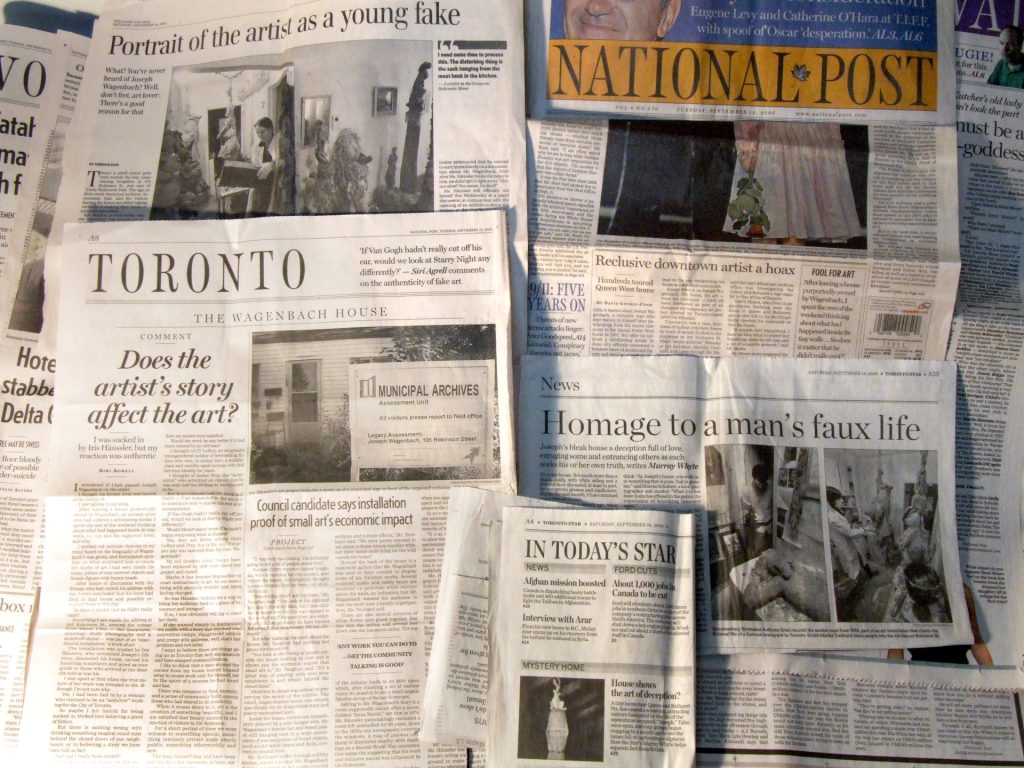
Häussler was not the only one for whom Joseph was real. Where fiction and reality may flow together for artists, others would say they collide. Häussler knows these people, and they know her. When she opened Joseph’s studio to the public in 2006, visitors assumed he had truly existed. When Häussler came clean, the outrage was considerable (not as great as the collective praise, but still). The National Post called it a ‘hoax’, and the Canadian writer Martha Baillie argued that Häussler had had no right to lie to her.
Something similar happened two years later with He Named Her Amber. Häussler presented the exhibition as an archaeological dig, overseen by an institute she had invented. But visitors became so immersed in the project that they collected money, offered to help, and even searched for Amber’s relatives. When they learned that Amber had sprung from Häussler’s imagination, they demanded their money back, cancelled their memberships and sent letters telling Häussler to wash her mouth out with soap. She even received a death threat: ‘I’m gonna kill you, terrible bitch from Holocaust country.’ She suspects it came from someone who had felt deceived after seeing the Wagenbach installation, and then again after He Named Her Amber. Where, she wonders, does this claim people make on the truth come from?
Häussler: ‘People expect labels, they read the little text beside an artwork, nod, move on. They consume. If they don’t see a label – as with my work – they have only themselves to rely on. They invest time and effort, they commit. That is an emotional process. So they develop a sense of ownership that visitors to a conventional exhibition rarely have. When it turns out that the life they are seeing isn’t “real”, they feel shame – that they allowed themselves to be fooled, and by a “friendly” institution like a museum, funded by their taxes. Shame then turns into indignation.’
The museum in question gave Häussler a list of phone numbers of people who had filed complaints. For a year and a half, she would call one of them from time to time. Not out of guilt, but out of curiosity. ‘I think, in hindsight, I wanted a conversation instead of a confrontation. Sometimes they just needed to vent their anger. But once that was done, calm would set in and space would open. Beautiful conversations unfolded, with people I understand and take seriously. I sometimes find the art world too arrogant – as if the motto were: we make it, others may look. But visitors often have much to teach us. For me, the dialogue with them is part of the work.’
A game?
Not at all.
Nothing is as important and as real to Häussler as the lives she invents. And the best outcome: that visitors to her installations refuse to believe it is fiction. That they call her a thief, a trickster. And that they do so with such conviction that she herself begins to doubt and thinks: could it possibly be that this person truly existed?
Recent stories
-
![]()
BREAKING #306: ‘I’m not a performing monkey’
-
![]()
BREAKING #305: It grew dark, but we didn’t need any light.
-
![]()
Li’s Forecast #8: Patterns in textile
-
![]()
Asma’s Beauty Case: ‘Who am I actually working for?’
-
![David Claerbout The Woodcarver and the Forest]()
There’s No Movement Without Friction: Director David Claerbout on ‘The Woodcarver and the Forest’
-
![Magdalene Odundo, Untitled #7 (1994)]()
BREAKING #304: ‘If you have not stood face to face with something, it has simply not truly been known by you.’
-
![]()
BREAKING #303: ‘That dizzying, hopeless procession of transformations’
-
![Judy Chicago, Peeling Back, 1974. Jordan Schnitzer Family Foundation Collection. - Judy Chicago, Peeling Back, 1974. Offset fotolithografie op ragpapier, 72,39 × 55,88 cm. Collectie Jordan Schnitzer Family Foundation. © Judy Chicago / Artists Rights Society (ARS), New York. Foto © Donald Woodman / ARS, NY. Courtesy of the artist]()
The Making Of:: Judy Chicago in Amsterdam
-
![1-54 Contemporary African Art Fair Marrakech]()
Morocco: a playground for progressive art: 1-54 in Marrakech
-
![Smileys van Maria Roosen]()
Li’s Forecast #7: Solid Energy
-
![]()
Chef’s Favourites: Books, films, restaurants and recipes
-
![Alymamah Rashed in haar studio | © Mateusz Stefanowski, courtesy Dior]()
A landscape, archive and statement: The iconic Lady Dior reimagined by artists
-
![The Islington Twins in front of Rembrandt's Nightwatch at the Rijksmuseum, Amsterdam, 7 December 2025]()
A Weekend with The Twins: In Amsterdam
-
![Chef Mory Sacko, guest-curator of See All This #40, wearing one of the hand-painted aprons at See All This' Dinner Party, 6 December 2025 | photo: Katerina Bezede]()
A Taste of Mory’s Magic: Recreate His Festive Soup Dish at Home
-
![The Islington Twins for Burberry]()
Fruits, Fats & Fundaments: Lessons in Nutrition from the Streets of London
-
![The Dinner Party, 6 december 2025, Felix Meritis Amsterdam | foto: Katerina Bezede]()
The Dinner Party: 10 Years See All This
-
![]()
The Gentle Radicalism of Eating Together: A Night with The Macallan at Flore
-
![Nicole Ex tijdens haar speech, The Dinner Party, See All This, 6 december 2025]()
10 years of See All This: ‘Do you like the party?’
-
![Joseph Beuys, Fat Chair, 1964, fat, wax, barbed wire, wooden chair, 41.6 x 94.5 cm]()
Feeding the Eye: A Visual Banquet
-
![Hilma af Klint, De zwaan, serie
SUW/UW, groep IX: deel I, nr. 16, 1915, olieverf op doek, 154,5 × 154,5 cm]()
Why Doctors Are Prescribing Art: 10x When Art Becomes Medicine