Madhvi Parekh
Pretty Brilliant Women in the Arts
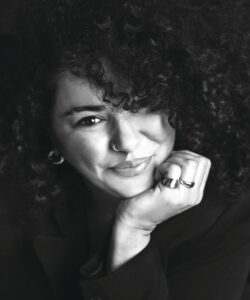
For generations, the story of art has been told through a singular lens. When the first editions of canonical texts like Janson’s History of Art and Gombrich’s The Story of Art were published, they featured zero women artists. The Pretty Brilliant: Women in the Arts series aims to make whole what has long been a one-sided story. In these issues, featuring 583 artists, we celebrate women who have always been creating, innovating, and inspiring, like Madhvi Parekh.
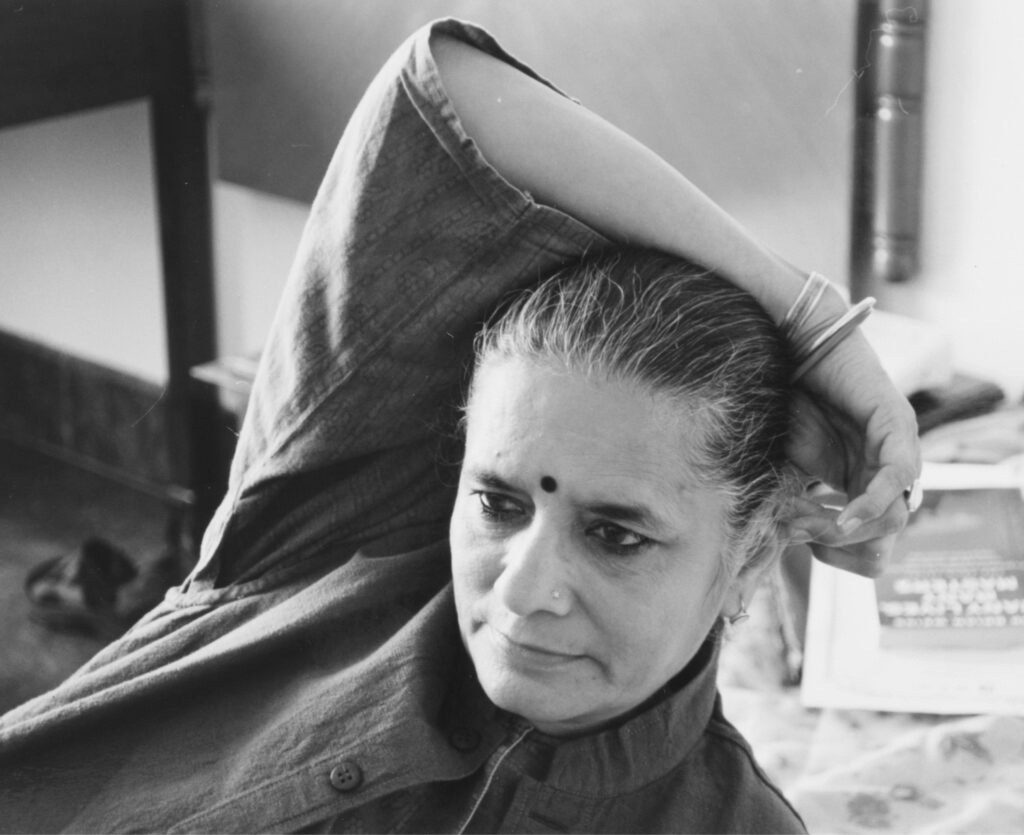
Modernist painter Paul Klee once said: ‘A line is a dot that went for a walk.’ Throughout Madhvi Parekh’s work, dots certainly amble through the vibrant village of Sanjaya, the artist’s childhood home. Born in the Western-coastal Indian state of Gujarat, Parekh’s work echoes the memories of her youth, familial rituals such as intricate rangoli floor designs, and folk motifs.
A relative latecomer on the artistic scene, Parekh began drawing during her pregnancy with her first child. Parekh’s husband Manu, a renowned artist at the time, gifted her a book on drawing exercises by Paul Klee: ‘One day I told my husband that I want[ed] to learn painting and he was elated by the idea. Rather than theorising art, he asked me to draw a circle, a square, a triangle. Before long, these shapes started evolving into distinct forms – a moon, a speaking tree.’
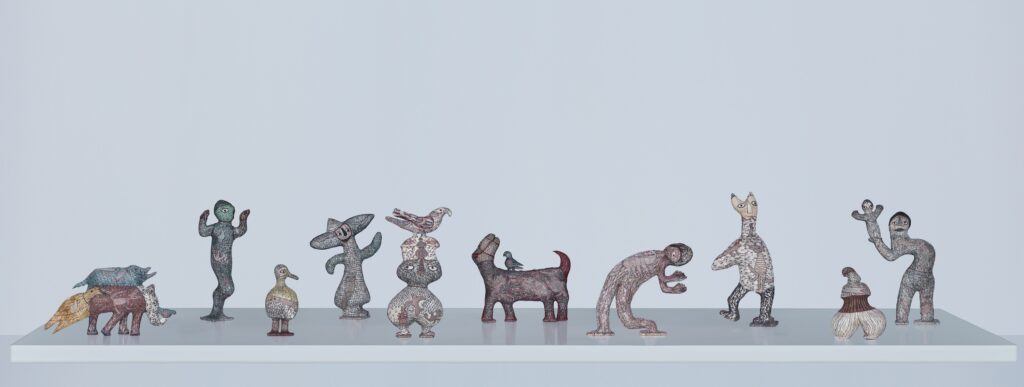
Decades later and the self-taught Parekh has been exhibited across the world. Her work originated as drawings and paintings taking inspiration from local folk legends and figures but these anthropomorphic forms have since evolved off the page.
In collaboration with artisans at the Chanakya School of Craft, Parekh oversaw the production of fantastical creatures, using a papier-mâché technique, which were subsequently embroidered using various intricate needlepoint techniques. These creatures stage a scene exuding a charm reminiscent of children’s fairy tales. Parekh’s style has been compared to that of Paul Klee and even Joan Miro’s in the bulbosity of her figures but while Parekh might have been influenced by the former, her work is unique and endlessly pioneering.
Discover more women artists in the complete Pretty Brilliant Women in the Arts series.
Recent stories
-
![]()
BREAKING #306: ‘I’m not a performing monkey’
-
![]()
BREAKING #305: It grew dark, but we didn’t need any light.
-
![]()
Li’s Forecast #8: Patterns in textile
-
![]()
Asma’s Beauty Case: ‘Who am I actually working for?’
-
![David Claerbout The Woodcarver and the Forest]()
There’s No Movement Without Friction: Director David Claerbout on ‘The Woodcarver and the Forest’
-
![Magdalene Odundo, Untitled #7 (1994)]()
BREAKING #304: ‘If you have not stood face to face with something, it has simply not truly been known by you.’
-
![]()
BREAKING #303: ‘That dizzying, hopeless procession of transformations’
-
![Judy Chicago, Peeling Back, 1974. Jordan Schnitzer Family Foundation Collection. - Judy Chicago, Peeling Back, 1974. Offset fotolithografie op ragpapier, 72,39 × 55,88 cm. Collectie Jordan Schnitzer Family Foundation. © Judy Chicago / Artists Rights Society (ARS), New York. Foto © Donald Woodman / ARS, NY. Courtesy of the artist]()
The Making Of:: Judy Chicago in Amsterdam
-
![1-54 Contemporary African Art Fair Marrakech]()
Morocco: a playground for progressive art: 1-54 in Marrakech
-
![Smileys van Maria Roosen]()
Li’s Forecast #7: Solid Energy
-
![]()
Chef’s Favourites: Books, films, restaurants and recipes
-
![Alymamah Rashed in haar studio | © Mateusz Stefanowski, courtesy Dior]()
A landscape, archive and statement: The iconic Lady Dior reimagined by artists
-
![The Islington Twins in front of Rembrandt's Nightwatch at the Rijksmuseum, Amsterdam, 7 December 2025]()
A Weekend with The Twins: In Amsterdam
-
![Chef Mory Sacko, guest-curator of See All This #40, wearing one of the hand-painted aprons at See All This' Dinner Party, 6 December 2025 | photo: Katerina Bezede]()
A Taste of Mory’s Magic: Recreate His Festive Soup Dish at Home
-
![The Islington Twins for Burberry]()
Fruits, Fats & Fundaments: Lessons in Nutrition from the Streets of London
-
![The Dinner Party, 6 december 2025, Felix Meritis Amsterdam | foto: Katerina Bezede]()
The Dinner Party: 10 Years See All This
-
![]()
The Gentle Radicalism of Eating Together: A Night with The Macallan at Flore
-
![Nicole Ex tijdens haar speech, The Dinner Party, See All This, 6 december 2025]()
10 years of See All This: ‘Do you like the party?’
-
![Joseph Beuys, Fat Chair, 1964, fat, wax, barbed wire, wooden chair, 41.6 x 94.5 cm]()
Feeding the Eye: A Visual Banquet
-
![Hilma af Klint, De zwaan, serie
SUW/UW, groep IX: deel I, nr. 16, 1915, olieverf op doek, 154,5 × 154,5 cm]()
Why Doctors Are Prescribing Art: 10x When Art Becomes Medicine