There’s No Movement Without Friction
Director David Claerbout on ‘The Woodcarver and the Forest’
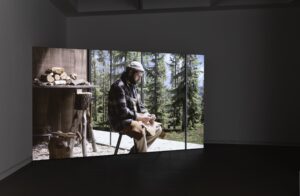
Time has always been a central element in David Claerbout’s film installations. His latest 22-hour film The Woodcarver and the Forest is currently on view at Galerie Annet Gelink in Amsterdam and is at once unhurried and meditative, yet faintly ominous: how long would it take for a woodcarver to turn every tree in a forest into spoons? And what does that say about our own relationship with nature?
Within every tree trunk lies a spoon in the making. Yet not every piece of wood is suitable. You only realise that if you are fortunate enough, while watching Claerbout’s new installation film The Woodcarver and the Forest (2025), to encounter the scene he calls ‘the serial killers’ room’. It is a space inside the large glass house where the titular woodworker has his studio – one you would never expect from the outside: a Bluebeard chamber in which all the discarded spoons have been gathered.
We happen to watch the film together while Claerbout is in Amsterdam for the opening of the exhibition at Galerie Annet Gelink, where the work is being shown in the Netherlands for the first time. Claerbout (Kortrijk, 1969) had previously described the scene somewhat shyly, as though such a morbid fantasy did not quite belong in his meditative film. But now he is pleased: it is one of the ‘easter eggs’ – film jargon for the surprises hidden within the 22-hour work for the attentive and persistent viewer. For there is more in The Woodcarver and the Forest that is not exactly what it seems.
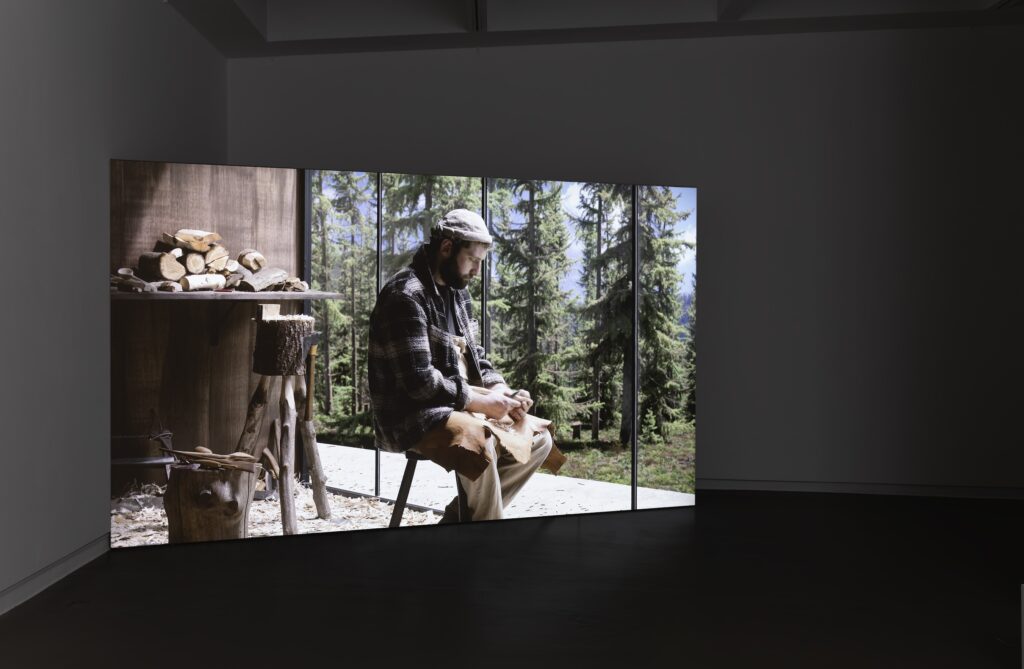
There is more in ‘The Woodcarver and the Forest’ that is not exactly what it seems
In recent years, more of Claerbout’s work has been shown in the Netherlands. Last year, his film installation Birdcage was installed in the Grote Kerk in Alkmaar as a kind of altarpiece, in which a country house exploded in slow motion and silence – only consequence, no cause. At West in The Hague in 2022, his thousand-year film Olympia (The real time disintegration into ruins of the Berlin Olympic stadium over the course of a thousand years) was shown – a live-rendered work in which not only does the light shift every hour, but the future appearance of the film depends on how everything develops – geopolitics, weather, climate. The primal idea behind the new work, he explains, once again stems from his fascination with time, and how the mechanical worldview of clocks and cameras altered not only our sense of time but also our perception.
The Woodcarver emerged during the Covid pandemic, when many people used their surplus time to return to craft and manual labour, from baking bread to pottery. That return to the analogue offered a counterweight to our digital lives, to screen fatigue and the under-stimulation of the tactile. During a residency with S+T+ARTS at Gluon, Claerbout subsequently explored the relationship between AI and the human brain. If AI systems are so dependent on linguistic input, does art made with AI primarily appeal to our rational, left hemisphere? And where, then, is the intuitive and sensory dimension that people so clearly longed for during lockdowns?
The meditative quality of the film gives you ample time to reflect on questions concerning humans and nature – human nature, and our all-too-human tendency to bend nature to our will. In that sense, the spoon is a fitting symbol. A primal tool which, in the woodcarver’s hands, only comes into being through a range of developed technologies and instruments – from chopping to splitting, gouging and planing, and finally sanding with a soft piece of bark. Thus the making of a spoon becomes a unit of time within a system of calculation that appears logical, but is not. A spoon relates to a forest as a woodchip does to eternity.
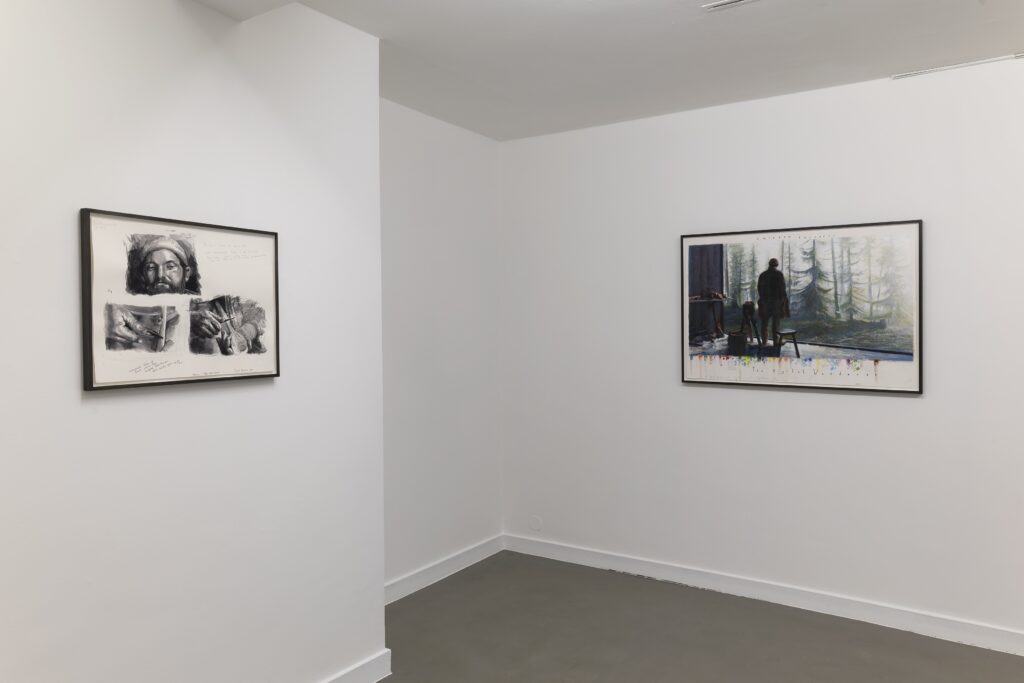
To transform the entire forest of ninety trees visible outside the woodcarver’s windows into spoons would take thirteen years and yield 11,700 spoons
To transform the entire forest of ninety trees visible outside the woodcarver’s windows into spoons would take thirteen years and yield 11,700 spoons, he had ChatGPT calculate. The film itself comprises two working days, from sunrise to sunset – day 160 and day 531. These were filmed by a traditional crew of filmmakers. The final day consists of a series of black-and-white photographs, also on display in Amsterdam.
The sound design was created using ASMR techniques – autonomous sensory meridian response – soft, soothing, repetitive sounds and gestures with strong sensory associations that can evoke a bodily sense of well-being in those susceptible to it. Scenes of the woodcarver at work alternate with exterior shots, where the wind rustles through the trees just as gently. It was important, Claerbout says, that the film would have a tangible effect on its audience, not merely an intellectual one. ‘That may irritate art experts, but for my mother and my aunt and my uncle the film first had to be calming.’
This is also the paradox of the technology used: experiencing something that feels natural, yet is more artificial than one might wish to believe. According to Claerbout, this is because we live in an age of radical industrialisation in which everything forms part of the same system – even the slowing down we seek in order to escape it.
Uncanny valley
On closer inspection, the visual style of the film proves as frictionless as its sound design: light and colour were refined using an AI tool. At the same time, deliberate glitches appear – errors in the computer-generated imagery and AI hallucinations. The idyllic forest turns out to be a literal uncanny valley – a term for unsettling realism. Each time you look at the large glass matchbox from outside, you see the woodcarver in the distance ‘like a frozen, lifeless man’ behind the window. A little like a non-playable character in a video game – a figure not controlled by the player but by the game’s programme itself, perhaps endlessly sweeping in the background to make a scene appear more realistic. In this context, the short film Hardly Working (2022) by the Swiss collective Total Refusal is worth mentioning – it shows how the sole purpose of such virtual figures is to work, but only when they are being watched.
Idealiter kijkt je met twee types aandacht naar het werk, hoopt Claerbout. ‘Enerzijds is er de associatie met return to nature, de weldaad van het hout, het tactiele, het oliën, die ASMR-geluiden, maar anderzijds gaat het ook over de manier waarop zelfs het archetype van de kluizenaar gecommodificeerd is. Wie leeft er nou zo teruggetrokken in het bos met als enige doel de bomen om te zetten in producten?’
deally, Claerbout hopes, viewers approach the work with two kinds of attention. ‘On the one hand there is the association with a return to nature – the sensual pleasure of wood, the tactile quality, the oiling, those ASMR sounds – but on the other hand it is also about the way even the archetype of the hermit has been commodified. Who really lives so withdrawn in the forest with the sole aim of turning trees into products?’
It recalls what philosopher Mark Fisher called ‘precorporation’ – capitalism’s tendency to incorporate forms of opposition in advance, before they can pose a threat to the consumer society. Claerbout adds that our eyes play only a minimal role in perception, and that people have forgotten how to perceive in other ways.
One might say that in The Woodcarver and the Forest those glitches – the woodcarver jolting awake, the loop in which a trapped bird flutters hopelessly among the branches, the failed spoons, and the moments when the reassuring ASMR sounds create friction – function as emergency exits from the system. Proof that human consciousness is capable of balancing on the fault lines between the analogue and the digital. Without friction, there is no movement.
The Woodcarver and the Forest by David Claerbout is on view at Galerie Annet Gelink in Amsterdam until 21 March.
Recent stories
-
![]()
Self-discipline: ‘Reality, rhythm and roots’
-
![]()
-
![]()
Nature: ‘An equal co-creator’
-
![]()
Collectivism: ‘Not driven by ego’
-
![]()
Animism: ‘Reverence for the forest and the river’
-
![]()
Human vs. machine: ‘The hopeless future’
-
![]()
Metamorphosis: ‘Manipulation is timeless’
-
![]()
Art Unlimited: Editorial #41
-
![]()
Asma’s Beauty Case: ‘History moves slowly’
-
![]()
BREAKING #307: ‘We are in what passes away’
-
![]()
BREAKING #306: ‘I’m not a performing monkey’
-
![]()
BREAKING #305: It grew dark, but we didn’t need any light.
-
![]()
Li’s Forecast #8: Patterns in textile
-
![]()
Asma’s Beauty Case: ‘Who am I actually working for?’
-
![David Claerbout The Woodcarver and the Forest]()
There’s No Movement Without Friction: Director David Claerbout on ‘The Woodcarver and the Forest’
-
![Magdalene Odundo, Untitled #7 (1994)]()
BREAKING #304: ‘If you have not stood face to face with something, it has simply not truly been known by you.’
-
![]()
BREAKING #303: ‘That dizzying, hopeless procession of transformations’
-
![Judy Chicago, Peeling Back, 1974. Jordan Schnitzer Family Foundation Collection. - Judy Chicago, Peeling Back, 1974. Offset fotolithografie op ragpapier, 72,39 × 55,88 cm. Collectie Jordan Schnitzer Family Foundation. © Judy Chicago / Artists Rights Society (ARS), New York. Foto © Donald Woodman / ARS, NY. Courtesy of the artist]()
The Making Of:: Judy Chicago in Amsterdam
-
![1-54 Contemporary African Art Fair Marrakech]()
Morocco: a playground for progressive art: 1-54 in Marrakech
-
![Smileys van Maria Roosen]()
Li’s Forecast #7: Solid Energy