10 years of See All This
‘Do you like the party?’
‘While the squirrel was still asleep, the wind blew a letter under his front door. The squirrel heard the rustle of the paper, leapt out of bed and opened the letter. It was a small, grey letter and it smelled a little sour. The squirrel read:
Dear Squirrel,
I hereby invite you to my party. It’s a very small party. I’m not inviting anyone else.
Will you come round now?
Mussel’
It’s a fragment from Toen niemand iets te doen had (When No One Had Anything to Do). The title alone made something in me flop down longways in the grass. When No One Had Anything to Do. At the party of the two friends, warm seawater lapped around Squirrel’s tail, and opposite him Mussel bobbed at the tideline. They shared a piece of liquorice root. And there was silence for a long time when Mussel asked: ‘Do you like the party?’
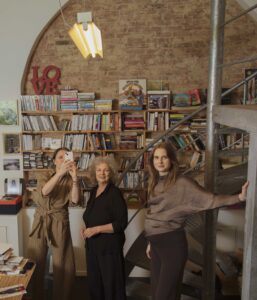
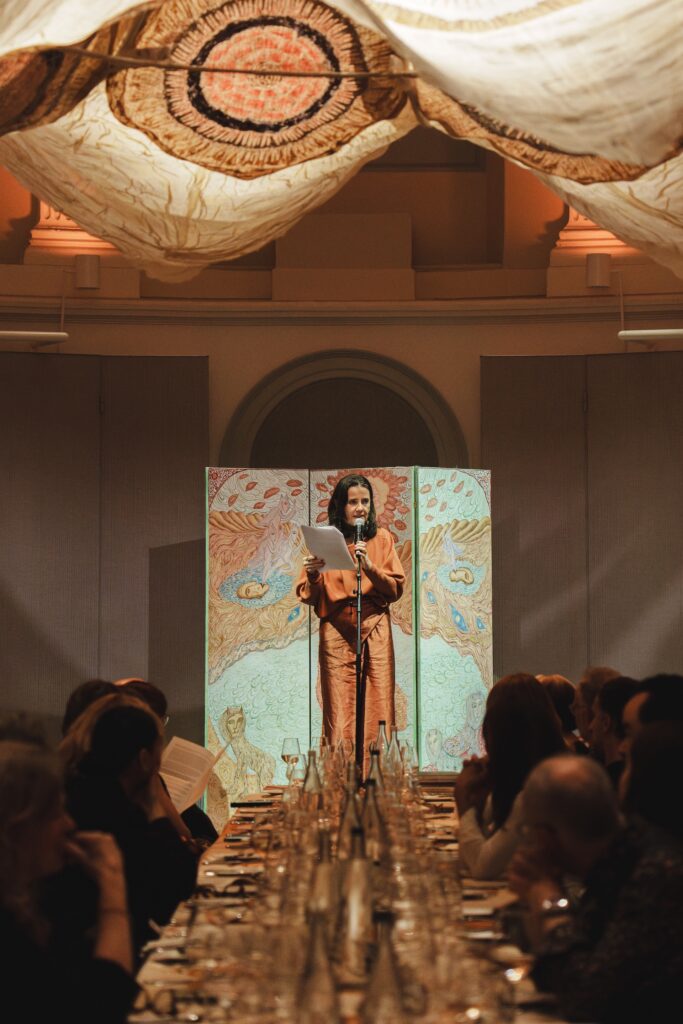
We sent 180 grey letters – what else is it but a question of scale – and we are so pleased that you’ve come to the water’s edge on the Keizersgracht; to the eighteenth-century cultural house Felix Meritis, where tonight you have nothing to do but be together and eat in this egg-shaped room, whose acoustics are so unique that the Small Hall of the Concertgebouw is a copy of it. The egg. The basis of an excellent omelette. The egg. The place from which everything begins.
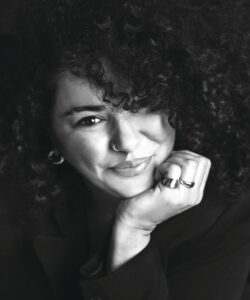
When I personally crawled out of my egg, my twin sister and I were so small that we were placed in separate incubators for six weeks. Perhaps that’s why I’m not, by nature, much of a party-maker or party-goer, and why Mussel’s party has always stayed with me. But who you ‘are’, of course, isn’t who you have to remain. And so, by ingenious means, I’ve ended up at the head of this extended table, as host. ‘A great host,’ Jessica Collins writes in our anniversary issue, ‘is a connector who brings people together and holds space for something to be born that wasn’t there before.’ Okay…
Tonight, we’ve gathered around a 70-metre-long table, laid with Belgian linen, handpainted with Eva Bartels’ human figures. Above us hangs the floral spirit of Cecilia Fiona: What a Joy to Live Above and Below All at Once (2025). The lily stands for purity and rebirth – for death and a new beginning. And it’s about things that rise from their ashes that I want to speak with you tonight. But there’s no rush, because this is a 20-minute live podcast.
Tonight, we celebrate ten years of See All This with the launch of #40, an issue made with our Parisian guest curator and chef Mory Sacko: Cooking is Caring. A motto that expresses his beliefs, because of all the ingredients that must be right, Mory says there is one ingredient that is indispensable: intention. The intention to care for the other, right down to the deepest level.
Forecaster Lidewij Edelkoort interviewed him at his starred restaurant MoSuke, just around the corner from her in Montparnasse. After that conversation she rang me as I walked out of Utrecht station: ‘I’ve never met anyone like him,’ she said, delighted. ‘I think this is the new type of person… good, generous and modest.’ Mory is in the kitchen, but Emilie Rouquette, Mory’s wife and Directrice Générale of Groupe Mory Sacko, may well want to accept this praise for him – and for her. Because you don’t become a singular kind of person on your own!
An issue about food wasn’t our idea. It was Rafi Shibolet’s. The art historian and travel agent I ran into one day at an opening. He said See All This was a ‘wonderful initiative’, and immediately added that he had a ‘fantastic idea’. ‘Having ideas isn’t our problem,’ I laughed, taking in the small enthusiastic man before me. I had worn-out distribution systems, sky-high paper prices and a faltering PostNL on my mind, but he carried on undeterred: ‘You should make an issue about the power of food, because sharing fragrant, steaming dishes can bring us together,’ he said, ‘lift us beyond cultural borders and beyond the borders inside ourselves.’ ‘Why don’t you come to Israel and Palestine with your readers?’ he invited me. ‘Something incredible is happening there in culinary terms – an almost entirely plant-based cuisine with unbelievable flavours, born from that melting pot of cultures.’ ‘All right,’ I said, ‘let’s do it.’ It was September 2023. A few weeks later, the devastating war broke out. And the rest is not history, but a new open wound in a wounded world.
During the adventurous journey we’ve made with See All This over the past ten years, my personal quest was to find an escape route – away from that destructive motorway on which we roar along. I visited artists whom I suspected held a key; people with the intuition and imagination to rethink, to choose new paths. It’s because of them that I’m happier, wiser and more hopeful than I was ten years ago. It’s also because of them that See All This has evolved from an art magazine into a magazine about art and nature, into a movement that advocates a gentle revolution.
Some of those artists would become our guest curators – the very best decision for team and reader. It began with Catherine de Zegher and #20 and the first part of our trilogy Pretty Brilliant Women in the Arts. From her we learned that the art-historical canon has a hidden side: the shady realm of women makers, who kept – and keep – creating even when no one is watching.
Nomadic photographer Iwan Baan (#22) took us to the most hopeful places on earth. He documents how the face of the world is changing, and has built a network of friends and places across the globe. I can hardly imagine how great the impact of his body of work will be on future generations.
Behind the soft world of wool and the tactile work of artist Claudy Jongstra (#24) we found a spinning wheel of resolve, knowledge and activism: Claudy herself. An ultimate champion of a new world.
Through garden designer Piet Oudolf (#30) we discovered that plants have characters that can strengthen or suffocate one another, rather like people, really. From Piet’s own character we learned that nature and ego don’t mix. Ego grows only in the city. People who daily experience nature’s grandeur bow in reverence.
‘Home is where affection resides,’ architect Bijoy Jain (#32) taught us with an issue about the meaning of home. His otherworldly, handmade architecture feels more archaeological than contemporary, so deeply is it woven into the fabric of the landscape.
Lidewij Edelkoort (#34) taught us that it won’t be long before humanity has to find a new reason for being; that work will soon no longer define our identity. And that making things by hand may well become that purpose.
From poet and traveller David Whyte (#36) we learned that it’s possible: to put words to the unnameable without it becoming airy-fairy. The way you look at the world, Whyte believes, is the way the world looks back at you. So show yourself to the world.
At the moment we’re already working on the summer issue of 2026 with the theme The Body – The Political and the Sensual. An issue we’re making with none other than the artist Marlene Dumas.
In my search for the holy grail, actress Tilda Swinton is my latest acquisition. We heard her speak at the press conference for her exhibition Ongoing at the Eye Filmmuseum. An extraterrestrial, sovereign, generous artist.
As Chanel’s Cultural Ambassador she travels the world to the studios of young artists, and she had reached the startling conclusion that they were all fighting the same beast: loneliness. They had even cut ties with family and friends – the people who had helped them get to where they were. She had no explanation for it, but she did have a solution. And she drew from her own professional practice. A film is made by many people, within the nourishing, creative process of a collective. It’s true: nothing is as healing as making things together.
Yet the twentieth-century idea of what art is – and who the artist is – still dominates: it would be an expression of the most intensely individual emotion, taking shape between the four bare walls of your studio. A familiar idea, in which the Picassos of this world thrived, but which we must abandon at breakneck speed. In fact, abandon every mould. Every fixed idea about your own identity or that of another.
That brings me to the power of thought and the powerlessness of language – something another key figure spoke about: herman de vries. Never before have I interviewed someone so completely open and permeable. ‘I don’t know any secrets,’ he said. He spoke the truth. He lives with his wife in his old schoolhouse on the edge of the Steigerwald, his beloved beech forest in Eschenau, Germany. And this is what he said:
‘The greatest quality of visual art is that it can articulate something that cannot be captured in language. That gives art the ability to make the basic principle of the world tangible: unity. Language isolates things from one another,’ herman continued. ‘Take the word “perfect”. In language we have to set something against it – something that would be “imperfect”. Think of right or left in politics. But they’re false oppositions. Words polarise, while things are in fact connected.’
He went on: ‘Everything belongs together. Everything has its place and function, otherwise it wouldn’t exist. Trees cannot exist without soil bacteria. So a tree is not better than a bacterium. The idea that we stand above or below one another is an illusion. Hierarchy does not exist. One develops out of the other. And that applies to everything and everyone. We come from one another and we are equal: all in one – one in all.’
Cecilia’s lily, our flower, The Joy to Live Above and Below All at Once, is about that same principle of unity. As above, so below. As within, so without. It’s the alchemical principle – around which, in the seventeenth century, beautiful and unique books were printed just up the way, now found at The Embassy of the Free Mind, also on this canal.
Amsterdam was a unique city of free thinkers. Beyond religion and state, and drawing too on ancient Eastern insights, books were made about the synergy between heaven and earth, and about the alchemical transformation of lead into gold. And it’s about the transformation from lead into gold that we’re speaking here. But how?
Everything we believe should change in the world asks for a metamorphosis within ourselves. As within. As without. But just as the artist can no longer do that transformation from a lonely studio, no one can make that transformation alone. Because we are a network – a mycelium made of stardust – that relates to one another ingeniously and magically.
In keeping with the above, everything we believe needs to change in the world is something that calls for change within ourselves. As within. As without. We are like the forest and the orcas, like the bacteria and the wind: we are a vibrating network, a mycelium made of stardust, ingeniously interwoven with one another. A network with nodes – hubs from which it branches more quickly. Think of a central station. Living near such a station sets your own life in motion more easily, because you can simply get from A to B faster.
This room is full of hubs, central stations – investor Bob Meijer, photographer Anton Corbijn, scientist Louise Fresco, curator Philip Fimmano, forecaster Lidewij Edelkoort, photographer Iwan Baan, and my husband Thijs Asselbergs. I’ve been keeping a close eye on these hubs over the past few years, and they share two striking traits: a love of travel and generosity. True generosity – sharing ideas and contacts, homes and money – is like a particle accelerator: like current, like light.
Yesterday the moon was full. It was the last full moon of the year, also known as the ‘Cold Moon’ or the ‘Moon of the Long Nights’. And may it be a long night, celebrating ten years of See All This in freedom – and the silver Mercur we won last week as Media Brand of the Year. But above all, we are here together to celebrate the one most urgent thing: celebrating the other – whose similarities to us are many times greater than the differences.
You’re still owed one answer from me. The answer to the question Mussel asked after a long afternoon and sharing a piece of liquorice root:
‘Do you like the party?’
It took a while before Squirrel replied:
‘Sure.’
Recent stories
-
![]()
Self-discipline: ‘Reality, rhythm and roots’
-
![]()
Nature: ‘An equal co-creator’
-
![]()
Collectivism: ‘Not driven by ego’
-
![]()
Animism: ‘Reverence for the forest and the river’
-
![]()
Human vs. machine: ‘The hopeless future’
-
![]()
Metamorphosis: ‘Manipulation is timeless’
-
![]()
-
![]()
Art Unlimited: Editorial #41
-
![]()
Asma’s Beauty Case: ‘History moves slowly’
-
![]()
BREAKING #307: ‘We are in what passes away’
-
![]()
BREAKING #306: ‘I’m not a performing monkey’
-
![]()
BREAKING #305: It grew dark, but we didn’t need any light.
-
![]()
Li’s Forecast #8: Patterns in textile
-
![]()
Asma’s Beauty Case: ‘Who am I actually working for?’
-
![David Claerbout The Woodcarver and the Forest]()
There’s No Movement Without Friction: Director David Claerbout on ‘The Woodcarver and the Forest’
-
![Magdalene Odundo, Untitled #7 (1994)]()
BREAKING #304: ‘If you have not stood face to face with something, it has simply not truly been known by you.’
-
![]()
BREAKING #303: ‘That dizzying, hopeless procession of transformations’
-
![Judy Chicago, Peeling Back, 1974. Jordan Schnitzer Family Foundation Collection. - Judy Chicago, Peeling Back, 1974. Offset fotolithografie op ragpapier, 72,39 × 55,88 cm. Collectie Jordan Schnitzer Family Foundation. © Judy Chicago / Artists Rights Society (ARS), New York. Foto © Donald Woodman / ARS, NY. Courtesy of the artist]()
The Making Of:: Judy Chicago in Amsterdam
-
![1-54 Contemporary African Art Fair Marrakech]()
Morocco: a playground for progressive art: 1-54 in Marrakech
-
![Smileys van Maria Roosen]()
Li’s Forecast #7: Solid Energy