Collectivism
‘Not driven by ego’
We asked seven curators and directors to look ahead. Which themes and trends will shape the conversation in the coming years? And which artists are already showing where things are headed? Jacquill G. Basdew is a curator, cultural thinker and initiator. He is a member of the Supervisory Board of the Kunstmuseum in The Hague and Dutch Culture. In his work he operates at the intersection of art, society and institutional reflection.
In a time when the world seems to be falling apart more and more, I believe that the future of art does not lie in isolation but in community. The solitary artist will always have to exist – those moments of being alone remain indispensable – but not as a romantic ideal. Rather as someone who reflects in silence on how an individual practice relates to the greater whole: not driven by ego, but by care and shared responsibility. Being alone does not have to be about lack; it can create space for awareness. In that interplay between introspection and connection, collectivity emerges.
As a curator and maker, and as part of a younger generation, I have been shaped by an intergenerational dialogue. It has made me realise that collectives have always existed as a source of growth and resilience. What we see today is therefore not a new phenomenon, but a continuation of something deeply embedded in our society – now viewed through a new lens and from new intersections.
In January I travelled to the US to see two evenings of performances by Carrie Mae Weems (1953), in collaboration with other artists and musicians, at the Lincoln Center in New York. Her work Contested Sites of Memory brought people together to reflect on collective memories in a time of division, and on how the past can carry us toward a shared future.
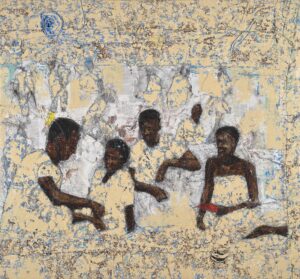
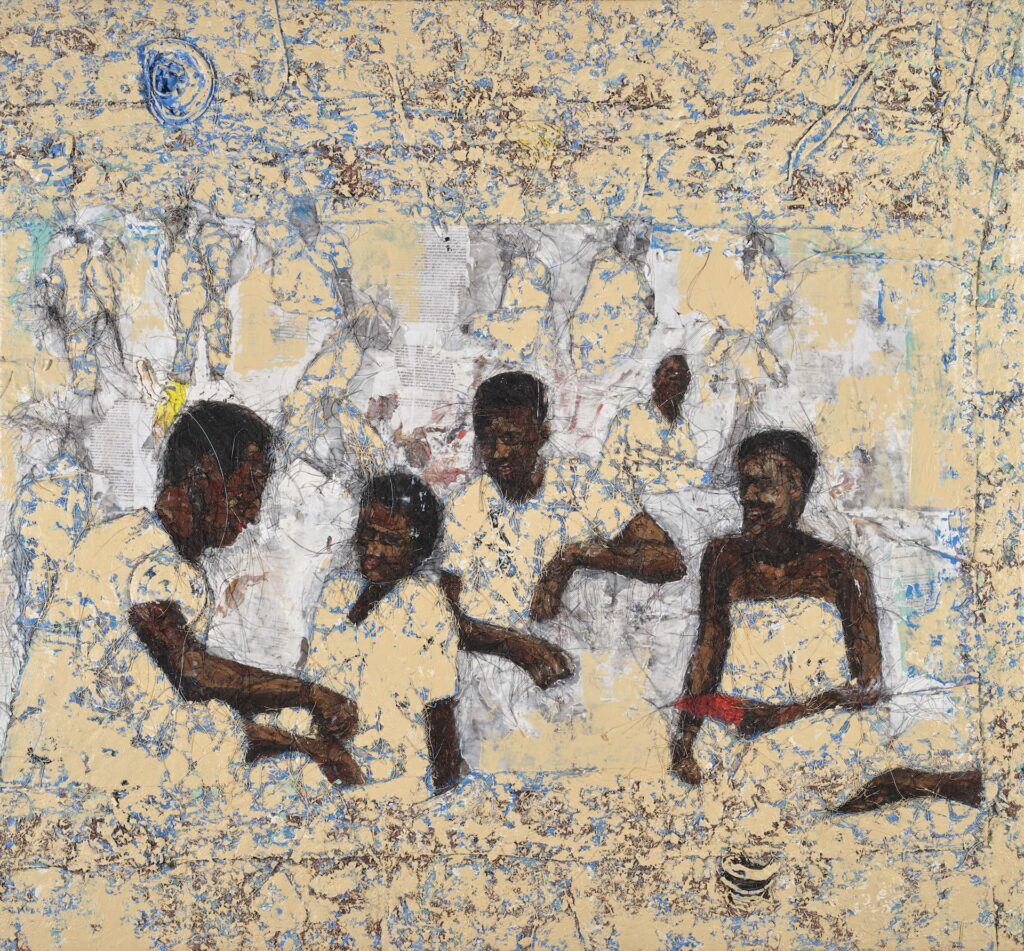
I also met the Kenyan artist Kaloki Nyamai (1985), who told me that commercial success is not an end goal for him, but a means to build infrastructures in which his community can flourish. His work will be shown later this year at the Biennale in Venice curated by Koyo Kouoh (1967-2025), a curator who reflected on community and solidarity for years.
This idea of art as a supporting structure travelled with me and reappeared in Chicago, in the exhibition Unto Thee by Theaster Gates (1973) at the Smart Museum of Art, in the South Side, where the artist comes from. Through his art, Gates builds physical places where people can gather, learn and heal. Places where culture is not only shown, but lived.
Also beyond the visual arts this movement manifests itself, for example in the work of Grace Wales Bonner (1990), recently appointed creative director menswear at the fashion house Hermès. With her English and Jamaican roots she uses fashion as a vehicle to bring worlds together and to make underrepresented communities visible – with beauty as a gentle yet powerful catalyst for change.
What binds all these makers is that their global success always flows back into their communities. They invest in people, places and knowledge. Collectivity and individuality are not opposites, but partners in the creative process. Together they form a living ecosystem in which art can contribute to a more connected and more just world.
This is an article from See All This #41, spring 2026.
Recent stories
-
![]()
-
![Spread uit See All This no.40. foto: Katerina Bezedei]()
-
![]()
Rituals: ‘Not static or nostalgic, but alive’
-
![]()
Self-discipline: ‘Reality, rhythm and roots’
-
![]()
-
![]()
Nature: ‘An equal co-creator’
-
![]()
Collectivism: ‘Not driven by ego’
-
![]()
Animism: ‘Reverence for the forest and the river’
-
![]()
Human vs. machine: ‘The hopeless future’
-
![]()
Metamorphosis: ‘Manipulation is timeless’
-
![]()
Art Unlimited: Editorial #41
-
![]()
Asma’s Beauty Case: ‘History moves slowly’
-
![]()
BREAKING #307: ‘We are in what passes away’
-
![]()
BREAKING #306: ‘I’m not a performing monkey’
-
![]()
BREAKING #305: It grew dark, but we didn’t need any light.
-
![]()
Li’s Forecast #8: Patterns in textile
-
![]()
Asma’s Beauty Case: ‘Who am I actually working for?’
-
![David Claerbout The Woodcarver and the Forest]()
There’s No Movement Without Friction: Director David Claerbout on ‘The Woodcarver and the Forest’
-
![Magdalene Odundo, Untitled #7 (1994)]()
BREAKING #304: ‘If you have not stood face to face with something, it has simply not truly been known by you.’
-
![]()
BREAKING #303: ‘That dizzying, hopeless procession of transformations’